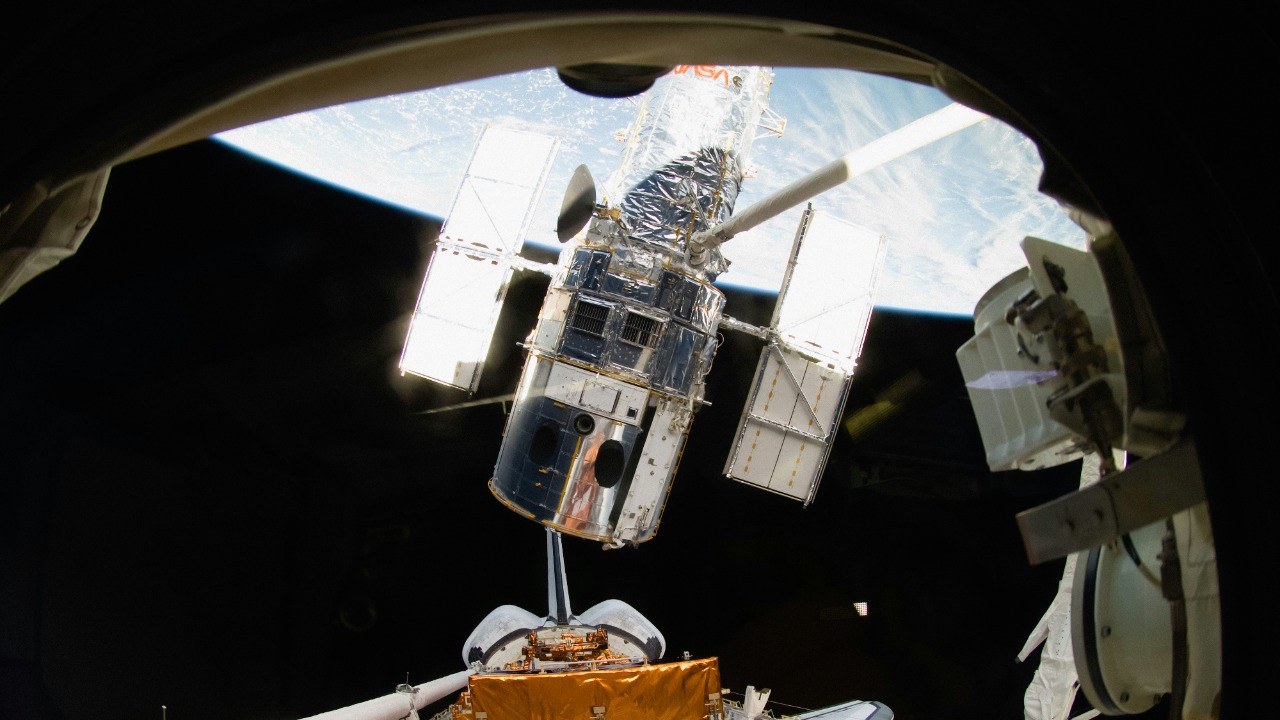

The Hubble Space Telescope is suddenly facing a much shorter future than many astronomers expected, with new modeling pointing to a serious risk that it could plunge back into the atmosphere around 2029. Instead of quietly operating into the 2030s, the observatory that has defined modern space astronomy may now be in its final three to five years unless a rescue plan materializes.
The shift is driven less by failing hardware than by the harsh realities of orbital mechanics and solar activity, which are dragging Hubble into thicker air far faster than earlier forecasts suggested. As experts reassess how long it can safely stay aloft, they are also weighing what its loss would mean for science, budgets, and the politics of spaceflight in the late 2020s.
The new 2029 risk window
Recent analyses of Hubble’s orbit have converged on a stark conclusion: the telescope’s reentry into Earth’s atmosphere is now expected within roughly five to six years, with 2029 emerging as a key danger year. Scientists attribute the accelerated timeline to increased solar flux that is heating and puffing up the upper atmosphere, which in turn is creating more drag on the spacecraft and pulling it down faster than earlier models anticipated, a trend that has led some trackers to warn that Hubble could be gone in about three years if conditions worsen. That projection is not a hard deadline, but it has reset expectations about how narrow the margin has become.
According to reporting that cites SpaceNews journalist Jeff Foust, the updated orbital data were presented at a recent American Astronomical Society meeting, where specialists walked through scenarios that place a significant probability on reentry around 2029 if no intervention occurs. Those briefings have sharpened the sense that the countdown is no longer an abstract, far-off concern but a concrete planning problem for NASA and its partners, with implications for how long Hubble can keep contributing to spatial research in the future.
Aging hardware in a falling orbit
What makes the new timeline so jarring is that Hubble itself is not in obvious physical decline. Engineers describe the observatory as being in “excellent technical condition,” with all of its science instruments in good shape and expected to remain so for years, a status its chief scientist highlighted when Hubble marked its 35th birthday. Since its launch in 1990, the telescope has transformed astronomy with deep-field images, precise distance measurements, and detailed views of galaxies and nebulae, a record of discovery that has made the prospect of an abrupt end feel like the premature closing of an observatory that still has plenty of science left to do.
The real threat is the slow but relentless decay of its orbit as atmospheric drag saps energy from each pass around Earth. Analysts note that Hubble’s altitude has been dropping for years, and that the current solar cycle is swelling the upper atmosphere in ways that accelerate that descent, a trend that has prompted some scientists to warn that the possibility of reentry in the next five to six years is now very real. In other words, the telescope’s biggest problem is not what is inside its instruments but the environment it is moving through.
Reboost dreams and NASA’s limited options
NASA has not been blind to the orbital problem, and over the years the agency has explored multiple ways to raise Hubble’s altitude and extend its life. Earlier planning documents described “reboost” missions that would adjust its orbit and delay reentry, and more recent discussions have focused on partnering with commercial spacecraft to perform that work, a concept that has been debated in forums where NASA supporters have dissected the technical and safety challenges. The basic idea is straightforward: dock a crewed or robotic vehicle to Hubble, fire thrusters to raise its orbit, and buy another decade or more of observing time.
In practice, the path is far more complicated. NASA has already sought help with the aging telescope by inviting proposals to raise its orbit, noting that although Hubble is currently in a productive phase, its altitude is low enough that debris and drag are growing concerns. One high profile idea has involved Billionaire Jared Isaacman, who purchased two SpaceX Crew Dragon missions and has floated the possibility of using a commercial flight to service or reboost the telescope, but NASA officials have also flagged docking risks and the need to protect Hubble’s delicate structure from unintended damage.
Politics, budgets, and the end-of-era narrative
The looming cutoff is arriving just as NASA’s broader budget picture is tightening, which complicates any attempt to mount an expensive rescue. As Hubble turned 35, analysts warned that the best case for its continued operation might only carry it into the 2030s, and that looming budget cuts could force hard choices about how much to invest in an observatory that is already well past its original design life, a concern raised in coverage that also noted how Hubble now sits within a portfolio shaped by shifting priorities in Washington and by President Donald Trump’s choice of NASA leadership. Those pressures make it harder to justify a complex reboost mission when new observatories, from the James Webb Space Telescope to future infrared and X-ray missions, are competing for the same dollars.
At the same time, the narrative of “The End of an Era” has taken hold among astronomers who have spent their careers working with Hubble data. Commentators have described how The End of Hubble’s run would close a chapter that began with its troubled early optics and continued through multiple servicing missions, and they have emphasized that its Declining Orbit is now the main constraint. Since the telescope’s launch in 1990, it has been a constant presence in both professional astronomy and public culture, so the prospect of losing it to an uncontrolled reentry rather than a graceful retirement feels, to many in the field, like a failure of planning as much as an inevitable outcome of physics.
What comes after Hubble falls
Even as the clock ticks down, scientists are trying to extract as much value as possible from Hubble’s remaining years. Some analyses suggest that, Due to increased solar flux levels, scientists now expect that Since its launch in 1990 the telescope has already delivered far more science than originally promised, and that even a few extra years of operation could yield critical data on exoplanet atmospheres, dark matter, and the evolution of galaxies. Other reporting notes that, Due to increased solar flux levels, scientists now estimate that Hubble‘s reentry will take place in 2029, which has prompted mission planners to prioritize observations that cannot easily be replicated by other facilities.
There is also growing attention on what happens when the spacecraft finally reenters. As the Hubble Space Telescope faces the end of its mission, experts predict that it could reenter Earth‘s atmosphere earlier than once expected, and they are weighing how to manage the risk of debris reaching the surface. That concern is part of a broader conversation about orbital junk, with one recent study estimating a 26% chance of space debris falling through airspace this year, a figure that has led Experts to call for more controlled deorbit plans. In that context, whether Hubble is gently steered into the ocean or allowed to fall on its own has become a test case for how the world handles the retirement of large, aging satellites.
More from Morning Overview