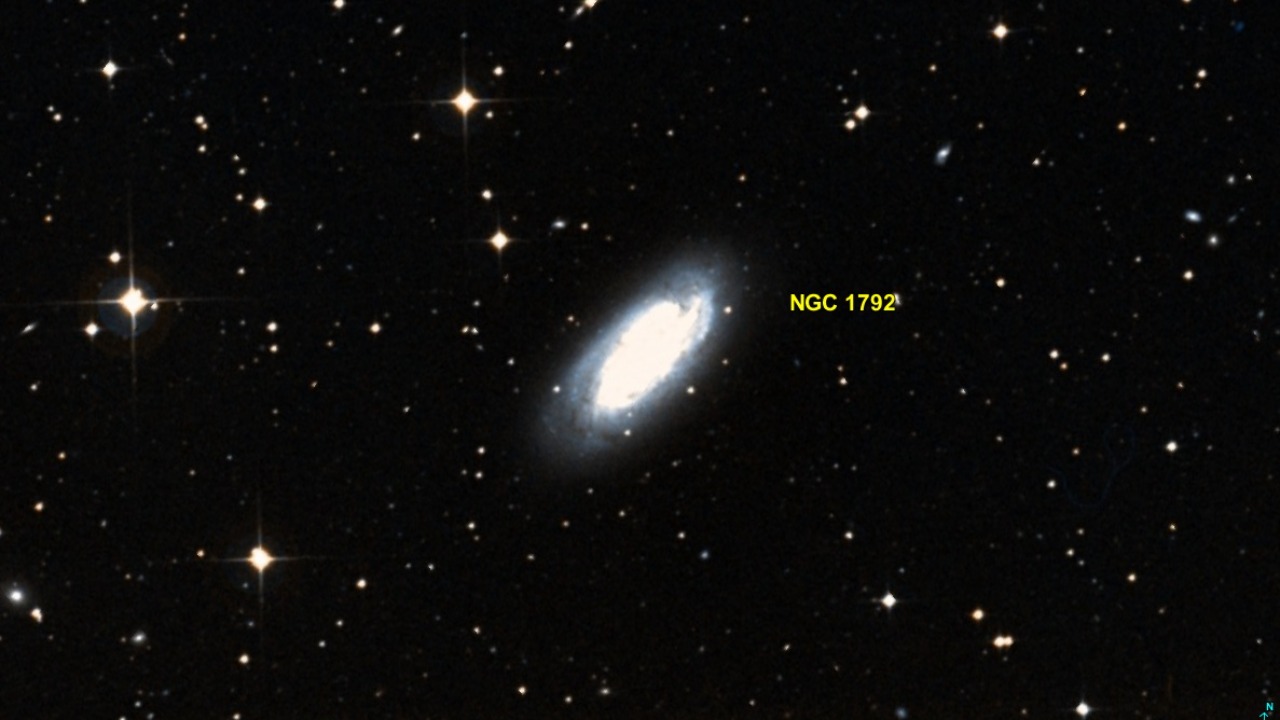

The latest image from the Hubble Space Telescope turns a distant spiral galaxy into a laboratory for extreme weather in space, where gas, dust, and gravity combine to trigger a torrent of newborn suns. In the stormy system NGC 1792, star formation has shifted into overdrive, transforming an otherwise familiar spiral into a blazing starburst that lets astronomers watch how galaxies grow, reshape themselves, and sometimes tear at their own structure.
I see this view as more than a pretty picture. It is a snapshot of a galaxy caught mid‑transformation, its spiral arms lit by violent episodes of birth and feedback that echo through its disk and halo, and it shows how a single object can connect ideas about galactic collisions, stellar nurseries, and even the life cycles of gas clouds that will one day collapse into new generations of stars.
Hubble’s stormy spiral: a galaxy on the edge
At the center of this story is NGC 1792, a spiral galaxy whose disk looks anything but calm. Instead of the smooth, well ordered arms seen in quieter systems, its structure appears ragged and turbulent, with clumps and knots that betray intense star formation and disturbed gas. In the new observation, the Hubble Space Telescope isolates this chaos in sharp detail, turning what might have been a faint smudge into a richly textured portrait of a galaxy in upheaval that fits the idea of a “stormy spiral galaxy in starburst overdrive” almost too well.
The image, highlighted in coverage of Hubble Captures, shows how the telescope’s resolution can separate individual clusters and dust lanes inside NGC 1792’s disk. The reporting describes a chaotic spiral galaxy whose close environment is stirring up its gas and dust, and that context helps explain why the arms look shredded and asymmetric instead of gently winding. In this view, the galaxy is not a static pinwheel but a dynamic system, shaped by gravity, pressure, and feedback from the very stars it is now frantically producing.
NGC 1792: a storm of new stars
NGC 1792 has been singled out as a textbook example of a spiral galaxy caught in a phase of unusually intense star formation. Rather than forming stars at a leisurely pace, large parts of its disk are lit up by clusters of massive, short‑lived suns that have only just ignited. That pattern is what astronomers mean when they describe the galaxy as “stormy” and “highly active,” a place where the usual balance between gas supply and star formation has been pushed out of equilibrium.
The latest Hubble Picture of the Week frames NGC 1792 as a storm of new stars, emphasizing how its spiral arms are crowded with regions where gas is collapsing into dense clusters. That description is echoed in social media posts that present the same observation as a stormy and highly active spiral galaxy, reinforcing the idea that this is not a quiet, settled system. Instead, the galaxy is in the middle of a starburst episode that is reshaping its appearance and, over longer timescales, its internal structure.
Reading the image: dust lanes, blue clusters, and red glows
Look closely at the Hubble view and the galaxy’s anatomy starts to separate into distinct components, each telling a different part of the story. Dark, threadlike dust lanes slice across the bright disk, tracing the cold gas reservoirs that feed new star formation. Between those lanes, bright blue knots mark clusters of hot, young stars that have recently emerged from their natal clouds, while more diffuse light fills the background with the combined glow of older stellar populations.
One of the most striking features in the close‑up imagery is the pattern of Blossoming red lights scattered along the arms. These patches trace so‑called H‑alpha emission from dense clouds of hydrogen molecules that are being ionized by nearby massive stars. The reporting notes that these red regions mark out where stars form most vigorously, turning the arms into a chain of stellar nurseries. In that sense, the color contrast in the image is not just aesthetic, it is a map of where the galaxy is currently investing its gas into new generations of stars.
Edge‑on drama and the view from different angles
NGC 1792 is not presented as a perfectly face‑on spiral, and that slightly tilted perspective adds to the sense of drama. The galaxy’s disk appears thick and textured, with dust structures that seem to rise above and below the main plane, hinting at outflows and vertical motions driven by stellar feedback. That geometry also helps astronomers gauge how far star‑forming regions extend away from the midplane, which in turn reveals how violently the starburst is stirring the surrounding gas.
An edge‑on view reference to NGC 1792 underscores how different angles can highlight different physical processes. When the disk is seen more from the side, dust lanes cut sharply across the light, and the thickness of the stellar component becomes more obvious. In the Hubble material, the combination of a slightly inclined disk and high resolution makes it easier to separate foreground dust from background star fields, which is crucial for modeling how light is absorbed and re‑emitted inside such a turbulent galaxy.
Starburst overdrive: what makes NGC 1792 so intense
Calling NGC 1792 a starburst galaxy is not just a flourish, it reflects a specific physical state in which the rate of star formation is unusually high for the galaxy’s size and gas content. In this mode, gas is converted into stars so rapidly that it can significantly deplete the available fuel on relatively short cosmic timescales. The result is a disk packed with massive, luminous stars that dominate the galaxy’s light and inject huge amounts of energy back into the interstellar medium through radiation, winds, and supernova explosions.
Social media coverage of the new image spells this out directly, describing NGC 1792 as a starburst galaxy and a powerhouse of star formation. The same reporting notes that its gravitational interaction with a neighboring system is thought to be stirring up the gas, especially on one side where gravity has a stronger effect. That asymmetry helps explain why the star formation looks lopsided and why some arms appear more chaotic than others. In effect, the galaxy’s environment has pushed it into overdrive, turning a passing gravitational tug into a full‑scale episode of accelerated stellar birth.
Gravity’s hand: interactions and asymmetric arms
Galaxies rarely evolve in isolation, and NGC 1792 is no exception. The disturbed structure and uneven distribution of star‑forming regions point to an external influence, most likely a close gravitational encounter with a companion. Such interactions can compress gas on one side of a galaxy more than the other, triggering waves of star formation that propagate along the arms and into the central regions, while also warping the disk and twisting the spiral pattern.
The description of NGC 1792’s environment in the Stormy Spiral Galaxy coverage and the note that gravity has a stronger effect on one side of the disk in the starburst galaxy reel both support this picture of an off‑kilter interaction. In that scenario, tidal forces pull on the galaxy’s outer regions, funneling gas inward and piling it up in certain arms. The result is a pattern of bright, clumpy star‑forming segments that trace where the gravitational disturbance has been most effective at compressing the interstellar medium.
The red glow of star factories
One of the most evocative phrases attached to the new Hubble view is “The Red Glow of Star,” a shorthand for the way hydrogen emission lines light up regions where massive stars are forming. In NGC 1792, these red patches are not confined to a narrow ring or central bar, they are scattered across the spiral arms, signaling that the starburst is widespread rather than localized. That distribution matters, because it shows that the galaxy’s gas has been destabilized on large scales, not just in its core.
Reporting on the unprecedented image from The Hubble Space Telescope highlights NGC 1792 and explicitly calls out The Red Glow of Star formation in its arms. Combined with the earlier note about Blossoming red lights marking H‑alpha emission, this paints a consistent picture of a galaxy whose arms are studded with active star factories. For astronomers, those glowing regions are more than visual accents, they are signposts that can be used to measure star formation rates, gas densities, and the impact of feedback on the surrounding medium.
Hubble’s role and the PHANGS connection
Behind the aesthetics of the image lies a broader scientific program that uses Hubble to dissect nearby galaxies in detail. By resolving individual star clusters and dust structures, the telescope lets researchers connect large‑scale patterns, such as spiral arms and bars, with the small‑scale physics of star formation. NGC 1792 fits neatly into that strategy, offering a case where environmental effects and internal dynamics combine to produce an especially vigorous burst of activity.
The coverage of Hubble Captures notes that the observation is linked to the PHANGS‑HST effort, which systematically maps star‑forming regions in nearby galaxies. In that context, NGC 1792 is one data point in a larger sample that spans a range of morphologies and environments. By comparing this stormy spiral to calmer systems in the same survey, astronomers can tease out how factors like gas content, interaction history, and internal structure influence when and where galaxies tip into starburst mode.
From Hubble to Webb: connecting stellar storms
While Hubble excels at optical views of galaxies like NGC 1792, the James Webb Space Telescope extends that work into the infrared, where it can peer through dust and reveal even earlier stages of star formation. The physics, however, is shared. In both cases, gas clouds are compressed until they become dense enough to collapse under their own gravity, forming clusters of new stars that then carve cavities and drive shocks into their surroundings.
A recent report on a triple star system observed by Webb notes that the gas inside a towering spire is being stirred up and compressed to the point that it will undergo gravitational collapse and form more stars. That description could just as easily apply, on a larger scale, to the gas clouds in NGC 1792’s arms. In both settings, gravity, turbulence, and feedback interact in a feedback loop, with each generation of stars helping to shape the conditions for the next. By combining Hubble’s sharp optical images with Webb’s infrared sensitivity, astronomers can build a more complete picture of how stormy galaxies like NGC 1792 sustain their starburst episodes and eventually wind them down.
Why this stormy spiral matters
NGC 1792’s moment in the spotlight is not just about showcasing Hubble’s capabilities, it is about capturing a galaxy at a critical stage in its evolution. Starburst phases are relatively brief compared with the full lifetime of a galaxy, yet they can dominate its growth, chemical enrichment, and structural transformation. By freezing one such phase in exquisite detail, the new image gives researchers a benchmark for testing models of how interactions, gas flows, and internal dynamics conspire to ignite and regulate these intense episodes.
For me, the appeal of this stormy spiral lies in how it condenses a complex set of processes into a single, visually arresting frame. The Blossoming red H‑alpha regions, the asymmetric arms shaped by gravity, the thick, dust‑laden disk, and the overarching label of starburst overdrive all point to a galaxy that is both familiar and extreme. In studying NGC 1792 through Hubble’s lens, astronomers are not just cataloging another pretty spiral, they are watching a galaxy weather a transformative storm that will leave lasting imprints on its stars, gas, and future.
Supporting sources: Hubble spots a storm of new stars! This NASA/ESA … – Instagram.
More from MorningOverview