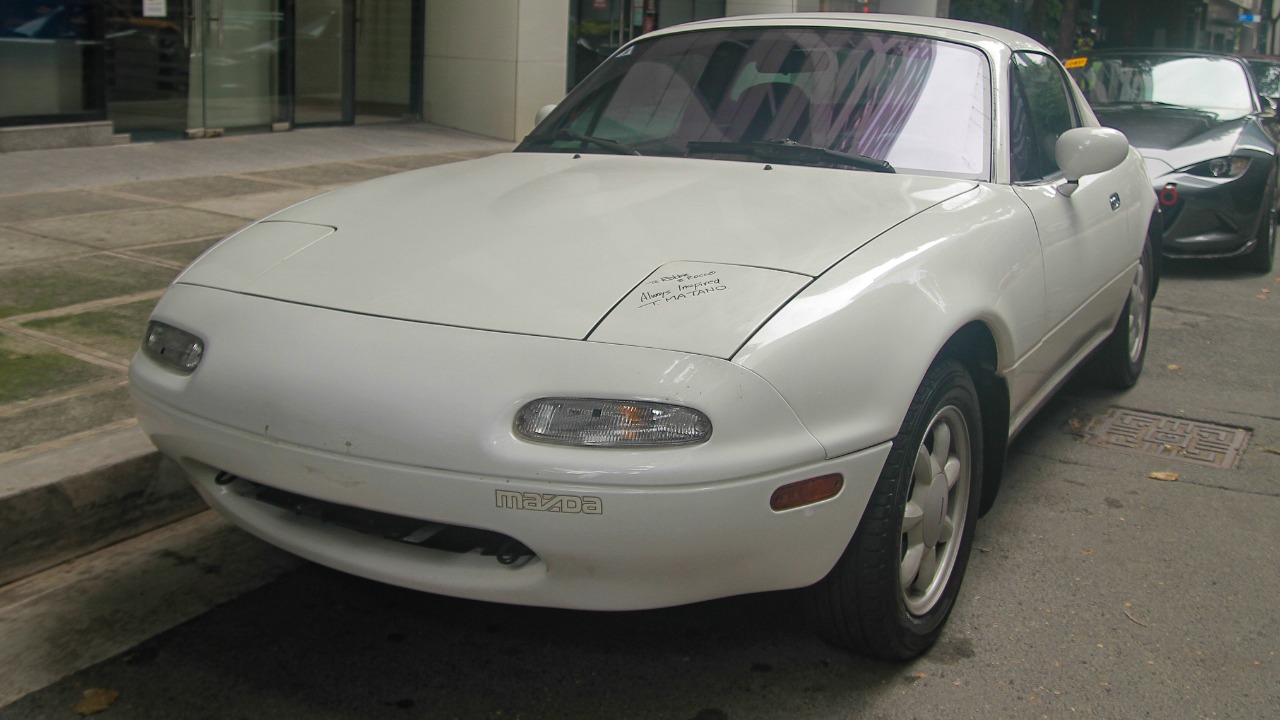

The Mazda Miata has always been sold as proof that driving joy is about balance, not brute force, and nowhere is that clearer than in the way later generations got quicker even as peak horsepower slipped. Instead of chasing ever larger engines, Mazda kept returning to the same core idea: reduce weight, sharpen the chassis and gearing, and let smart engineering do what raw output could not. The result is a car that, on paper, sometimes looks weaker than its predecessors but on a back road or race track feels decisively faster.
That apparent contradiction is not a marketing trick, it is the product of deliberate choices about power-to-weight ratio, aerodynamics, electronics, and even how the driver interacts with the car. By looking at how the Miata evolved from the original NA to the current ND, and by comparing real lap times and specs, I can trace how Mazda made a roadster that accelerates harder, corners quicker, and inspires more confidence despite making less peak power than the model it replaced.
The original Miata’s simple formula
The first Miata, the NA, set the template: light, modestly powered, and obsessively tuned for feel. Early production cars weighed roughly 2,100 pounds and used a 1.6‑liter four cylinder that would not impress on a dyno but came alive when paired with a short wheelbase and a crisp manual gearbox. That combination made the car more about maintaining momentum than about explosive straight line speed, which is why so many drivers still describe the NA as the purest expression of Mazda’s lightweight sports car philosophy.
Period performance numbers underline how little outright muscle the NA brought to the table. In one breakdown of Production Model MX specifications, the early 1990 to 1997 cars are listed with a Curb weight of approximately 2,070 lbs, a Displacement of 1.6L, Horsepower of just 115 hp, and modest Torque output. Those figures would barely qualify as hot hatch territory today, yet the car’s low mass and responsive chassis made it a benchmark for accessible handling, and that baseline is crucial for understanding how later Miatas could feel faster without simply adding power.
How later generations gained weight and complexity
As the Miata evolved into the NB and NC generations, it inevitably picked up size, safety equipment, and comfort features. Side impact structures, more robust crash protection, and modern conveniences all added pounds, and by the time the NC arrived it was clearly larger and heavier than the original. That growth worried purists who saw the car drifting away from the minimalist ethos that had made the NA so beloved, especially as stability control and other driving safety systems became standard.
Reporting on the transition into the NC generation notes that the car was larger, heavier, and came packed with driving safety systems that some enthusiasts felt ran counter to the original’s free spirit, even as Mazda tried to preserve the playful character that had sold more than 1.2 million of the roadsters worldwide. One detailed look at how the Miata changed over time points out that the NC’s added mass and complexity were exactly the kind of creep that sports car fans fear, yet it also highlights that Mazda was already looking for ways to offset those compromises with smarter engineering rather than simply bolting on more power, a tension that becomes clear in later analysis of how the car lost horsepower but got quicker.
Power-to-weight ratio beats peak horsepower
The key to understanding why a newer Miata can be quicker with less power is the simple math of power-to-weight ratio. If you reduce mass by a larger percentage than you reduce horsepower, the car effectively has more power available to move each pound, which improves acceleration and responsiveness. That is exactly what Mazda did when it moved from the NC to the ND, trimming hundreds of pounds while accepting a small drop in rated output for some versions.
Technical comparisons of the NC and ND spell this out explicitly, focusing on POWER, WEIGHT, and RATIO rather than just headline horsepower. One detailed breakdown notes that Curb weight for the ND is down to 2,332 lbs, and that The ND gains a stronger horsepower-per-pound figure than the NC despite the apparent step back in peak output. By reframing the discussion around power-to-weight RATIO instead of raw numbers, Mazda could credibly claim that the newer car was more energetic and more efficient, a claim backed up by the way the ND feels under hard acceleration and by the way it performs in independent NC vs ND tests.
Gearing, torque curves, and real-world speed
Horsepower figures also hide how much work can be done by gearing and torque delivery. A slightly lower peak horsepower engine that makes more torque in the midrange, combined with shorter gear ratios, can feel much stronger in the kind of 30 to 70 mph pulls that matter on a back road or track. Mazda leaned into this by tuning later Miata engines and transmissions for usable thrust rather than bragging rights at the top of the rev range, which is one reason the ND often feels more urgent than its spec sheet suggests.
Analyses of the Miata’s evolution emphasize that the ND’s drivetrain was calibrated to keep the engine in its sweet spot, with a focus on how quickly the car can exit a corner rather than on its absolute top speed. That approach shows up in comparative testing where the ND posts quicker lap times than the NC despite the apparent power deficit, and it aligns with Mazda’s broader Skyactiv philosophy of optimizing combustion efficiency and gearing. When you combine a lighter chassis with a torque curve that is easier to access and ratios that keep the engine on boil, the stopwatch tends to favor the car that looks weaker on paper, which is exactly what happens when the ND is stacked against its predecessor in instrumented testing.
Weight loss by design, not by accident
The ND’s weight reduction was not a happy accident, it was the result of a deliberate program to reverse the Miata’s gradual bloat. Mazda’s engineers set out to remove mass from the structure, suspension, and even interior components, using more advanced materials and smarter packaging to claw back the agility that had defined the NA. That effort meant resisting the industry trend toward ever larger bodies and more insulation, and it required a willingness to accept that some buyers would prefer a quieter, cushier car that the Miata simply would not become.
Coverage of the ND’s development notes that Sources close to the project reported the fourth iteration of Mazda’s roadster would feature Skyactiv weight reduction and efficiency tech to counter the pounds it had gained over the years. Those reports described how Mazda applied its Skyactiv approach not just to the engine but to the entire vehicle architecture, trimming structural mass and simplifying components so the car could shed a few extra pounds over the years of generational creep. By the time the ND reached showrooms, that strategy had paid off in a curb weight that undercut the NC by a significant margin, validating early Skyactiv predictions and setting the stage for the car’s improved performance despite its modest power rating.
Lap times prove the concept on track
On a race track, the Miata’s emphasis on balance and weight reduction shows up in lap times that often embarrass more powerful machinery. Because the car is so forgiving at the limit and so easy to place, drivers can carry more speed through corners and spend less time recovering from mistakes, which matters more over a full lap than a few extra horsepower on the straights. That is why spec Miata racing has become one of the most popular forms of grassroots motorsport, and why each generation of the car is scrutinized for its potential as a track weapon.
One comparative test of all four generations as race cars illustrates this with hard numbers, listing the Miata NA with a FAST TIME of 1:14.154 around a test circuit using engines and gearboxes that were factory-spec pieces. The write up notes that When Mazda’s race-minded engineers designed the original car they created a platform that could be pushed hard without exotic modifications, and that later generations built on that foundation with stiffer structures and more refined suspension geometry. By the time the ND is evaluated in the same multi-generation comparison, its combination of lower weight and improved power-to-weight ratio allows it to post competitive or better lap times even when its peak horsepower trails the outgoing NC, confirming that Mazda’s strategy works where it counts.
Electronics that add speed instead of stealing fun
Modern driver aids are often blamed for diluting sports cars, but in the Miata’s case they can actually help the car go faster without smothering its character. Stability control and traction systems on later generations are tuned to be permissive, stepping in gently to catch big slides rather than clamping down at the first hint of oversteer. That allows drivers to explore the car’s limits with more confidence, which in practice means they can brake later, turn in harder, and get back on the throttle sooner without fear of an unrecoverable spin.
Analyses of the NC and ND highlight that the newer cars arrived with more sophisticated driving safety systems, yet careful calibration meant they did not feel like a digital leash. One detailed look at how the Miata got quicker even as it lost horsepower notes that the car’s electronics were part of a broader package that included suspension tuning and steering refinement, and that Fortunately the added systems were integrated in a way that preserved the car’s playful nature. That same reporting, echoed in a separate analysis of the Miata’s evolution, argues that the net effect of these changes is a car that is easier to drive quickly for a wider range of drivers, which again translates into better real-world pace even if the spec sheet looks conservative.
Why tuners still chase more power
Even with Mazda’s careful balancing act, there is a thriving aftermarket built on the idea that the Miata is always better with more power. Turbo kits, engine swaps, and standalone ECUs are common, and they show how much headroom the chassis has beyond its factory tune. For some owners, the ideal Miata keeps the stock car’s lightness and feedback but adds the kind of straight line shove that can hang with modern hot hatches and entry level sports cars, a combination that the factory has been reluctant to offer directly.
One striking example of this mindset is a Mazda-Honda project that pairs a Miata chassis with a high revving Honda engine. In that build, described as a Mazda-Honda colab that makes the perfect sports car, the buttery smooth power delivery of the Honda unit replaces the Miata’s stock 2.0‑liter, which is portrayed as practical but less exciting. The hybrid car sends just shy of 250 ponies to the ground, a huge jump over stock, and the report frames it as the logical extension of the Miata’s philosophy for drivers who want more straight line drama without giving up the roadster’s agility, a vision captured in the detailed Related Content Compared description.
What the Miata’s evolution says about modern performance
Looking across all four generations, the Miata’s journey from the NA’s 115 horsepower to the ND’s leaner but more capable package shows how modern performance is increasingly defined by efficiency and integration rather than raw output. Mazda’s engineers used weight reduction, smarter gearing, refined suspension geometry, and carefully tuned electronics to deliver a car that accelerates harder and laps quicker even when the spec sheet suggests a step backward. That approach aligns with broader industry trends toward lighter, more efficient vehicles, but the Miata stands out because it applies those ideas to pure driving enjoyment rather than to fuel economy alone.
For enthusiasts, the lesson is that a spec sheet can mislead if it is read in isolation. The Miata’s story shows that a car can be larger and heavier in some generations yet still regain its edge through targeted weight loss and chassis work, and that a modest drop in peak horsepower can coexist with a better power-to-weight ratio and faster lap times. As reports on how the car got quicker while losing horsepower repeatedly note, the crucial factor is how all the pieces fit together, from Skyactiv structural engineering to the calibration of stability control, and in that sense the Miata remains a case study in how to make a sports car faster without simply turning up the boost or bolting in a bigger engine.
More from MorningOverview