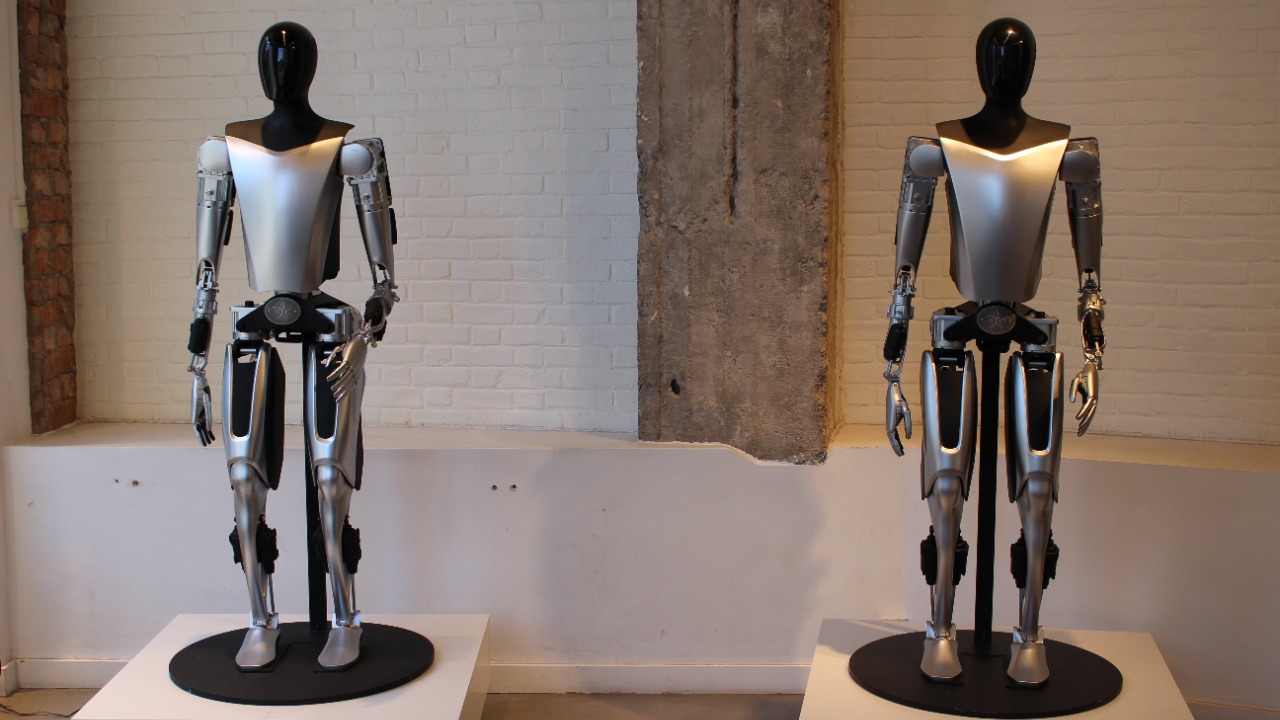

Elon Musk has spent the past few years promising that a general purpose humanoid worker is not science fiction but Tesla’s next big product. The question now is not whether Optimus exists, but how far it has really progressed from stage demos to something that can survive in a factory or a living room without a safety team hovering nearby. The latest reporting paints a picture of rapid investment, ambitious timelines and early customers, but also of a robot that still struggles with basic balance and autonomy.
To understand how close Musk is to a working Optimus robot, I need to separate the hype from the hardware: what Tesla is actually building, where it is being produced, how the company is staffing the project, and what independent observers say about its current capabilities. Only then does the gap between Musk’s vision of millions of humanoids and the reality of a fragile prototype come into focus.
Optimus as Musk’s next “largest product” bet
Elon Musk has framed Optimus as more than a side project, describing humanoid robots as a potential pillar of Tesla’s future business. In one recent discussion of the program, he argued that Humanoid robots could become “the largest product category in history,” a statement that sets expectations far beyond niche industrial automation. That framing helps explain why he has repeatedly tied Optimus to Tesla’s core identity as an artificial intelligence and manufacturing company rather than treating it as a speculative moonshot.
Positioning Optimus this way also raises the stakes for how quickly the robot can move from prototype to product. If Musk is right that a general purpose humanoid can eventually handle everything from factory work to household chores, then the addressable market is enormous, but only if the robot can operate safely and reliably in unstructured environments. The company’s own description of Optimus, first introduced in 2021 and now presented as a key part of its long term strategy, underscores that Tesla is betting its AI stack and its manufacturing playbook on turning this humanoid into a scalable platform rather than a one off gadget.
From stage demos to pilot production lines
Behind the rhetoric, Tesla has started to build the physical infrastructure needed to make Optimus at scale, even if the robot itself is still evolving. Reporting on the company’s manufacturing plans describes how Nov discussions inside Tesla focused on Expanding Optimus production within the existing Giga Texas campus instead of constructing a separate facility. That choice suggests Tesla wants to leverage its current automotive factories, and the associated supply chains, to ramp humanoid output while keeping capital spending in check.
Separate coverage of the manufacturing ramp indicates that Nov marked a milestone when Optimus Enters Pilot Production, with a Gen3 Line Coming in 2026 and a stated Target Price of around $20K. The same update noted that Your supply chain risks remain, a reminder that even if Tesla can assemble early units, sourcing actuators, sensors and compute at automotive scale is a separate challenge. Together, these details show that Optimus is no longer just a lab prototype, but the production system around it is still in a cautious, experimental phase.
Hiring, timelines and the Optimus Gen 3 reveal
Staffing is another signal of how serious Tesla is about turning Optimus into a real product. In Dec, a widely shared update flagged that NEWS indicated Tesla now has 110 open job listings related to its Optimus robot program. In the same breath, Elon Musk was quoted on Optimus version 3, saying “The n…” and outlining a goal of having meaningful deployment by the end of 2026. That level of hiring, concentrated on one product line, suggests Tesla is building a dedicated organization around the robot rather than relying on a small skunkworks team.
On the roadmap side, Dec reporting on Tesla’s planning noted that Elon Musk laid out the company’s Optimus timeline during Tesla’s Q3 2025 earnings call, offering unusually specific guidance about when a new version would be revealed. Separate coverage of the product roadmap added that Jan Technology Jan reports describe how Tesla is preparing to unveil its Optimus Gen 3 humanoid robot in early 2026, with the first units expected to handle tasks like folding laundry or tightening bolts. Taken together, the hiring surge and the Gen 3 reveal plan point to a company that is racing to iterate on hardware and software, even if the current generation is still limited.
What Optimus can actually do today
For all the talk of Gen 3 and massive markets, the most sobering reporting focuses on what the robots can do right now. One detailed account of internal testing states bluntly that, as of Jan, Right now, not a single Optimus can even stay upright without help. They fall over. Engineers pick them up. The same report notes that the company has not yet proved that the robot is worth putting in factories, which is a stark contrast to Musk’s public framing of Optimus as nearly ready for real work. If balance and basic locomotion are still unreliable, then the robot is far from the kind of autonomous worker Musk has described.
Another Jan assessment of the program reinforces that gap, explaining that Tesla’s Optimus humanoid robot, on which Musk is betting a large part of the company’s future, may not be “ready” yet. According to that account, the report notes that the robots are not consistently operating independently, and that safety teams still need to intervene when they stumble or misjudge their environment. The same piece, attributed to the TOI Tech Desk / TIMESOFINDIA.COM, underscores that Optimus is still in a fragile, research heavy phase rather than a robust industrial product. When I weigh these accounts against Tesla’s own optimism, I see a project that is technically impressive but still wrestling with the fundamentals of bipedal robotics.
Public stumbles and the $20,000 price narrative
The tension between promise and reality has already spilled into public view. In early Jan, video of a Tesla robot mishap circulated widely, showing an Optimus unit failing in a way that critics seized on as emblematic of the project’s immaturity. Coverage of the incident noted that, to date, neither Tesla nor Elon Musk has commented on the failure, even though the same reporting reiterated that the robot is expected to retail at roughly $20,000. The silence from the company, combined with the aggressive price target, raises questions about whether Tesla is prioritizing optics over a candid discussion of technical risk.
At the same time, other reports describe a more polished side of the rollout, including a Nov update that framed the start of production as a major milestone. One account highlighted how WATCH showed that Elon Musk‘s Tesla has begun production of its first humanoid robot, emphasizing that the launch is getting closer and that the company is working on more precise and delicate movement. That narrative, focused on progress and refinement, sits uneasily alongside footage of a robot that cannot reliably stay on its feet. As a reporter, I see these contrasting images as a reminder that early production does not automatically mean a product is ready for unsupervised deployment.
Early adopters, home demos and the consumer pitch
Despite the technical caveats, Tesla is already testing the consumer story around Optimus. A Jan feature on domestic robots describes how Optimus, Created by Tesla’s AI and Robotics Division Customers, has already been showcased to diners at a Tesla themed restaurant in Los Angeles. In that setting, the robot is presented less as an industrial tool and more as a glimpse of a future where humanoids can do housework, help address poverty and even perform surgeries. The same piece notes that following approval of Musk’s gigantic projects, the robots are being discussed in a price range of $20,000 to $30,000, which aligns with the company’s broader pricing hints.
Another Jan report on the consumer angle goes further, stating that “Early adopters” are already ordering the bots for $20,000 with delivery anticipated for later in 2026. The same account quotes Randy Howie, co founder of a robotics company, weighing in on whether Optimus can really become the robo domestic of your dreams. If customers are indeed placing deposits at that price, Tesla is effectively pre selling a product that, by other accounts, still needs engineers to pick it up when it falls. That disconnect between marketing and maturity is one of the clearest signs that the project is being pushed hard on multiple fronts at once.
Revised expectations and internal recalibration
Inside Tesla, there are signs that the company has already had to temper its own expectations. A Jan deep dive into the project reports that Tesla has backed away from its initial Optimus timeline of putting a commercial version to work in its own factories as quickly as Musk once suggested. Instead, the company is now described as taking a more phased approach, focusing first on tightly controlled tasks before letting the robots roam freely on production lines or in public spaces. The same piece sketches Musk’s broader vision of a world where people can work less and hang out with their families while robots handle more of the drudgery, but it makes clear that this future is not arriving overnight.
That recalibration is echoed in other coverage that stresses how much work remains on autonomy and reliability. The Jan analysis from the Tesla project notes that Optimus is still heavily dependent on human oversight and that the company has had to adjust its internal milestones accordingly. From my vantage point, this is a familiar pattern for Musk led ventures: aggressive initial timelines that slip as the engineering reality sets in, followed by a second phase where the product either quietly fades or, as with SpaceX’s rockets, eventually catches up to the rhetoric after years of iteration.
Investor expectations and 2026 as a make-or-break year
While engineers wrestle with gait and grasping, investors are already treating Optimus as one of Tesla’s key catalysts for the next year. A Jan market analysis notes that Beyond the robotaxi, Kallo anticipates that 2026 will feature updates on Optimus production, along with additional clarity on Tesla’s energy business. That framing effectively bakes Optimus progress into the stock’s narrative, even though the robot is still in pilot production and far from mass deployment.
Other investor focused commentary points out that Optimus is now mentioned in the same breath as Tesla’s core automotive and energy segments, which raises the pressure on Musk to show tangible milestones. If 2026 brings only more demos and no credible evidence of robots doing useful work in Tesla’s own factories, the market may start to discount the humanoid story. On the other hand, even a modest deployment of a few dozen units performing repetitive tasks could be enough to convince some analysts that the long term thesis is intact, especially given Musk’s argument that humanoid robots could eventually outnumber cars in Tesla’s product mix.
So how close is Musk to a truly “working” Optimus?
When I put all of this together, I see a project that is much further along institutionally than technically. Tesla has integrated Optimus into its Giga Texas manufacturing footprint, as shown by the decision to expand production within that campus rather than build a new plant, and it has moved into pilot production with a Gen3 line planned for 2026. The company has opened 110 roles dedicated to the robot, is planning a high profile Optimus Gen 3 reveal, and is already testing consumer messaging around a roughly $20,000 price point with early adopters and restaurant demos in Los Angeles. On paper, those are the hallmarks of a product on the cusp of commercialization.
Yet the most candid technical reporting still describes robots that fall over, need engineers to pick them up, and cannot operate independently for extended periods. Tesla has quietly backed away from its earliest internal timelines, and even sympathetic analysts frame 2026 as a year for “updates” rather than mass deployment. In that sense, Musk is close to a working Optimus in the corporate and financial sense, with factories, hiring plans and preorders lining up behind the vision. In the stricter sense of a reliable, general purpose humanoid that can be dropped into a factory or home and left alone, the available evidence suggests he is still at least several major iterations away, with 2026 shaping up as the year when the gap between promise and performance will be hardest to hide.
More from MorningOverview