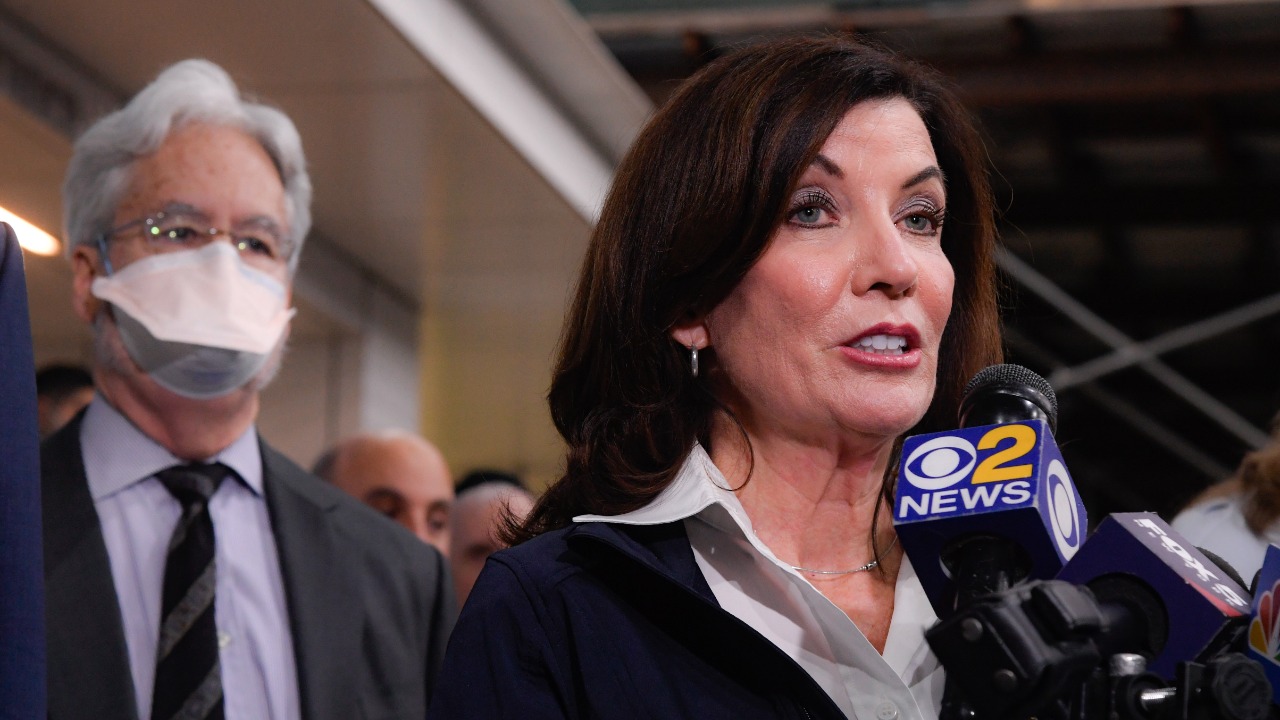

New York is moving to shut the door on one of the most volatile uses of artificial intelligence, with Gov. Kathy Hochul pushing to outlaw AI generated images in political campaigns in the final stretch before voters head to the polls. Her proposal would make New York one of the first states to treat synthetic political imagery not just as a disclosure problem but as a form of deception that can be banned outright.
The move comes as AI tools make it trivial to fabricate convincing photos and videos of candidates, and as campaigns experiment with the technology in ways that test the limits of existing election law. Hochul is betting that a hard line on political deepfakes will resonate with voters who already distrust what they see online, even as it raises thorny questions about free speech and federal preemption.
Hochul’s proposed ban and the 90 day election window
Gov. Kathy Hochul of New York has signaled that she wants to draw a bright legal line around the most sensitive part of the campaign calendar, the final 90 days before an election. In that period, she is seeking to prohibit campaigns from distributing AI generated images of people, including opposing candidates, without their consent, a step that would directly target the kind of deepfake attack ads that can go viral in hours but take weeks to debunk. Her team has framed the effort as a way to keep voters from being blindsided by fabricated scandals in the closing days of a race, when misinformation is hardest to correct and turnout decisions are being locked in.
The governor’s push has been described as a crackdown on AI images in political campaigns, with the focus on synthetic visuals that depict real individuals in situations that never occurred. Reporting on her plan notes that Gov. Hochul wants to ban AI images in political campaigns and has raised concerns that, without clear rules, New York could face a slippery slope where manipulated content becomes normalized in electioneering. A separate account of her announcement underscores that Gov. Kathy Hochul of New York made the call on a Sunday, emphasizing that the prohibition would apply to AI generated images of people, including opposing candidates, in the 90 days before an election, and that consent from those depicted would be required for any such material to be used.
From disclosure rules to outright prohibitions
New York’s move toward an outright ban on certain political deepfakes builds on a broader shift from transparency to restriction in AI regulation. Earlier efforts in the state have focused on disclosure, requiring that audiences be told when they are seeing synthetic content rather than banning the content itself. That approach is already visible in the commercial sphere, where lawmakers have targeted AI generated “synthetic performers” in advertising and insisted that viewers be informed when a human likeness is not real.
On December 11, 2025, New York enacted a law regulating the use of AI generated synthetic performers in advertising, with detailed Disclosure Requirements that apply whenever a synthetic performer is used. A related analysis of the same statute describes how New York enacts law regulating the use of AI generated synthetic performers in advertising and notes that the measure appears in a Privacy and Information Security Law context, underscoring that transparency is treated as a consumer protection issue as much as a creative one. In politics, however, Hochul is now signaling that disclosure alone may not be enough, especially when a fabricated image can inflict damage even if a small disclaimer is technically present.
New York’s wider AI rulebook and the RAISE Act
The proposed political ad crackdown does not exist in a vacuum, it sits on top of a rapidly expanding AI rulebook that New York has been assembling across sectors. The state has already moved to regulate how AI is used in hiring, safety critical systems and creative industries, positioning itself as a national test bed for what comprehensive AI governance might look like. That context helps explain why Hochul is comfortable reaching into the sensitive realm of campaign speech, she is treating AI as a systemic risk that requires a coordinated response rather than a series of isolated fixes.
One key piece of that framework is an AI transparency law that New York enacted on the heels of a White House Executive Order that aimed to curb such state laws, a tension that was flagged in an analysis titled New York Enacts to curb such state laws. Another major statute, described as New York Enacts RAISE Act for AI Transparency Amid Federal Preemption Debate, notes that New York Governor Kathy Hochul signed the Responsible Artificial Intelligence Systems and Evaluation (RAISE) Act and that its effective date will be January 1, 2027, with New York Governor putting her name on a law that sets AI safety rules for developers. A separate account of a sweeping AI safety law notes that New York has officially joined California at the forefront of US artificial intelligence regulation and that Governor Kathy Hochul signed a measure that imposes obligations on certain AI models in New York, with New York and California now seen as parallel laboratories for AI policy.
Political ads, PAID Act disclaimers and real world campaigns
Even before Hochul’s latest proposal, lawmakers in Albany were already grappling with how to handle AI in campaign messaging. One major effort is the “political artificial intelligence disclaimer (PAID) act,” which would require political communications that use generative AI to include clear disclaimers and would obligate campaigns to maintain records of such usage. That approach reflects a belief that voters should at least know when they are being targeted with synthetic content, even if the content itself is not banned.
The bill, identified as NY State Senate Bill 2025 S2414, is listed as 2025 S2414 (ACTIVE) and its summary states that it enacts the political artificial intelligence disclaimer (PAID) act, requires political communications that use generative AI to include disclaimers and directs campaigns to maintain records of such usage, with the status marked as ACTIVE. On the ground, AI is already reshaping New York politics, as illustrated by a video report asking “Are AI generated ads changing New York politics?” which notes that Andrew Cuomo, referred to as Cuomo, is not known as the most tech forward candidate for mayor but has put artificial intelligence to novel use in his latest campaign, a development captured in a segment available on YouTube. The gap between experimental campaign tactics and the legal framework is precisely what Hochul is now trying to close.
Film industry rules, federal friction and the Trump factor
Hochul’s stance on political AI is also shaped by her experience regulating synthetic media in entertainment, where the state has already forced studios and platforms to adjust. She signed legislation to protect consumers and boost AI transparency in the film industry, a package that requires clear notice when AI is used to replicate a performer’s likeness and aims to prevent actors from losing control of their digital doubles. That law treats AI as both an economic and a civil rights issue, signaling that the state is willing to intervene when technology threatens to erase consent.
An official account of that measure notes that Governor Hochul Signs Legislation to Protect Consumers and Boost AI Transparency in the Film Industry and that the initiative is framed as a way to protect performers’ likeness, with Governor Hochul Signs described as a milestone for the film industry. A separate legal update on AI notes that some states may face aggressive federal challenges to their AI laws and that the Executive Order itself is likely to be challenged, with the analysis warning that, though some states may face aggressive federal challenges to their AI laws, the Executive Order itself is likely to be challenged and advising stakeholders to monitor developments over the next six months, a caution captured in a piece titled Though Executive Order. That tension is already visible in the political arena, where one report on Hochul’s push to ban AI in political advertising notes that New York Gov. Kathy Hochul delivered remarks before the House Committee on Oversight and Government Reform on Capitol Hill and that she framed her proposal as protecting voters across the state, with New York Gov Kathy Hochul explicitly tying AI rules to democratic integrity.
National politics are never far from these debates. A separate account of Hochul’s plan to restrict AI in political advertising notes that New York has been at the forefront of a push to regulate the emerging AI industry even as the Trump administration vows to scuttle action on any new regulations, with New York cast as a counterweight to federal reluctance. Another report on her desire to ban AI images in campaigns describes how NY Gov. Hochul wants to ban AI images in political campaigns and warns that, without such a step, the state could risk a slippery slope, a concern captured in coverage of Gov Hochul’s proposal. A social media post amplifying her announcement reiterates that Gov. Kathy Hochul of New York wants to prohibit campaigns from spreading AI generated images of people, including opposing candidates, without their consent in the 90 days before an election, with the message noting that she made the statement on a Sunday and that it drew engagement from users such as Scott and 1.3K others, a detail preserved in a Sunday post. As New York and California push ahead, and as President Trump’s administration signals skepticism of new AI rules, the legal fate of Hochul’s political ad crackdown could become an early test of how far states can go to police synthetic speech in the age of generative AI.
Supporting sources: New York Enacts, NY Gov. Hochul, New York Enacts, Hochul seeks ban, New York Enacts, NY State Senate, Governor Hochul Signs, New York Governor, Gov. Kathy Hochul, New York Enacts, Hochul seeks ban, AI-generated ads changing, AI Legal Updates:.
More from Morning Overview