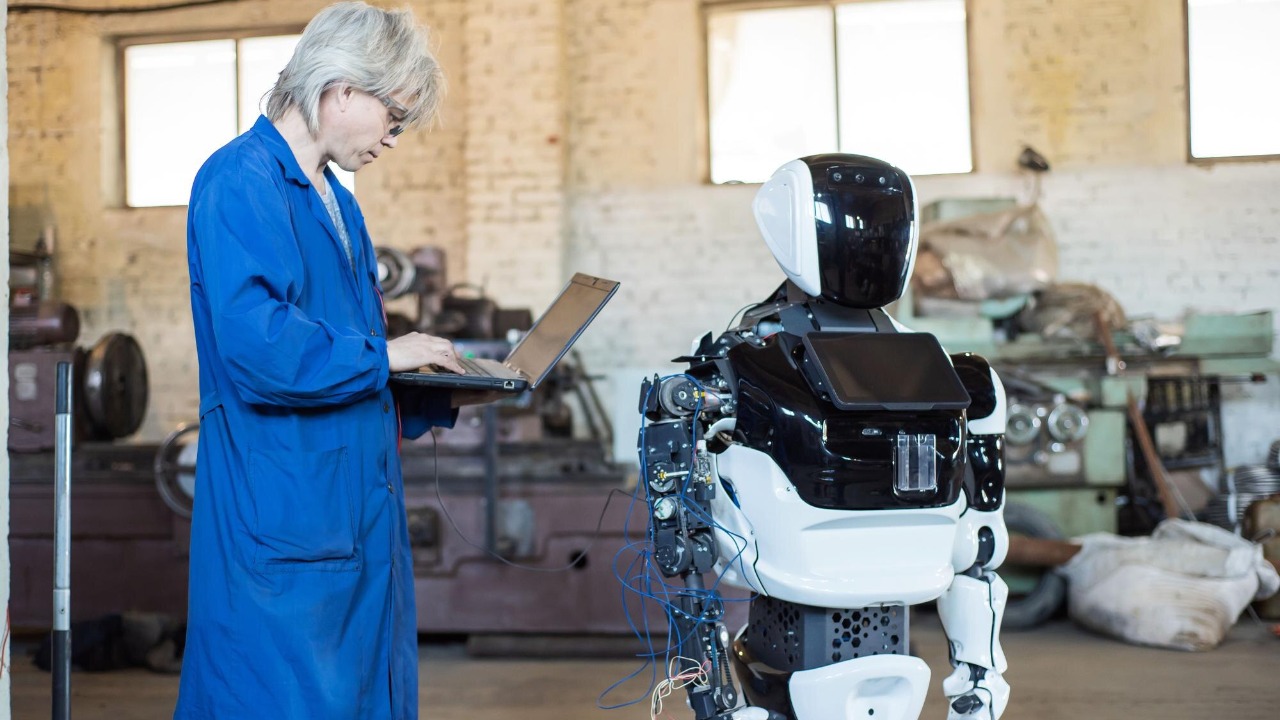

Humanoid robots have quietly crossed a threshold from lab demos to real industrial work, and the software making that leap possible is Google’s Gemini family of AI models. Instead of being teleoperated or locked into rigid scripts, the latest factory robots are running on-device Gemini systems that can see, reason and act in real time on the line. The result is a new kind of shop floor, where a robot’s “brain” can be updated like an app and redeployed across different machines and tasks.
At the center of this shift is a partnership between Google’s AI teams and hardware makers that are betting their next generation of humanoids on Gemini. Boston Dynamics is now building a pilot line of Atlas robots that rely on Google’s models for high level decision making, while Google DeepMind is pushing embodied versions of Gemini into everything from bi arm manipulators to mobile platforms. I see this as the first serious test of whether general purpose AI can handle the messy, variable work of real factories.
Gemini’s leap from chatbot to robot brain
Gemini started life as a family of language and multimodal models, but its most consequential incarnation may be as a control system for machines. In a detailed technical walkthrough, Jun and Karolina Parada describe how Google DeepMind adapted Gemini into a vision language action model that can interpret camera feeds, understand natural language instructions and output motor level commands, effectively turning it into an autonomous robot “brain” that runs on local hardware rather than a distant data center, a shift they frame as a fundamental change in how robots work in the real world, as shown in a recent Gemini robotics demo.
That same push is visible in Google’s decision to ship a dedicated Gemini Robotics model that can operate directly on robots. In technical benchmarks, Google reports that this local model performs at a level close to the larger cloud based Gemini Robotics system, even though it runs on more constrained processors inside the robot body, a result that underpins the company’s argument that Gemini can be a foundational model for robotics rather than just a conversational assistant, as detailed in its robotics benchmark report.
On-device control and the end of tethered robots
For factories, the most practical breakthrough is that Gemini can now run entirely on the robot, without a network connection. Jun’s team has emphasized that the new on device AI model for robotics can operate without needing to be connected to the internet, which marks a major shift from cloud dependent systems and allows robots to keep working even if connectivity is spotty or security rules forbid external links, a capability highlighted in coverage of Google’s offline Gemini Robotics model.
Google has formalized this approach in a product it calls Gemini Robotics On Device, a lightweight variant designed specifically for local robot control. The company describes Gemini Robotics On Device as a model that can run tasks locally and directly control a robot’s movements, with Tuesday’s release framed as a way to let industrial machines perceive their environment, reason about it and act without round trips to the cloud, a design that is spelled out in detail in its announcement of Gemini Robotics On Device.
Embodied reasoning with Gemini Robotics 1.5
Running locally is only half the story, because factory work also demands planning and adaptation, not just reflexes. Google’s answer is Gemini Robotics 1.5, a model tuned for what the company calls embodied reasoning, where the AI generates multi step action plans, monitors execution and adjusts on the fly as conditions change, effectively acting as the robot’s high level brain while lower level controllers handle precise motion, a division of labor that is central to the description of Gemini Robotics 1.5.
DeepMind’s own technical write up goes further, arguing that Gemini Robotics 1.5 brings AI agents into the physical world by letting a single model generalize across different robot bodies. In one example, tasks that were only presented to the ALOHA 2 robot during training also just work on the Apptroni humanoid and the bi arm Franka robot, and vice versa, suggesting that the 1.5 system is learning an abstract understanding of manipulation and motion that can transfer between platforms, a capability that is documented in the company’s report on Gemini Robotics 1.5.
Reasoning powers for messy factory work
Industrial environments are unpredictable, with parts arriving misaligned, tools wearing down and human coworkers moving through shared spaces, so the key test for any AI system is how well it can reason under uncertainty. DeepMind describes Gemini Robotics 1.5 G as a step change in this respect, saying that the model Gives Robots Reasoning Powers by combining perception, language understanding and action planning in a single architecture, which allows robots to interpret ambiguous instructions, infer missing context and still complete tasks safely, a capability that is central to the analysis of Gemini Robotics 1.5 G.
In practice, that means a humanoid on a line can be told to “pick up the blue housing from the second pallet and mount it on the next chassis” and use its cameras and internal model of the workspace to figure out what that means, even if the pallet is slightly out of place or the lighting has changed. Google AI’s broader robotics work frames this as moving from brittle, hard coded routines to flexible agents that can handle a range of different robotics hardware, a philosophy that underpins the tie up between Google AI and Gemini Robotics described in coverage of next gen humanoid robots.
Boston Dynamics puts Gemini on the line
The most concrete sign that Gemini is now running humanoid robots on factory lines comes from Boston Dynamics, which has opened a pilot production line for up to 1,000 Atlas robots that tap Google Gemini AI for their control stack. The company is building this pilot capability in LAS VEGAS, positioning Atlas as a general purpose humanoid that can be deployed into industrial settings and powered by Google Gemini AI for perception and decision making, a strategy laid out in reporting on Boston Dynamics’ plan to produce up to 1,000 Atlas units.
That pilot line is not just about building robots, it is also a proving ground for how Gemini powered humanoids behave in a production environment. Boston Dynamics is integrating Google Gemini AI into Atlas so that the robot can handle tasks like moving components, loading machines and working alongside people, while Google AI and Gemini Robotics provide the underlying models that let the same software stack run across a range of different robotics hardware, a collaboration that is described in detail in the report on how Boston Dynamics’ next gen humanoid will carry Google DeepMind DNA.
From research reel to factory floor
The path from research prototype to factory deployment has been unusually fast for Gemini, in part because Google DeepMind designed the robotics models with real hardware in mind from the start. In a widely shared clip, Jun explains that Google DeepMind is bringing their Gemini Robotics model on device as the first vision language action system built to help robots understand instructions and act in the physical world, a framing that underscores how the same core model can move from lab arms to mobile platforms, as shown in the Gemini Robotics on device reel.
Independent analysts have picked up on this acceleration, noting that what started as “big news in robotics” when Google DeepMind made its move on June 24 has quickly turned into a practical toolkit for running robots in places as varied as warehouses, homes or on a space station. One breakdown of the launch argues that Google’s strategy is to make Gemini the default robot brain that can be dropped into different bodies and environments, with on device execution and offline capabilities as core design goals, an interpretation laid out in a detailed note on Google’s robots brain.
Offline resilience and security for industrial buyers
For manufacturers, the offline nature of Gemini Robotics On Device is not just a technical curiosity, it is a risk management feature. Google DeepMind has presented the on device model as a way to enable offline robot control so that critical tasks like assembly, inspection or material handling can continue even if external connectivity is cut, a design that also reduces the attack surface for cyber intrusions because sensitive production data does not need to leave the facility, as described in the launch of Gemini Robotics On Device.
That same offline capability is what allows robots to be deployed in remote or high security environments where network links are unreliable or tightly controlled. Jun’s team has emphasized that the on device AI model for robotics can operate without needing to be connected to the internet, which is particularly relevant for sectors like defense manufacturing, energy infrastructure or aerospace, where air gapped systems are the norm and any cloud dependency would be a non starter, a point underscored in reporting on Google’s offline Gemini AI for robots.
How benchmarks translate into real productivity
Google has leaned heavily on benchmarks to argue that its local robotics models are ready for industrial use, but the real question is how those numbers map to throughput and uptime on the line. In its technical materials, the company notes that in benchmarks the on device model performs at a level close to the cloud based Gemini Robotics system, which suggests that factories do not have to trade off much intelligence to gain the benefits of local control, a claim that is central to the company’s benchmark focused announcement.
From a factory manager’s perspective, those benchmarks matter because they indicate how reliably a humanoid can handle tasks like kitting, palletizing or machine tending without constant human intervention. Google’s own demos show robots folding clothes and manipulating household objects as a proxy for fine grained dexterity, and while no one is buying a million dollar humanoid to do laundry, the same capabilities translate into handling flexible materials, wiring harnesses or irregular castings on a line, a connection that is made explicit in Jun’s presentation of Gemini as a general purpose robot brain.
What changes next on the factory floor
With Boston Dynamics ramping a pilot line for Atlas and Google DeepMind pushing Gemini Robotics 1.5 into more hardware, the near term impact on factories is likely to be a gradual layering in of humanoids alongside existing automation rather than a wholesale replacement. I expect early deployments to focus on tasks that are too variable for traditional robots but too repetitive or ergonomically punishing for people, such as unloading mixed pallets, feeding parts into CNC machines or handling heavy components in final assembly, roles that play to Atlas’s physical capabilities and Gemini’s reasoning strengths as described in reports on Boston Dynamics’ pilot line.
Over time, the more profound change may be organizational rather than mechanical, as factories start to treat robots less like fixed assets and more like updatable software platforms. With Gemini Robotics On Device and Gemini Robotics 1.5 acting as a common brain across different machines, a plant could, in principle, retrain or fine tune a single model and then push that update to fleets of humanoids, arms and mobile bases, creating a kind of continuous improvement loop in software that mirrors what lean manufacturing has long tried to do in process, a direction that is implicit in Google AI’s framing of Gemini Robotics as a foundational robotics model.
More from Morning Overview