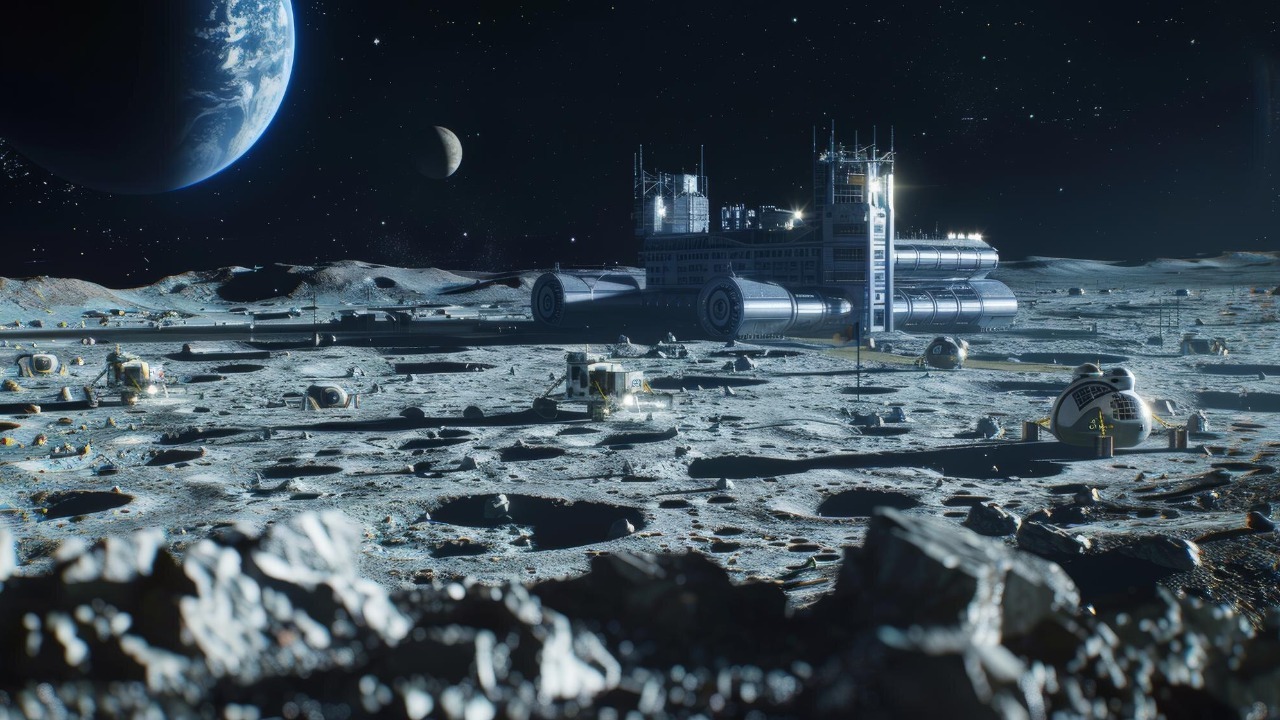

Deep beneath the forests and lakes of northern Minnesota, researchers say they have found traces of a substance long treated as a prize of the Moon rather than the American Midwest. The discovery of Helium-3 in a remote corner of the state reframes both the future of fusion energy and the economics of space mining, shifting a once-speculative “fuel of tomorrow” into a very terrestrial debate.
Instead of existing only in lunar dust and science fiction, this rare isotope now appears to be trapped in rock and gas formations under Minnesota’s wilderness, raising urgent questions about how, and whether, to tap it. I see this as a turning point where planetary science, energy policy and local land use collide in a single, unlikely place.
From lunar fantasy to northern Minnesota reality
For decades, Helium-3 has been described as a kind of cosmic fuel coupon, sprinkled across the Moon’s surface by the solar wind and largely absent on Earth. Scientific discussions of lunar resources have repeatedly highlighted Helium as a theoretical fusion fuel whose concentration in Moon regolith is far higher than on our planet, which is shielded by its magnetic field. In that framing, the path to Helium-3 ran through rockets, landers and regolith processing plants, not through boreholes in the North Woods.
That narrative shifted when researchers working in Northern Minnesota reported that Helium-3, usually discussed as a Moon resource, is present in trace amounts in subsurface formations. According to their findings, the isotope is associated with Helium trapped in natural gas fields and crustal rocks, suggesting that the state’s deep geology hides more than iron ore and taconite. The idea that a “fuel of tomorrow” once thought to be lunar-only is now being sampled under Minnesota’s wilderness forces a rethinking of how we map strategic resources on Earth itself.
What makes Helium-3 such a coveted “fuel of tomorrow”
Helium-3 is not just another industrial gas, it is a specific isotope of Helium that fusion researchers have eyed for its potential to produce energy with fewer radioactive byproducts than conventional fusion fuels. In experimental designs, Helium-3 can be fused with deuterium or with itself, promising high energy yields and, in some configurations, charged particles that can be converted directly into electricity. That is why discussions of Helium-3 routinely describe it as pivotal for nuclear fusion research, even as practical reactors remain unproven.
The stakes are sharpened by the broader strain on global Helium supplies. Reports warning that the world’s conventional Helium reserves could be exhausted within about thirty years underscore how fragile the supply chain already is for applications like MRI machines, semiconductor fabrication and scientific instruments. When those same analyses point out that a far rarer isotope, Helium-3, is central to fusion experiments, the Minnesota find starts to look less like a curiosity and more like a strategic asset. It links a remote Midwestern site to a global race to secure the gases that underpin both today’s technologies and tomorrow’s reactors.
Why the Moon was supposed to be Helium-3’s home
The reason Helium-3 has been so closely tied to the Moon is rooted in basic space physics. Without a thick atmosphere or strong magnetic field, the lunar surface is directly bombarded by the solar wind, which carries Helium nuclei that become embedded in the top layers of regolith. Over billions of years, that process has enriched the Moon’s dust with Helium-3 at concentrations far above typical terrestrial rocks, which is why scientific reviews of Helium-3 have treated it as a prime target for future lunar mining.
That expectation has shaped entire business cases for Moon exploration. Analyses of lunar sample return missions have highlighted the “Dollars and sense” of bringing Helium-3 back to Earth, arguing that its potential as a fuel for fusion power could justify the cost of mining and transport. In that worldview, the Moon was not just a scientific destination but a prospective energy outpost, with Helium-3 as the flagship export. The Minnesota discovery does not erase that logic, but it complicates it, because any terrestrial source, even a modest one, changes the baseline assumptions about scarcity and access.
Minnesota’s geology steps into the energy spotlight
To understand why Helium-3 might show up in Minnesota, it helps to look at the state’s deep-time geology. Northern Minnesota sits on some of the oldest continental crust on Earth, part of the Canadian Shield, where ancient volcanic and tectonic activity left behind complex rock formations and mineral deposits. The same region that hosts iron ranges and copper-nickel prospects now appears to harbor Helium trapped in subsurface structures, with a fraction of that gas containing the coveted Helium-3 isotope described in recent work on Northern Minnesota.
What stands out is the setting: a remote site deep in Minnesota’s wilderness, far from the industrial corridors more commonly associated with energy extraction. Reporting on that remote area describes Helium-3 as part of a broader Helium signature in the rocks, suggesting that the isotope may be migrating upward from deeper mantle sources or trapped in sealed pockets. When I look at that picture, I see a state better known for lakes and forests suddenly appearing on maps of strategic energy resources, a shift that will test how Minnesota balances conservation, tribal rights and the lure of high-value extraction.
From Moonshot economics to Midwestern trade‑offs
For years, the economics of Helium-3 were framed as a “moonshot” problem: could any realistic price for fusion fuel justify the cost of mining and shipping it from the Moon. Analyses of lunar return missions have argued that if fusion reactors using Helium-3 ever become commercially viable, the element’s value could be high enough to support a dedicated supply chain from the lunar surface. That is why discussions of commercial opportunity around Helium-3 have been intertwined with broader plans for Moon bases, regolith processing plants and cislunar transport.
The Minnesota find does not instantly undercut those scenarios, because the scale and concentration of Helium-3 in the state remain unverified based on available sources. What it does, however, is introduce a competing narrative in which at least some Helium-3 can be sourced from Earth, potentially at lower technical risk than lunar mining. That raises practical questions for policymakers and investors: should scarce research dollars chase extraction on another world when a portion of the resource might be tapped under existing regulatory frameworks at home. The answer will depend on detailed resource assessments, but the very existence of a Midwestern option changes the strategic calculus.
Local stakes in a global fusion race
While Helium-3 is a global story, the immediate consequences will be felt in Minnesota’s communities. The state already navigates contentious debates over mining in sensitive watersheds, including proposals near the Boundary Waters Canoe Area Wilderness. Adding Helium-3 to the mix means that local residents, tribal governments and state regulators may soon be weighing not just familiar questions about sulfide runoff or habitat loss, but also the symbolic weight of hosting a resource tied to the future of fusion power. The fact that this is happening in Minnesota, rather than in a distant lunar crater, makes those choices more immediate and personal.
At the same time, the discovery plugs directly into a broader race to secure critical materials for advanced energy systems. As fusion startups and national laboratories refine their designs, any credible terrestrial source of Helium-3 will attract attention from governments and private firms that want to lock in supply. Reports describing a remote site deep in Minnesota’s wilderness as a new source of a fuel once believed to exist only on the Moon hint at how quickly a quiet research project can become a geopolitical talking point. I expect that as more data emerge, the conversation will broaden from scientific curiosity to hard choices about who benefits, who bears the risk and how a single isotope can reshape both space policy and life on the ground.
More from Morning Overview