
New fossil discoveries are forcing scientists to redraw the boundaries of ancient oceans, suggesting that some of the most formidable marine predators did not always stay at sea. From gigantic reptiles that rival modern whales in size to sharks entombed deep inside a continental cave system, the emerging picture is of “sea monsters” that pushed into rivers, estuaries and even underground waterways. Together, these finds hint that the line between ocean and land was far more porous for prehistoric giants than it is for most large marine animals today.
Instead of a simple story of creatures confined to open water, the fossil record now points to a dynamic world where apex predators followed food and opportunity wherever they could, including far inland. I see a pattern taking shape: as researchers connect bones, teeth and trackways from distant sites, they are uncovering a deep-time experiment in mobility that helped these animals dominate ecosystems on both sides of the shoreline.
Sea monsters that rival today’s giants
When people imagine a “sea monster,” they often picture something larger than life, but recent research suggests that description is not an exaggeration. One investigation into an enormous marine reptile, presented by Jan in a detailed analysis, describes a creature so massive it could overshadow even the largest living whales, with a body plan built for power and long-distance cruising rather than delicate maneuvering. The scale of this animal, reconstructed from partial remains and comparative anatomy, reinforces the idea that prehistoric seas supported predators at the absolute upper limit of what vertebrate bodies can achieve in water, a reminder that modern blue whales are part of a much longer story of oceanic gigantism that includes these ancient reptiles as well as giant sharks and ichthyosaurs documented in other studies.
What stands out to me is not only the size but the ecological implications of such a predator. A marine reptile that could dwarf today’s largest animals would have needed vast hunting grounds and a flexible diet, likely ranging across entire basins in search of shoals of fish, squid-like cephalopods and smaller marine reptiles. The reconstruction shared by Jan in the context of the biggest sea monster underscores how these giants were not evolutionary accidents but highly successful designs, honed by selection to dominate open water in ways that left a deep imprint on marine food webs.
Clues from a 180‑million‑year‑old predator
While some fossils hint at sheer size, others reveal how these animals actually lived. A rare specimen of a 180‑million‑year‑old “sea monster,” highlighted by Bethan Finighan, captures a long‑necked marine reptile in remarkable detail, from its paddle‑like limbs to the delicate vertebrae that supported its serpentine neck. The fossil, described alongside a plesiosaur model that helps visualize the animal in three dimensions, shows a predator adapted for stealth and precision, using a small head on a flexible neck to dart into schools of fish while keeping its bulky body at a distance. That combination of reach and maneuverability would have allowed it to exploit niches that bulkier hunters could not, especially in shallow coastal waters and lagoons.
I find the context around this discovery just as revealing as the bones themselves. The report notes that the coverage, which runs alongside a gallery labeled with “View 3 Images” and a timestamp including “14:58, 01 Apr 2025,” situates the fossil within a broader push to understand how these animals diversified during the Jurassic. By tying the specimen to a specific 180‑million‑year window, researchers can compare it with other marine reptiles from similar strata and track how neck length, limb shape and skull design evolved over time. The work described by Bethan Finighan shows that even a single well‑preserved fossil can anchor a much larger narrative about how predators adapted to different marine habitats, from open shelves to nearshore environments that blurred into river mouths.
From ocean to land: a boundary‑pushing lineage
The most provocative evidence that ancient sea monsters roamed beyond the ocean comes from research that explicitly tracks a marine predator’s journey toward land. In a detailed discussion introduced in Nov, scientists describe an ancient creature that began its evolutionary story as a fully aquatic hunter, then gradually developed traits that allowed it to exploit environments closer to shore and eventually on land. The narrative, framed as an exploration of how life transitions between realms, highlights anatomical changes such as more robust limb bones, altered joint angles and shifts in spine flexibility, all of which point to an animal that was no longer limited to buoyant support in water. Instead, it was experimenting with weight‑bearing on solid ground, at least for short excursions.
For me, the significance lies in how this case study reframes the idea of a “sea monster.” Rather than a static archetype, it becomes a phase in a lineage that could move back and forth between ocean and land, depending on where food and safety were available. The researchers featured in the From Ocean To Land discussion emphasize that this transition was not a single leap but a series of incremental steps, each conferring a small advantage in shallow water, tidal flats or river deltas. That pattern mirrors what we see in other major transitions, such as early tetrapods leaving the Devonian seas, and it supports the idea that some of the most formidable marine predators were also pioneers at the water’s edge, testing new territories that would eventually become fully terrestrial ecosystems.
Sea monsters in the world’s largest cave
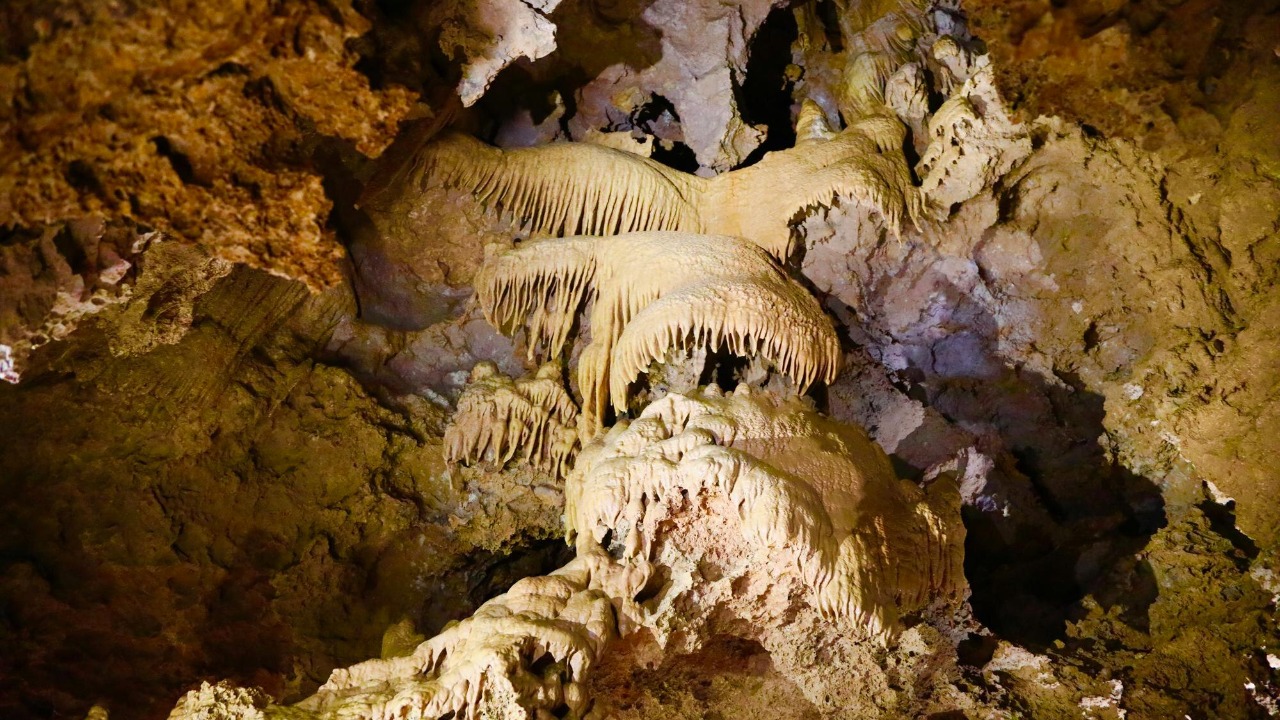
If any discovery captures the idea of a marine predator far from its expected home, it is the unearthing of fossil sharks deep inside Mammoth Cave. Reports describe how Two prehistoric sea monsters were identified in this vast underground system, with their remains preserved in rock that dates back an astonishing 325 m years. The site, Mammoth Cave in Kentucky, is known today as the world’s largest cave, a labyrinth of passages carved by ancient rivers, yet the fossils show that in the distant past it was part of a very different landscape, one where shallow seas and coastal plains overlapped. The animals themselves, described as formidable sharks, add a new dimension to the cave’s story, turning it from a purely geological wonder into a window on early marine ecosystems.
What I find striking is how these sharks ended up there in the first place. The reporting by Eric Ralls notes that the fossils were identified through a dedicated program that scoured the cave walls for traces of ancient life, revealing that the rock layers now forming ceilings and corridors were once seafloor sediments. That means the sharks were not “trapped” in a cave as we know it today, but died in a marine or coastal setting that later subsided and was hollowed out by groundwater. The account of Two prehistoric sea monsters in Mammoth Cave shows how inland rock can preserve a record of ancient seas, and it underscores that the boundaries between ocean and continent have shifted dramatically over hundreds of millions of years.
Troglocladodus, Glikmanius and the 325‑million‑year puzzle
The Mammoth Cave story deepens further with the formal identification of two new shark species, Troglocladodus trimblei and Glikmanius careforum, which Scientists uncovered in the same Kentucky cave system. These animals, described as sea monsters in their own right, lived roughly 325 million years ago, a time when early sharks were diversifying into a wide range of forms. Troglocladodus appears to have had specialized teeth suited for slicing through flesh, while Glikmanius is linked to a lineage of large predatory sharks that patrolled ancient seas. Their presence in what is now an inland cave suggests that the region once hosted a rich marine ecosystem, perhaps a shallow inland sea or coastal shelf teeming with invertebrates and smaller fish.
From my perspective, the key insight is how these species help reconstruct early shark evolution and the geography of their habitats. By placing Troglocladodus trimblei and Glikmanius careforum in a 325‑million‑year context, researchers can compare them with related fossils from other parts of the world and test hypotheses about how shark lineages spread across ancient oceans. The fact that they were found in Kentucky, far from any modern coastline, supports the idea that sea levels and continental positions have shifted so dramatically that today’s landlocked regions once lay beneath waves. The detailed account of how Scientists uncovered these sharks shows that even remote cave passages can hold crucial clues about where ancient sea monsters roamed.
Ichthyotitan and the rise of inland giants
Not all evidence of boundary‑pushing sea monsters comes from caves. Along the banks of the River Severn, an 11‑year‑old girl helped identify remains of what researchers now consider the largest‑ever marine reptile, a giant dubbed Ichthyotitan severnensis. The fossils, recovered from coastal cliffs and riverine deposits, point to an animal that may have rivaled or exceeded the size of the biggest known ichthyosaurs, with a skull and body built for high‑speed pursuit in open water. Yet the setting of the find, in sediments influenced by both marine and river processes, hints that this predator may have frequented estuaries and nearshore channels where freshwater and seawater mixed, following prey that moved in and out with the tides.
I see Ichthyotitan severnensis as a powerful example of how giant marine reptiles could exploit transitional zones rather than staying far offshore. Estuaries and broad river mouths would have offered abundant fish and cephalopods, along with carcasses washed down from inland, creating a buffet for a large, opportunistic hunter. The scientific description of this species, which notes that the full study was published in the journal PLOS ONE, underscores how careful stratigraphic work can link a fossil to specific depositional environments. In this case, the combination of marine and fluvial signatures in the rock supports the idea that some of the largest sea monsters were regular visitors to waters that lapped against ancient shorelines and river deltas.
A new elasmosaur and the 85‑million‑year shoreline
Another piece of the puzzle comes from the identification of a new elasmosaur, a long‑necked marine reptile that lived 85 m years ago and stretched around 12 meters in length. Scientists describe Its strong teeth as evidence of a powerful bite, capable of seizing slippery prey in open water, while the elongated neck suggests a hunting strategy similar to earlier plesiosaurs, using reach and surprise to snatch fish and other small animals. The age of this elasmosaur places it in the Late Cretaceous, a period when sea levels were high and shallow epicontinental seas flooded large parts of the continents, creating vast inland waterways that connected to the open ocean.
In that context, I read this discovery as more than just another addition to the roster of marine reptiles. An elasmosaur adapted for life in broad, shallow seas would have had ample opportunity to move along coastlines, into bays and up estuarine channels, especially if those routes offered rich feeding grounds or safer breeding areas. The report that Scientists identify a new elasmosaur emphasizes how its anatomy fits into a broader pattern of Late Cretaceous marine life, where reptiles, sharks and large fish all exploited the complex mosaic of inland seas. That mosaic would have blurred the line between “ocean” and “land” in practical terms, giving these animals a much wider range than a simple map of ancient coastlines might suggest.
Rewriting the map of ancient seas
When I step back from these individual discoveries, a consistent theme emerges: ancient sea monsters were not confined to the deep blue expanses we imagine when we think of oceans today. The 325‑million‑year sharks of Mammoth Cave, the estuarine giant Ichthyotitan severnensis, the 180‑million‑year plesiosaur described by Bethan Finighan and the 85‑million‑year elasmosaur all point to predators that thrived in transitional zones, from shallow inland seas to river mouths and coastal plains. Even the evolutionary narrative introduced in Nov, tracing a marine predator’s gradual move toward land, reinforces the idea that the boundary between ocean and continent was a permeable frontier, constantly tested by animals seeking new opportunities.
That realization has practical consequences for how I understand the fossil record and the search for future finds. Instead of focusing only on ancient shorelines as drawn on paleogeographic maps, researchers are increasingly probing caves, river valleys and inland basins for traces of marine life, recognizing that sea levels and tectonic shifts have radically reshaped the planet’s surface. The account of 325‑million‑year‑old sea monsters found where no one expected them, deep inside the world’s largest cave, is a vivid reminder that the most revealing fossils may be hiding in places that look, at first glance, entirely terrestrial. As more of these inland clues come to light, the story of sea monsters roaming beyond the ocean is likely to grow more complex, and far more compelling.
More from MorningOverview