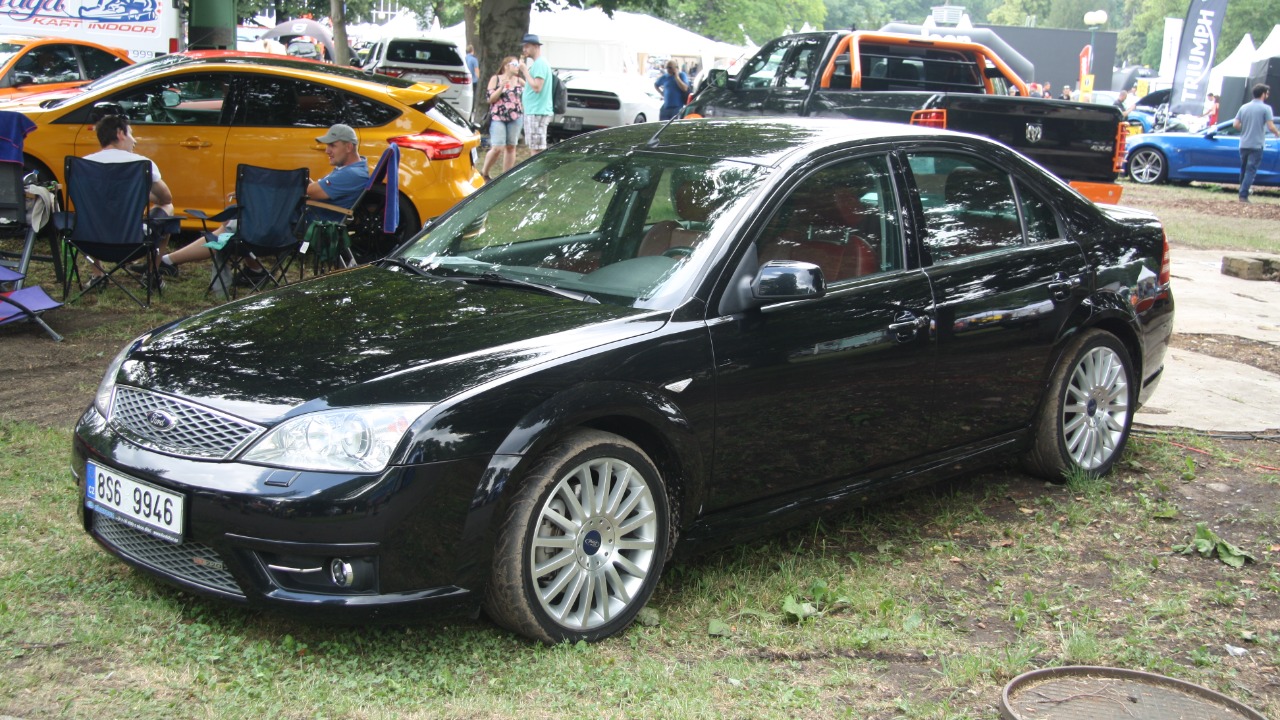

Ford has a long history of building ordinary looking family cars that deliver performance to trouble far more expensive machinery, and the Mondeo ST220 might be the clearest expression of that philosophy. On paper it was a sensible midsize sedan, but in practice it was tuned to embarrass prestige badges in the real world, including the BMW 3 Series that defined the segment for a generation.
By pairing understated styling with serious engineering, Ford created a midsize sleeper that could run with German sport sedans while blending into the commuter car park. I see the ST220 not as an outlier, but as the culmination of a Ford tradition that stretches from the Taurus SHO to modern “Wolf in Sheep’s Clothing” trucks, all built to surprise drivers who judge performance by the badge on the grille.
The Mondeo ST220, the quiet rival to Munich
At a glance, the Mondeo ST220 looked like any other Dec era Mondeo, which is exactly what made it so effective at catching BMW drivers off guard. The bodywork avoided the flared arches and oversized spoilers that shout for attention, instead relying on subtle changes and a slightly lower stance that only enthusiasts would notice. That restraint fits the classic definition of a sleeper performance car, a machine that hides its intent until the driver floors the throttle away from a traffic light, a role the ST220 was explicitly built to fill according to detailed analysis of the Mondeo ST220.
Underneath, Ford engineers treated the car far more seriously than its modest styling suggests, giving the ST220 a chassis and powertrain that could credibly chase an E46-generation BMW 3 Series on a back road. Contemporary assessments point to a carefully tuned suspension and strong brakes that let the car carry speed with confidence, while the V6 engine delivered the kind of midrange shove that matters in real-world overtakes rather than on-paper bragging rights. When I look at how the ST220 is remembered, it is clear that its mission was not to outgun BMW in a straight line, but to match the balance and composure that made the 3 Series a benchmark, all while wearing a Ford badge and a family car silhouette.
A sleeper lineage from Taurus SHO to Contour SVT
The ST220 did not appear from nowhere, it followed a template Ford had already proven with earlier sleepers like the Ford Taurus SHO. When the first SHO arrived, Ford dropped a 220 horsepower V6 into a conservative sedan body, creating what period reviewers called a wolf in sheep’s clothing that could reach a top speed of 143 miles per hour, figures that still stand out when you revisit the original Ford Taurus SHO. That car proved there was an audience for a family four door that could run with contemporary sports cars while looking like a company car in the office lot.
Ford doubled down on that idea with the Contour, where the Special Vehicle Team turned the humble sedan into the Ford Contour SVT Front Driver Side hero that enthusiasts still discuss. Period coverage notes how the Ford Special Vehicle Team reworked the Contour into a compact sedan with sharp steering and a chassis that rewarded committed driving, a transformation that made the Contour SVT a standout for handling and balance despite its unassuming shape. When I connect those dots, the Mondeo ST220 looks like the midsize evolution of a formula Ford had already refined in smaller and larger sedans.
Modern echoes, from SHO revival to turbocharged trucks
Even after the original SHO era, Ford kept returning to the idea of discreet performance in everyday packages, most obviously when it revived the Ford Taurus SHO nameplate with turbocharged power and all wheel drive. Recent retrospectives describe the later Ford Taurus SHO as The Turbocharged, AWD, Sports Sedan Bargain You Forgot You Wanted, a car that hid serious pace and traction under a conservative body and a mainstream badge, a point underscored in coverage of the Ford Taurus SHO. That car, like the ST220, was aimed at buyers who wanted BMW levels of speed and grip without the cost or attention that comes with a premium badge.
The sleeper mindset has also migrated into Ford’s truck lineup, where the language of a Wolf in Sheep’s Clothing is now used explicitly. The F-150 Sleeper Program by TC Customs and Town & Country Ford takes a regular looking pickup and turns it into a high performance machine, with the project described as a Wolf in Sheep’s Clothing and the Sleeper Program framed as a way to reimagine the modern truck while keeping it usable every day, as outlined in the Sleeper Program. When I see that language echoed in official marketing, it reinforces how deeply the sleeper concept is woven into Ford’s current performance strategy.
How Ford’s quiet cars stack up against BMW’s image
BMW has long sold the 3 Series on a blend of performance, prestige and everyday usability, but Ford’s approach with cars like the Mondeo ST220 has been to match the first and third elements while deliberately sidestepping the second. The ST220’s restrained styling and mainstream badge meant it lacked the curbside status of an E46, yet owners enjoyed a similar ability to cover ground quickly and comfortably, a contrast that helps explain why some enthusiasts now argue the Ford Mondeo ST220 deserves to be remembered as a forgotten hero. In that light, the car’s mission was not to dethrone BMW in showrooms, but to give informed buyers a way to enjoy comparable dynamics without paying for the roundel.
That same philosophy appears in Ford’s broader performance portfolio, where the company often lets engineering speak louder than styling. The Ford Motor Company Ranger Raptor, for example, hides a serious Performance Engine under its rugged but familiar bodywork, with a 3.0L EcoBoost V6 Performance Engine churning out 405 horsepower according to official Performance Engine demonstrations. While BMW leans heavily on visual cues and brand heritage to signal performance, Ford often lets vehicles like the Ranger Raptor and ST220 surprise drivers who only realise what they are dealing with once the road opens up.
Mondeo’s legacy and the enduring appeal of subtle speed
As the Mondeo line has wound down in Europe, tributes have highlighted how Even in bog-basic, stripped-out rent-a-beater spec, the Mondeo (Ford Mondeo) still revealed its underlying strengths. One reflective piece notes that the Ford Mondeo’s remarkable DNA shone through even in its most basic forms, a reminder that the platform beneath the ST220 was inherently capable long before engineers added performance tuning, a point made vividly in a farewell to the Ford Mondeo. When I consider that DNA, the ST220 looks less like a bolt-on performance variant and more like the purest expression of what the Mondeo chassis could do.
That legacy continues to echo in how Ford talks about performance today, from the way The Ford Mondeo ST is back as a nameplate at events like Goodwood, reminding fans of the earlier ST220 era, to the way dealers promote modern sleepers such as a 2026 Ford F150 Single Cab Coyote with an Upgrade to Leather On Us, as seen in promotional material for a Single Cab Coyote. When I connect those threads, from the understated Mondeo ST220 that could humble a BMW on a back road to today’s quietly overpowered trucks and turbo sedans, the pattern is clear: Ford keeps building vehicles that look like everyday transport but drive like something far more serious, and that is exactly what makes its midsize sleeper such a compelling alternative to the usual German suspects.
There is also a cultural element to this story, one that surfaces whenever The Ford Mondeo ST is back in the spotlight and fans recall how the ST badge once turned a family car into a driver’s favorite. Coverage of the Ford Mondeo ST revival taps into that nostalgia, linking the modern car to an era when a discreet badge and a slightly deeper exhaust note were the only clues that a Ford might be able to keep a BMW honest. In an age of ever more aggressive styling and oversized wheels, the enduring affection for cars like the ST220 suggests there will always be an audience for performance that whispers rather than shouts.
More from Morning Overview