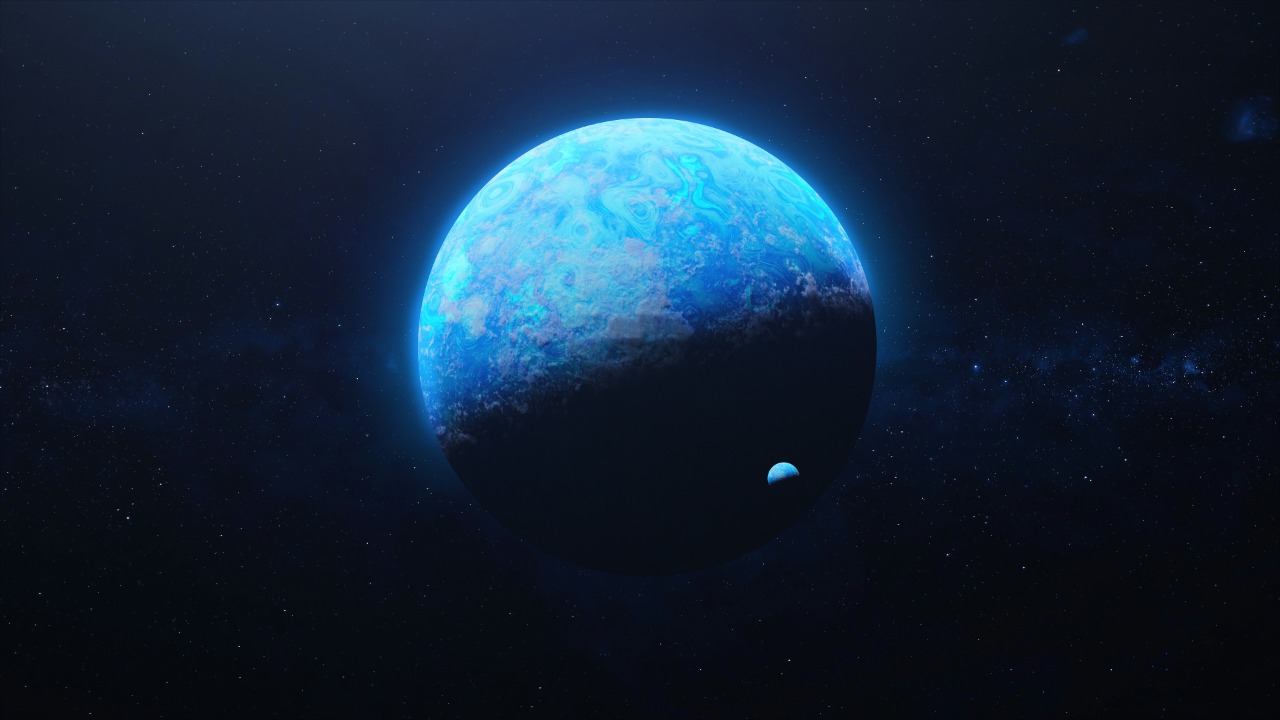

For the first time, astronomers have managed to weigh a planet that is not bound to any star, a lonely world drifting through the Milky Way with no sun of its own. The measurement turns a once-theoretical curiosity into a concrete object with a known mass and distance, giving researchers a new kind of planetary laboratory. It also marks a turning point in how I think about planets themselves, shifting the definition from “things that orbit stars” to worlds that can exist in deep interstellar night.
Rogue planets step out of the shadows
When most people picture a planet, they imagine a familiar scene: a world circling a bright star, like Earth around the Sun. Astronomers have now confirmed that some planets live far lonelier lives, traveling through space without any host star at all. These so-called rogue planets, also described as free-floating planets, are not just hypotheticals but a distinct population that drifts through the galaxy, detectable only through their subtle gravitational influence on background starlight.
Until recently, almost everything we knew about these objects came from indirect hints and statistical estimates, not from detailed measurements of any single world. The new result changes that balance by pinning down both the mass and distance of one specific rogue planet, turning an anonymous blip into a characterized object. In the technical language of the discovery, the team focused on an event associated with the designation 2024-BLG-0792, a signal that revealed a solitary planet-sized body rather than a star-bound world.
How to weigh a planet with no star
Weighing a planet that emits no light and orbits no star sounds impossible at first glance, but gravity provides a workaround. When a compact object passes in front of a more distant star, its gravity can bend and magnify the star’s light, a phenomenon known as gravitational microlensing. By carefully tracking how the brightness of that background star rises and falls, astronomers can infer the mass of the unseen lensing object and, with additional constraints, estimate its distance.
In the case of this newly measured free-floating planet, the breakthrough was achieved by combining precise microlensing data with detailed modeling of the event’s timescale and shape. The analysis showed that the lensing body had a planetary mass and no detectable host star, allowing the team to classify it as a rogue planet and to determine its basic properties. According to a newly released study, the event associated with 2024-BLG-0792 provided enough information to extract both the mass and distance of the lens, a milestone for characterizing free-floating worlds.
Meet the Saturn-sized wanderer
The specific planet at the heart of this result is roughly comparable in size to Saturn, a gas giant that in our own solar system orbits far from the Sun. Here, however, the Saturn-like world is not circling any star at all, instead moving through interstellar space with no permanent source of light or heat. That combination of a familiar scale and an utterly alien environment is part of what makes this object so compelling to me as a reporter: it is both recognizable and profoundly strange.
Earlier reporting described the object as a “rogue” planet the size of Saturn, emphasizing that it drifts through the galaxy rather than following a stable orbit around a star. When we imagine a planet, we think of one like ours, orbiting a star, but some have a far lonelier existence, drifting through the galaxy unbound by any sun and detectable only by scientists on Earth who catch their fleeting gravitational signatures. The Saturn-scale measurement, coupled with the absence of a host star in the microlensing data, cements this world’s status as a true free-floating planet rather than a dim star or brown dwarf.
Why 2024-BLG-0792 matters for planetary science
Pinning down the mass and distance of 2024-BLG-0792 does more than add a single data point to a catalog. It gives planetary scientists a concrete example of a free-floating world whose basic properties are known, something that has been missing from the field. With a measured mass in the planetary range and a well constrained distance, researchers can start to test models of how such objects form and how common they might be in the Milky Way.
According to the detailed analysis of the microlensing event associated with 2024-BLG-0792, the lensing object behaves like a solitary planet rather than a star or stellar remnant, and its distance can be inferred from the geometry of the lensing configuration. That combination of mass and distance constraints is what turns a transient brightening into a physical world with a place in three-dimensional space. For theorists who simulate the ejection of planets from young planetary systems, having a real, Saturn-sized rogue planet with measured parameters provides a valuable benchmark.
From rare curiosities to a hidden population
For years, rogue planets were treated as exotic oddities, the cosmic equivalent of shipwrecks drifting between star systems. As microlensing surveys have improved, the picture has shifted toward a hidden population that might be surprisingly large. If a single event like 2024-BLG-0792 can reveal a Saturn-sized planet, then similar events scattered across existing and future datasets may point to many more such worlds, each briefly betraying its presence as it crosses a background star.
The key insight from the new measurement is that free-floating planets can be detected and characterized systematically, not just stumbled upon. The same gravitational microlensing techniques that flagged this Saturn-sized rogue can, in principle, uncover a wide range of planetary masses, from Earth-scale objects up to gas giants, all unbound to any star. The fact that astronomers have now measured the mass and distance of at least one such object suggests that the Milky Way may be teeming with unseen planets, their existence inferred from the statistical patterns of microlensing events rather than from direct images.
What a starless planet tells us about planet formation
Understanding how a planet ends up without a star is one of the most intriguing scientific questions raised by this discovery. One possibility is that rogue planets form in protoplanetary disks like ordinary planets do, then are ejected through gravitational interactions with sibling planets or passing stars. Another is that some of them form directly from collapsing gas clouds, more like failed stars than displaced worlds. A Saturn-sized object like 2024-BLG-0792 sits at an interesting boundary between these scenarios, massive enough to resemble a small gas giant but still firmly in the planetary regime.
By measuring the mass and distance of this free-floating planet, astronomers can compare its properties with predictions from different formation models. If many rogue planets turn out to have masses similar to Saturn or Jupiter, that would support the idea that they are former members of planetary systems that were thrown out during periods of dynamical chaos. If, instead, a significant fraction cluster at higher masses, closer to brown dwarfs, that might point to a star-like origin. The new data on 2024-BLG-0792 do not settle the debate, but they provide a concrete anchor point for simulations that track how often planets are ejected and how their orbits evolve before they are lost to interstellar space.
Life in the dark: could rogue planets be habitable?
The idea of a planet with no star naturally raises questions about habitability. At first glance, a world drifting in interstellar space seems utterly hostile to life, with no sunlight and temperatures plunging toward the background of space. Yet planetary scientists have long speculated that some rogue planets could retain thick atmospheres or internal heat sources that keep parts of their surfaces or subsurfaces warm enough for liquid water. A Saturn-sized gas giant like 2024-BLG-0792 is unlikely to host life as we know it on any solid surface, but it could, in principle, harbor large moons with their own internal heating.
In our own solar system, moons such as Europa and Enceladus show that tidal forces and radioactive decay can sustain subsurface oceans even far from the Sun. If a similar moon orbited a rogue gas giant, it might maintain a warm interior for billions of years, insulated by ice and rock from the cold of interstellar space. The new ability to weigh a free-floating planet does not yet allow us to detect such moons, but it sharpens the conversation about where habitable environments might exist. Instead of limiting the search for life to planets in the habitable zones of stars, astronomers can now seriously consider starless systems where internal heat, not starlight, does the work.
The next wave of microlensing discoveries
The measurement of 2024-BLG-0792’s mass and distance is not an isolated triumph but a preview of what upcoming surveys could deliver. Ground-based networks that monitor dense star fields toward the center of the galaxy are already detecting thousands of microlensing events, only a fraction of which have been fully analyzed. As techniques improve and more telescopes coordinate their observations, the odds of catching additional rogue planets in the act of lensing will rise sharply.
Future space missions designed to study dark energy and exoplanets are expected to push microlensing sensitivity even further, capturing shorter and subtler events that could correspond to lower mass planets, including objects smaller than Saturn. The success of the current measurement, which relied on detailed modeling of a single event to extract the properties of a free-floating planet, shows that the method is ready for this next phase. I expect that in the coming decade, the catalog of rogue planets with measured masses and distances will grow from a single Saturn-sized wanderer to a statistically meaningful sample, reshaping our understanding of how common planets really are in the galaxy.
Redefining what it means to be a planet
At a conceptual level, weighing a planet with no star forces a reconsideration of what the word “planet” actually means. Traditional definitions have leaned heavily on the idea of orbiting a star, a criterion that made sense when all known planets, from Mercury to Neptune and the early exoplanets, fit that pattern. The existence of a Saturn-sized world like 2024-BLG-0792, drifting freely through the Milky Way yet clearly planetary in mass and composition, challenges that star-centric view.
In practice, astronomers already use a mass-based definition that distinguishes planets from brown dwarfs and stars, and the new measurement fits comfortably within that framework. What changes is the mental image: a planet is no longer necessarily a companion to a star but can be a solitary traveler whose only defining feature is its own gravity and internal structure. For me, that shift is as significant as the technical achievement of the microlensing analysis itself. It expands the category of “worlds” to include objects that spend their entire existence in darkness, known to us only because, for a brief moment, they bent the light of a distant star and revealed their presence.
More from MorningOverview