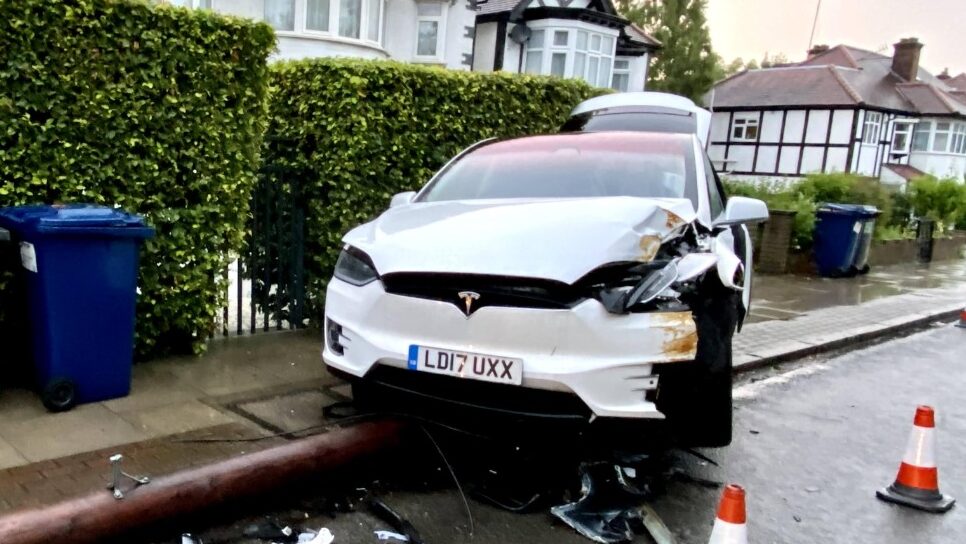

A Utah family is accusing Tesla’s Autosteer driver-assistance feature of steering their SUV into the path of an oncoming truck, killing four relatives and their dog on a holiday road trip. Their wrongful death lawsuit argues that the technology behaved unpredictably and that the company failed to protect ordinary drivers from a system that can suddenly veer off course.
The case arrives at a moment when Tesla’s automated driving tools are already under intense legal scrutiny, with juries in other states finding defects in Autopilot and awarding nine-figure verdicts. It raises a blunt question that regulators and courts are now being forced to answer: when a car on “autosteer” crosses the center line, how much responsibility lies with the human at the wheel and how much with the code that guided it there.
The fatal trip that turned into a test case
According to the complaint, the crash began as a routine family getaway from Perry, Utah, to the Tetons, a route that thousands of drivers follow every year without incident. After 46-year-old charter school director Jennifer Blaine finished work, she set out in the family’s Tesla Model X with two of her daughters, her son-in-law, and the family dog, planning to break up the drive with a stop in Idaho Falls before continuing north toward the mountains. What should have been a long but ordinary highway run instead ended in a violent collision with a truck that left four family members dead at the scene.
The lawsuit says the group was traveling in a Tesla Model X equipped with the company’s Autosteer function, which is marketed as a lane-keeping and steering assist tool designed for highway use. The plaintiffs allege that while the vehicle was using that feature on a divided road, it abruptly veered across the center line into the path of an oncoming truck, giving the human driver no realistic chance to correct course before impact. In their telling, the crash was not the result of reckless behavior or distraction, but of a system that misread its environment and then steered the car into danger.
Who the victims were and what the family says happened
The complaint centers on the life and death of 46-year-old Jennifer Blaine, described as a devoted mother and the director of a charter school in Perry, Utah, who was driving the Tesla Model X when it crossed into opposing traffic. Alongside her in the vehicle were two of her daughters, her son-in-law, and the family dog, all of whom were making the same trip they had taken before to enjoy time together in the Tetons. The plaintiffs say the group had stopped in Idaho Falls for a break, then resumed their journey on a highway where Autosteer was engaged and traffic was moving normally.
Relatives recount that the car was traveling within the posted speed limit when, without warning, it drifted or jerked into the oncoming lane and collided head-on with a truck, killing four occupants instantly and leaving the surviving family members to identify bodies and plan multiple funerals at once. In their lawsuit, they argue that no reasonable driver would expect a lane-keeping system to steer directly into opposing traffic, and that the human at the wheel had only a split second to react to a maneuver initiated by the software. The emotional core of their claim is that a feature sold as a safety enhancement instead became the direct cause of a catastrophe that wiped out a generation of their family.
Inside the lawsuit: Autosteer, warnings, and alleged defects
At the heart of the case is the allegation that Tesla’s Autosteer is defectively designed and inadequately safeguarded, particularly when used on roads that are not limited-access freeways. The family’s lawyers argue that the system should never have been available on the stretch of highway where the crash occurred, or at minimum should have been constrained so it could not steer across a solid center line into oncoming traffic. They say the software either misinterpreted lane markings or failed to recognize the boundary between directions of travel, then executed a steering command that a human driver would never intentionally choose in that moment.
The complaint also attacks the way Tesla communicates the limits of Autosteer, pointing to marketing language and in-car prompts that, in their view, encourage drivers to overestimate what the system can safely handle. While the company tells owners to keep their hands on the wheel and remain attentive, the plaintiffs say those warnings are undermined by the car’s ability to handle long stretches of driving on its own, which can lull users into trusting it as more capable than it is. They argue that a truly safe design would include stronger lockouts, clearer restrictions on where Autosteer can be activated, and more aggressive disengagement when road conditions fall outside the system’s tested envelope.
What Tesla says about Autosteer and driver responsibility
Tesla has long maintained that Autosteer and its broader Autopilot suite are driver-assistance tools, not replacements for human control, and that owners are explicitly told to remain ready to intervene at all times. In response to the Utah family’s claims, the company has not publicly conceded any defect, instead pointing to its general position that drivers are responsible for monitoring the road and that the system is designed to be overridden instantly by steering or braking input. The company’s manuals and on-screen messages emphasize that the technology is still in development and that it may do the wrong thing, including failing to detect obstacles or lane lines.
In statements cited in coverage of the lawsuit, Tesla stresses that its vehicles log detailed data about steering, braking, speed, and Autosteer engagement, which it uses to reconstruct what happened in serious crashes. The company typically argues that when collisions occur, they often involve misuse of the system, such as hands-free driving, inattention, or operation on roads that do not match recommended conditions. That framing sets up a direct clash with the Utah plaintiffs, who insist that even a fully attentive driver cannot be expected to anticipate or instantly counteract a sudden, software-driven swerve into oncoming traffic.
A pattern of litigation around Autopilot and Autosteer
The Utah case does not exist in isolation, and I see it as part of a growing wave of product liability suits that challenge how Tesla designs, markets, and updates its automated driving features. In Florida, a jury recently examined a crash involving a Model S using Tesla’s Autopilot and concluded that the system was defective, awarding a $329 million verdict that signaled a willingness to hold the company accountable for the behavior of its software. That decision, which came after detailed testimony about how the technology perceives and reacts to hazards, has been cited by plaintiff lawyers as a turning point in how juries view the balance of responsibility between human drivers and automated systems.
Another case that has shaped the legal landscape involved a hacker who dug into crash data from a Tesla and uncovered information that, according to attorneys, contradicted the company’s public narrative about the incident. That evidence became a key part of a trial that ended with a $243 million award to the family of a driver killed while using Autopilot, reinforcing the idea that internal telemetry and software logs can make or break these cases. Together, those verdicts and the Utah lawsuit suggest that courts are increasingly willing to scrutinize not just whether drivers made mistakes, but whether Tesla built enough safeguards into Autosteer and Autopilot to anticipate those mistakes and prevent them from turning deadly.
How the Utah family frames Autosteer’s role
The plaintiffs in the Utah crash are explicit in blaming Autosteer, not just human error, for the deaths of their loved ones, and they describe the feature as the active agent that steered the car into harm’s way. In their telling, the driver had engaged the system in good faith, believing it would help keep the Tesla Model X centered in its lane on a long highway drive, only to have it veer into the path of a truck with no obvious external trigger. They argue that this is not a case of a driver falling asleep or looking at a phone, but of a machine making a catastrophic decision that a reasonably careful human would not have made.
Family members have spoken publicly about the shock of learning that a tool marketed as “Autosteer” could, in their view, behave so unpredictably, and they say they would never have trusted it if they had understood its limitations. They describe the loss of a mother, daughters, and a son-in-law as a preventable tragedy that stems from corporate choices about how aggressively to roll out semi-automated driving features. By putting Autosteer at the center of their narrative, they are inviting a jury to decide whether the system’s design and warnings were adequate for ordinary drivers who may not have the technical background to parse the fine print.
What the complaint demands from Tesla
Beyond damages for wrongful death and emotional suffering, the Utah family is asking a court to force changes in how Tesla designs and deploys its driver-assistance technology. Their lawsuit calls for a finding that Autosteer is defective and unreasonably dangerous in its current form, particularly when it can be activated on undivided highways where a single mistake can lead to a head-on collision. They want the company to implement stricter geofencing, more conservative lane-keeping logic, and clearer, more prominent warnings that spell out the risk of sudden steering maneuvers and system failures.
The complaint also seeks to hold Tesla accountable for what the plaintiffs describe as a pattern of downplaying or concealing the risks associated with Autosteer and related features. They point to prior crashes and internal data as evidence that the company knew or should have known about scenarios in which the system could misread lane markings or drift into oncoming traffic, yet continued to market it as a safety enhancement. In their view, only a substantial verdict and court-ordered reforms will push the automaker to prioritize fail-safe behavior and transparency over rapid feature expansion.
How this case fits into a broader safety debate
From my perspective, the Utah lawsuit crystallizes a broader debate about how much autonomy to give consumer vehicles before the technology is truly ready for every road and every driver. Tesla’s approach has been to ship advanced features like Autosteer widely, then refine them through over-the-air updates based on real-world data, a strategy that can accelerate innovation but also exposes early users to edge cases that engineers did not fully anticipate. Critics argue that this effectively turns public highways into test tracks, with families like the Blaines bearing the risk when the software gets it wrong.
Supporters of Tesla’s strategy counter that automated systems already prevent countless crashes by reducing lane departures, rear-end collisions, and other common errors, and that focusing only on high-profile tragedies ignores the aggregate safety benefits. They note that human drivers cause the vast majority of accidents and that tools like Autosteer, when used properly, can help mitigate fatigue and distraction. The Utah case will not resolve that debate on its own, but it will force a jury to weigh the promise of semi-autonomous driving against the reality that a single miscalculation by a machine can have irreversible consequences.
Why the outcome could reshape automated driving
However the Utah lawsuit is resolved, I expect it to influence how automakers, regulators, and consumers think about the next generation of driver-assistance systems. A verdict that finds Autosteer defective and awards substantial damages could push Tesla and its competitors to slow the rollout of new features, tighten usage restrictions, and invest more heavily in redundant safeguards that prevent sudden lane incursions. It could also embolden other families to bring similar claims, especially in cases where crash data suggests that the vehicle initiated a dangerous maneuver while a driver was relying on automation.
On the other hand, if a jury accepts Tesla’s argument that the driver remained fully responsible and that Autosteer performed within its stated limitations, the decision could reinforce the current regulatory model that treats these systems as optional aids rather than shared-control partners. That outcome would still leave open questions about how clearly companies must communicate risks and how much training owners should receive before activating advanced features. Either way, the story of a Utah family whose road trip ended in a head-on collision with a truck will continue to shape the public conversation about what it really means to let a car steer itself, even part of the time.
Other high-stakes cases shaping Tesla’s legal risk
Legal experts watching the Utah case often point to a landmark trial in Miami, where a jury examined a deadly crash involving a Tesla using Autopilot and concluded that the system was defective, awarding a $329 million verdict against the company. In that proceeding, attorneys argued that Oct and You, as shorthand for ordinary drivers, cannot be expected to manage every nuance of a complex automated system while also handling the usual demands of the road. The jury’s decision signaled that at least some fact-finders are willing to treat Autopilot and Autosteer as products that must stand on their own safety merits, not just as optional add-ons that drivers use at their own risk.
Another influential case involved a deep dive into internal telemetry, where a hacker’s analysis of crash logs was framed in court as “Hacker Uncovers Tesla Autopilot Crash Data, Leading” to a major Verdict after “When” the data showed discrepancies with Tesla’s public account of the incident. In that matter, the revelation of hidden details about how the Model S using Tesla’s Autopilot behaved in the moments before impact helped persuade jurors to award $243 million to the victim’s family. Together with the Utah lawsuit, these outcomes suggest that future litigation will hinge not only on eyewitness accounts, but on the digital fingerprints left by Autosteer and related systems every time a driver taps the stalk and lets the car take the wheel.
How the family’s story has resonated publicly
Public reaction to the Utah crash has been shaped in part by the way relatives have spoken about their loss, describing a tight-knit Family that trusted Tesla and its Autosteer feature to make long drives safer, not more dangerous. They have shared memories of Jennifer Blaine as a dedicated educator and mother, and of the excitement the group felt as they set out from Perry, Utah, toward the Tetons, unaware that their journey would end in tragedy. Those personal details have turned an abstract debate about software and sensors into a human story that resonates far beyond the courtroom.
Coverage of the lawsuit has also highlighted the broader community impact, from students at Jennifer’s charter school grappling with the sudden loss of their director to friends and neighbors organizing vigils and fundraisers. In interviews, family members have said they hope their case will prompt changes that prevent other drivers from experiencing the same kind of sudden, inexplicable swerve into oncoming traffic that they believe Autosteer caused. Whether or not a jury ultimately agrees with their claims, their willingness to challenge a powerful automaker has added a new and emotionally charged chapter to the ongoing reckoning over automated driving technology.
What regulators and drivers may take away
As regulators watch the Utah case unfold, I expect them to revisit questions about how clearly companies must define the operational limits of systems like Autosteer and how aggressively they should enforce those limits through software. Agencies that oversee vehicle safety could push for standardized terminology, stricter testing on undivided highways, and mandatory reporting of crashes where driver-assistance features were engaged. They may also look more closely at whether current warning chimes and dashboard messages are enough to keep drivers engaged when the car appears to be handling most of the work.
For everyday drivers, the story serves as a stark reminder that even advanced systems with names like Autosteer and Autopilot are not infallible and that trusting them too much can have devastating consequences. Owners of a Tesla Model or any other vehicle with lane-keeping and adaptive cruise control may come away more cautious about when and where they activate those features, and more skeptical of marketing that implies near-autonomous capability. The Utah family’s allegations, combined with high-profile verdicts in other states, are likely to shape how people think about the trade-offs of semi-automated driving for years to come, even as the technology continues to evolve.
How multiple reports frame the same tragedy
Different accounts of the Utah crash converge on the same core narrative: a family road trip, a Tesla equipped with Autosteer, and a sudden, fatal incursion into oncoming traffic that left four relatives dead. One detailed report describes how the group left Perry, Utah, after Jennifer Blaine finished her workday, stopped in Idaho Falls, then continued toward the Tetons before the collision occurred on a highway where the Tesla crossed the center line into a truck’s path. Another emphasizes the emotional aftermath, quoting family members who say they learned of the crash only after authorities called to report that four had died at the scene and that their dog was also killed.
Additional coverage focuses on the legal framing, noting that the Family explicitly blames Tesla and its Autosteer feature for the crash and that the complaint argues a jury should determine whether the system is defective. One account highlights that a Tesla spokesperson did not provide detailed comment on the pending litigation but reiterated the company’s general stance on driver responsibility and the conditions under which Autosteer is intended to be used. Taken together, these reports paint a consistent picture of a lawsuit that is as much about the design and marketing of automated driving technology as it is about a single, devastating collision on a Western highway.
Why the stakes extend beyond one company
Although Tesla is the focus of the Utah lawsuit, the issues it raises reach across the entire auto industry, which is racing to add more automation to mainstream vehicles. If a jury concludes that Autosteer is unreasonably dangerous or that its warnings are inadequate, other manufacturers offering similar lane-keeping and adaptive cruise systems may face pressure to revisit their own designs and disclosures. Insurers, too, are watching closely, since clear findings about software fault could reshape how liability is allocated between drivers, automakers, and even software suppliers when crashes occur.
From my vantage point, the case underscores a simple but uncomfortable reality: as cars take on more of the driving task, the line between human and machine responsibility becomes harder to draw, yet the consequences of getting that balance wrong remain measured in lives lost. The Utah family’s decision to challenge Tesla over what they say Autosteer did on that highway forces everyone involved in automated driving, from engineers to regulators to drivers themselves, to confront how much trust they are willing to place in code that can, in a fraction of a second, steer a vehicle into or away from disaster.
More from MorningOverview