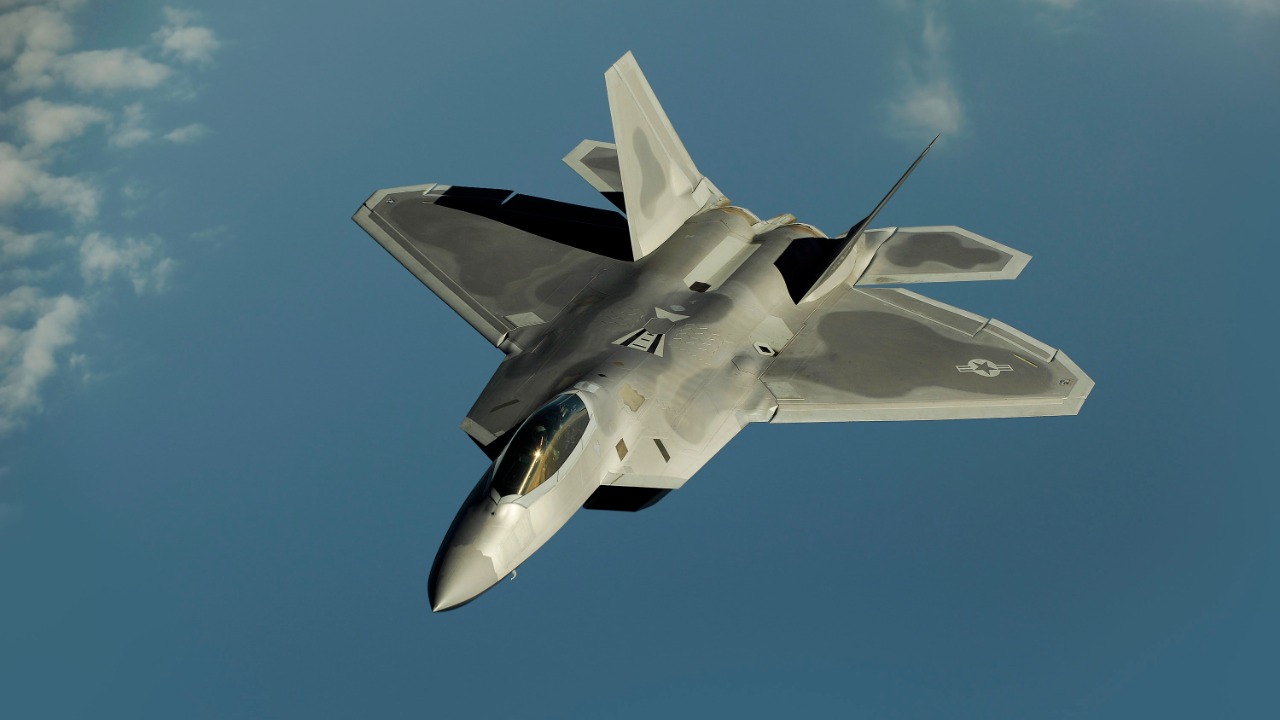

The United States is about to send its most secretive fighter into an entirely new kind of battle, one where a single pilot commands a pack of AI driven drones as easily as wingmen in a formation. The F-22 Raptor, long treated as a boutique air superiority asset, is being refitted to lead America’s first combat ready swarms of autonomous aircraft, turning a small fleet into a multiplying force. That shift is not a distant concept but a near term operational plan that will reshape how the Air Force fights in contested skies.
At the center of this transformation is a simple but radical idea: instead of sending one exquisite jet against a wall of enemy defenses, send a manned stealth fighter flanked by cheaper, attritable drones that can scout, jam, and strike on their own. The Raptor’s new mission is to become the quarterback for those collaborative combat aircraft, fusing data, delegating tasks, and keeping a human in the loop even as algorithms make split second decisions at machine speed.
Why the F-22 is being pushed to the front of the AI revolution
The decision to put the F-22 at the heart of America’s first AI enabled drone swarms is as much about timing as technology. The United States Air Force has already invested heavily in the Raptor’s stealth, sensors, and data links, and those strengths make it a natural command node for unmanned teammates that need secure guidance in the most dangerous airspace. In public briefings, the United States Air Force has framed the move as a “game changing” mission shift for what it still calls its most advanced fighter, a signal that the service is no longer content to use the jet only as a high end air to air specialist, but as the lead element in a networked kill web that can stretch far beyond the pilot’s own radar horizon, a role highlighted in recent USAF Reveals F-22 discussions.
There is also a hard numbers logic behind elevating the Raptor into this role. The Air Force has only 185 F-22s, and Of the combat coded jets, a smaller subset is fully ready for front line missions at any given time, which makes every airframe too valuable to risk casually in dense enemy air defenses. By pairing those scarce Raptors with loyal wingman drones that can absorb the riskiest tasks, planners hope to stretch the impact of each sortie and complicate any adversary’s targeting calculus, a concept that has been underscored in reporting on how Raptors and Of the Air Force are being upgraded for this mission.
From stealth ace to drone commander: how the Raptor will control its wingmen
Turning a single seat fighter into the nerve center for a swarm of autonomous aircraft requires more than a software patch, it demands a rethink of the cockpit itself. Engineers are building new interfaces that let a pilot task and monitor multiple drones without drowning in data, using intuitive displays and automation to keep the human focused on strategy rather than joystick level micromanagement. Early demonstrations have already shown an F-22 pilot using in cockpit controls to direct an unmanned aircraft in flight, with Lockheed Martin Skunk Works and the Air Force proving that a fighter crew can command a drone from the cockpit while still flying their own jet, a milestone captured in tests where Lockheed Martin Skunk Works and the Air Force linked manned and unmanned platforms in real time.
Conceptually, the Air Force wants the Raptor pilot to act less like a traditional stick and rudder operator and more like a mission commander orchestrating a distributed formation. Instead of manually flying each unmanned aircraft, the pilot will assign roles, such as escort, decoy, sensor node, or strike asset, and then let onboard AI handle the details of formation keeping and threat avoidance. Analysts who have reviewed the emerging tactics describe a future where the F-22’s displays show icons for each drone, with the pilot able to drag and drop tasks or approve suggested maneuvers, a vision that aligns with descriptions of handing a pilot a tablet like interface to manage Raptor Stealth Fighters Will Soon Have Loyal Wingman Drones as part of the Key Points and Summary on Drones.
The Collaborative Combat Aircraft program behind the swarms
Behind the Raptor’s new mission is a broader effort to field a family of unmanned systems known as Collaborative Combat Aircraft, or CCA, which the Air Force sees as its path to “affordable mass” in a future fight. Instead of buying more exquisite fighters that each cost upwards of tens of millions of dollars, planners want a mix of lower cost drones that can be built in larger numbers and tailored to specific roles, from electronic attack to missile truck. Program officials have described The CCA effort as a way to put more sensors and weapons into the battlespace without the price tag of another full fleet of manned jets, a rationale that has been emphasized in briefings on how The CCA program is intended to complement, not replace, existing fighters.
The USAF is moving quickly toward a production choice for these drones, with Air Force Eyes Fiscal 2026 Production Decision planning already underway to select which designs will move from prototypes into serial builds. Senior leaders have signaled that the first tranche of CCA will be paired primarily with the F-22 and the future sixth generation fighter, but they also see potential for bombers and other platforms to act as controllers for the autonomous systems. In public remarks, Air Force Secretary Frank Kendall has tied the Production Decision to a broader strategy of integrating CCA with the Next Generation Air Dominance (NGAD) fighter and other strategic platforms, a linkage that has been detailed in analyses of how Air Force Eyes Fiscal choices will shape The USAF’s unmanned fleet.
Why the F-22 is first in line, and what comes after it
For now, the Air Force has been explicit that the F-22 will be the first American fighter to fly operationally with AI enabled drone wingmen, a choice that reflects both its stealth pedigree and its role as a testbed for tactics that will later migrate to newer jets. Analysts note that the Raptor’s combination of low observability and powerful sensors makes it ideal for slipping close to enemy defenses while its unmanned teammates fan out ahead, soaking up radar emissions and feeding targeting data back to the pilot. Reporting on the program has stressed that the Raptor will be the first American jet to be equipped with the necessary hardware to fly alongside these collaborative aircraft, a point underscored in coverage of how the Raptor will be the first American platform to operationalize this pairing.
That early lead does not mean the F-22 will be the only manned aircraft to work with CCA for long. Aviation Week has reported that while the Air Force is only set, for now, to pair Collaborative Combat Aircraft with the F-22 and the upcoming sixth generation fighter, service planners are already considering expanding CCA pairing capabilities beyond those initial jets to include other fighters and even the upcoming Boeing F-47. The Air Force has acknowledged that the initial focus on the Raptor is partly about speed, using a known quantity to validate concepts before spreading them across the fleet, a trajectory that has been described in detail in assessments of how Aviation Week sees the Air Force broadening Collaborative Combat Aircraft and CCA integration.
The new drones: Talon, YFQ and the shape of the swarm
While the F-22 grabs the headlines, the real work of building a swarm capable force lies in the unmanned aircraft now emerging from industry. One of the most closely watched designs is Northrop Grumman’s prototype Talon drone, which has been given its own Air Force designation and is being evaluated as a potential CCA candidate. By Stephen Losey has reported that the Talon is being designed to carry sensors and weapons into contested airspace, taking on dangerous reconnaissance and strike missions that would otherwise fall to piloted fighters, and that the Air Force sees it as a way to push attacks away from manned cockpits, a concept that is central to how Northrop Grumman Talon could fit into the CCA portfolio.
Alongside Talon, the Air Force has also revealed the YFQ-48, a next generation unmanned combat aircraft that is explicitly tied to the collaborative combat program. Officials have described the YFQ as a platform built to operate alongside manned fighters in future conflicts, with the “48” designation signaling its place in a new line of experimental systems. Reporting on the rollout notes that the Air Force intends for the YFQ to serve as both a technology demonstrator and a potential operational asset, helping refine how swarms of unmanned aircraft can maneuver, share data, and coordinate fires with a human lead. The unveiling of the YFQ and its 48 series designation underscores how deeply the Air Force is investing in unmanned teammates for its fighters.
Training, tactics and the human in the loop
Equipping the F-22 to lead AI enabled swarms is only half the challenge, the other half is teaching pilots to fight in a formation where not every wingman is human. In practical terms, that means rewriting tactics manuals, redesigning simulators, and building new training syllabi that treat drone control as a core skill rather than a niche experiment. The Air Force has already begun preparing its F-22 Raptor stealth jets to lead drone operations, emphasizing manned unmanned teaming as a central concept and acknowledging that While the sixth generation fighter is still years away, the current fleet must learn to work with Collaborative Combat Aircraft now, a shift that has been highlighted in updates on how the While the Air Force is reshaping its fifth generation fighter tactics.
At the same time, senior leaders are keen to stress that AI will not be left to wage war on its own. In public discussions of AI driven drones, officials and analysts have repeatedly emphasized the idea of a human and machine integrated formation, where US fighter planes operate with autonomous wingmen but a human remains in the chain for lethal decisions. That framing is meant to reassure both pilots and policymakers that the new swarms will enhance, not replace, human judgment, and that ethical and legal oversight will be baked into the algorithms from the start. The notion of keeping a human in the chain has been a recurring theme in conversations about how AI driven drones are redefining the future of global warfare.
From experiments to units: building dedicated drone swarm forces
The shift to F-22 led swarms is not happening in isolation, it is part of a broader reorganization of the force structure to make room for dedicated drone units. The USAF plans specialized units for cheap attack drone swarms that are intended to fight a formidable adversary like China, with the goal of having them operational by the early 2030s after years of development and testing. Those units are expected to field large numbers of low cost unmanned aircraft that can saturate defenses, overwhelm sensors, and create openings for manned fighters to exploit, a concept that has been detailed in planning documents on how USAF plans specialized units to counter China.
Those dedicated swarm units will not replace the need for F-22 led formations, but they will change how the Air Force thinks about mass and attrition in a high end conflict. Instead of counting only on a limited number of stealth fighters to punch through enemy defenses, commanders will be able to send waves of unmanned aircraft ahead of or alongside the Raptors, using them as decoys, jammers, or strike platforms depending on the mission. In that environment, the F-22’s role as a swarm leader becomes even more critical, acting as the high end brain that coordinates cheaper assets and ensures that the chaos of a drone heavy battlespace still serves a coherent strategy.
The global race for drone wingmen and what it means for airpower
America’s push to put the F-22 at the center of AI enabled swarms is unfolding against a backdrop of rapid global competition in loyal wingman programs. Other air forces are experimenting with their own versions of collaborative drones, seeking similar advantages in mass, survivability, and flexibility, and the race to field operational systems by the late 2020s is intensifying. Analysts who track these developments note that the USAF’s decision to move toward a Fiscal 2026 production choice for CCA is partly driven by the need to stay ahead of rivals that are already testing their own autonomous wingmen, a dynamic that has been explored in depth in surveys of global drone wingman programs and how The USAF is positioning itself.
Within that race, the symbolism of choosing the F-22 as the first operational host for AI wingmen matters. The Raptor has long been a benchmark for air superiority, and turning it into a swarm leader signals that the definition of air dominance is shifting from platform centric metrics to network centric ones. Instead of asking which fighter is the most maneuverable or stealthy on its own, the more relevant question becomes which air force can best integrate manned and unmanned systems into a cohesive whole. The Air Force’s decision to make America’s Raptors the first operational fighters to fly with AI enabled drone wingmen as a standard tactic, a point underscored in video briefings on how Raptors will lead these formations, is a clear statement of where it believes the future of airpower lies.
Risks, limits and the road to combat deployment
None of this is guaranteed to work as advertised the first time it meets a determined adversary, and the Air Force is candid about the technical and operational risks that remain. Swarms of autonomous aircraft will depend on resilient communications, robust cyber defenses, and AI algorithms that can handle the fog of war without behaving unpredictably, all of which are still being tested and refined. The service has already acknowledged that first flights for CCA are imminent but that it will take years of experimentation to validate tactics, techniques, and procedures before declaring the system fully combat ready, a cautious approach reflected in updates on how The CCA effort is pacing itself toward operational use.
There are also strategic and political limits on how far and how fast the United States can push AI into lethal roles. Allies and adversaries alike are watching closely to see whether Washington will draw clear red lines around fully autonomous weapons, and domestic debates over accountability and oversight are likely to intensify as the first F-22 led swarms move from test ranges to real world deployments. For now, Air Force leaders are betting that keeping a human in the loop, investing in rigorous testing, and fielding CCA first as wingmen rather than independent strike platforms will help manage those concerns. If they are right, the Raptor’s next chapter as a swarm commander could mark the beginning of a new era in air combat, one where the most important weapon is not a single jet or drone, but the network that binds them together.
More from Morning Overview