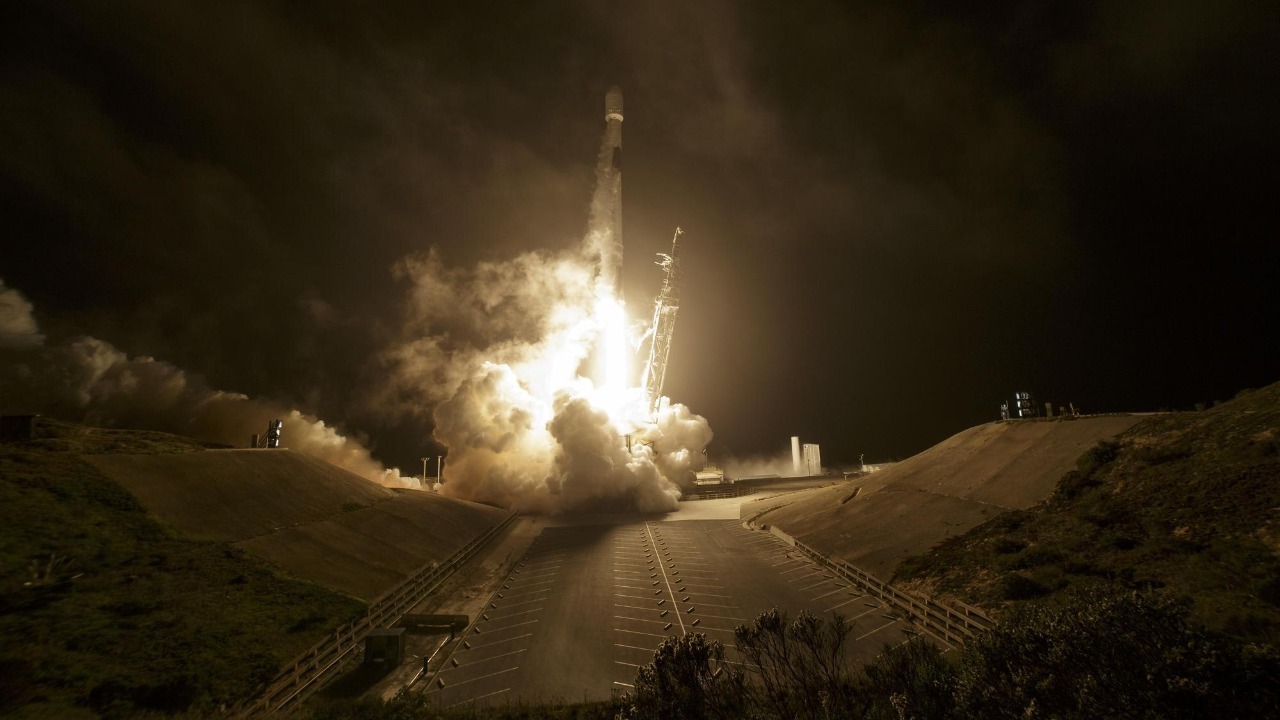

Elon Musk spent the past decade wiring the planet with commercial broadband satellites. Now his rockets are quietly lofting a parallel network built for war planners, spies, and secure government users. The same playbook that turned Starlink into a dominant civilian service is being repurposed into a classified, military-grade internet in orbit, with the United States leaning heavily on a single billionaire’s hardware for some of its most sensitive space infrastructure.
What began as an offshoot of a commercial constellation has evolved into Starshield, a dedicated line of national security satellites that blur the line between private enterprise and state power. As more of these spacecraft ride into low orbit on Falcon 9 rockets, the United States is effectively outsourcing a core piece of its future command-and-control backbone to SpaceX, and by extension to Musk himself.
From Starlink to Starshield: a civilian network weaponized
The foundation of this secretive military internet is Starlink, the sprawling constellation that already beams Internet access to most of the Earth. By flooding low orbit with thousands of small satellites, Starlink turned what used to be a niche government capability into a mass-market service, and it is that same architecture that now underpins a more classified layer of connectivity. Public launch logs show how aggressively SpaceX has scaled both Starlink and Starshield launches, revealing a dual-use system where civilian and military payloads share rockets, factories, and design DNA.
SpaceX formalized this pivot when it unveiled Starshield as a separate business line built on top of Starlink’s technology. Company materials describe Starshield as a secure satellite network tailored for government customers, with an emphasis on national security missions that go far beyond commercial broadband. In effect, Elon Musk’s Starlink constellation became the testbed, and Starshield is the hardened version, designed to host military payloads, encrypted communications, and specialized sensors that a purely civilian network would never carry.
Starshield’s classified role and the mystery signal in orbit
For all the marketing language about modular buses and secure links, the real nature of Starshield is largely hidden behind classification. What has surfaced comes from the small community of amateur satellite trackers who watch the sky for unusual behavior. One of them, Tilley, noticed an unexpected pattern in radio data and matched it to spacecraft that did not fit the usual Starlink profile, a clue that a separate, more secretive network was taking shape in the same orbital neighborhoods. His work highlighted how even a classified constellation can leave a detectable footprint once it starts talking to the ground.
Subsequent analysis tied that activity to Starshield, described in government-focused reporting as a classified version of SpaceX’s Starlink satellites that provide internet service around the world. The signal Tilley picked up was linked to the handful of Starshield satellites so far, and its purpose remains opaque to outside observers. What is clear is that the same low Earth orbit shell that carries consumer traffic is now also home to a classified signal whose function, routing, and users are known only to SpaceX and its government partners.
SpaceX’s new military business line and the Pentagon’s bet
SpaceX did not stumble into national security work by accident. The company rolled out a dedicated military satellite services line that explicitly leverages the Starlink internet architecture for defense and intelligence customers. Under the Starshield banner, SpaceX pitches secure communications, hosted payloads, and custom-built spacecraft as a turnkey package, positioning itself as a one-stop shop for orbital infrastructure that used to require multiple contractors. The company’s own description of Starshield emphasizes secure communications, Earth observation, and hosted payloads, all wrapped in end-to-end encryption and government-focused integration.
Reporting on the rollout made clear that this was not just a branding exercise. SpaceX framed Starshield as a new business line focused on military satellite services, explicitly stating that it would build on the existing Starlink network rather than starting from scratch. That approach lets the company reuse manufacturing lines, ground stations, and software while tailoring specific spacecraft for defense missions. In other words, the Pentagon is not just buying launches, it is buying into a vertically integrated ecosystem that SpaceX controls from rocket to router, as described in coverage of the new military satellite services line.
Launch contracts, Space Force, and the rise of a single gatekeeper
The United States is reinforcing that bet with hard cash and launch manifests. Under the National Security Space Launch program, the U.S. Space Force has awarded a slate of missions to SpaceX and United Launch Alliance, signaling that these two providers will handle the heaviest and most sensitive national security payloads in the near term. Official announcements describe how the Space Force selected SpaceX and United Launch Alliance for the first seven launches in a new phase of the program, a decision that effectively locks in SpaceX as a primary gatekeeper to orbit for classified systems.
Additional reporting on future launch assignments underscores just how central Musk’s company has become. Under the same national security framework, SpaceX is slated to fly five missions for the U.S. Space Force and the National Reconnaissance Office in fiscal 2026, while ULA, a partnership between Boeing and Lockheed Martin, will handle only two. Blue Origin did not receive any missions in that tranche, though it may enter the rotation later. The breakdown, which includes missions like NROL-86 for the NRO, shows how The Spac allocations favor SpaceX as the default ride to orbit for some of the country’s most secret satellites.
Falcon 9, crowded launch pads, and a militarized calendar
The operational tempo behind this shift is visible on the launch pads themselves. Early in 2026, The Falcon 9 rocket was scheduled to loft an Earth observing satellite for the Italian Space Agency from Vandenberg Space Force Base, a reminder that the same booster family that carries allied science missions also ferries classified hardware. Company updates about that mission from Vandenberg Space Force highlighted the routine nature of these flights, even as the payload mix grows more sensitive.
SpaceX’s broader launch calendar reinforces how tightly interwoven its commercial and military work has become. In January, the company lined up more Starlink missions using Falcon 9 rockets from Space Launch Complex pads that also support national security flights. Coverage of that schedule described how More Starlink launches are stacked alongside other government work, turning each month’s manifest into a blend of consumer broadband, allied science, and classified payloads that may include Starshield hardware.
Elon Musk’s leverage and the strategic risk of dependence
All of this adds up to a profound shift in who controls the infrastructure of American power in space. Elon Musk’s SpaceX is expanding its Starlink satellite technology into military applications with a new business line that is explicitly designed to operate the network in space for government users. Reporting on that expansion notes that Elon Musk’s SpaceX is not just selling capacity, it is operating a bespoke military variation of Starlink on behalf of the United States. That gives a single private actor extraordinary leverage over a system that could be central to battlefield communications, intelligence sharing, and strategic deterrence.
As I look across the launch manifests, the classified signals, and the formal creation of Starshield, I see a future in which America’s most sensitive orbital infrastructure is deeply entangled with one company’s commercial empire. Starshield, described as a classified version of SpaceX’s Starlink satellites, is already emitting a signal whose purpose remains in question, even as it promises secure connectivity for national security users. The fact that Starshield is a classified version of a civilian network captures the core tension: the same architecture that lets a remote village stream Netflix can, with a different payload and a different encryption key, become the backbone of a secret military internet in orbit.
More from Morning Overview