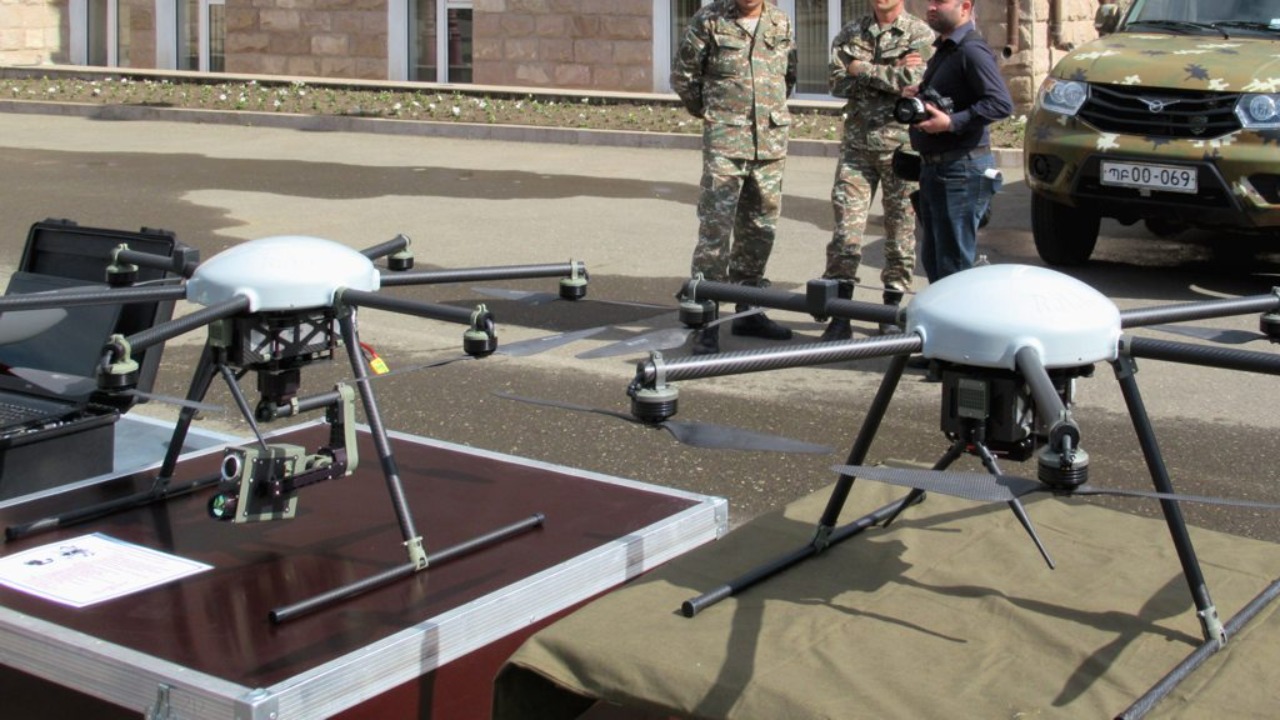

Armored vehicles are no longer just blunt instruments of firepower. On battlefields saturated with cheap, lethal drones, they are being rewired into rolling sensor hubs that launch, control, and survive swarms of robotic scouts. Instead of charging blindly into ambushes, crews now fight by proxy, pushing small unmanned systems ahead of the hull to see and strike first.
I see this shift most vividly in Ukraine, where tanks and infantry fighting vehicles are learning to coexist with quadcopters, ground robots, and loitering munitions that can hunt targets far beyond the crew’s line of sight. The result is a new kind of “smart scout” role for armor, one that blends traditional protection with remote eyes and precision weapons.
Frontline armor in a drone-saturated war
On a battlefield where Russian units flood the sky with small explosive quadcopters, Ukrainian crews have learned that any exposed vehicle is a target the moment it moves. Reports from the front describe positions where no one dares risk exposure around Kharkiv, Ukraine’s second-largest city, just 20 miles from the Russian border, because hovering munitions can appear without warning and drop grenades into open hatches or engine decks. In that environment, an armored vehicle that does not bring its own unmanned escorts is effectively blind, and every movement becomes a gamble against Russian operators watching from above.
To stay alive, Ukrainian soldiers are increasingly turning to nimble, remote-controlled platforms that can scout routes, probe suspected ambushes, and even act as decoys while the main vehicle remains under cover. Accounts from the front describe Ukrainian troops facing deadly Russian drones and responding by pushing small robotic systems ahead of their own lines, treating them as expendable scouts that can draw fire or trigger hidden threats before a crewed tank rolls forward. In this cat-and-mouse contest between Russian and Ukrainian units, armor is evolving from a lone spearhead into the protected command post for a web of unmanned systems.
From flying spotters to armed extensions of the hull
The most visible change is the way crews now treat drones as standard kit, not exotic add-ons. One Ukrainian soldier, Akim, uses an aerial drone to scout city streets and approach routes so he does not have to risk his life walking into a kill zone, a practice that turns every building corner into a camera feed instead of a blind guess. The same pattern is emerging across units that rely on small quadcopters to peek over ridgelines, check intersections, and confirm whether a suspected Russian position is real before an armored column commits. Every time a drone or a robot does something in place of a human, it shifts the risk calculus in favor of the crew inside the vehicle.
What began as simple reconnaissance has quickly blurred into direct attack. Footage and analysis of how Ukraine and Russia use small unmanned aircraft show that these platforms have evolved from basic scouts into armed systems that can drop munitions or guide artillery onto targets that the operator can no longer see with the naked eye. In many cases, a tank or infantry fighting vehicle now acts as the protected control node for these flying spotters, with the crew using the drone’s video feed to cue their own guns or to call in supporting fire. The armored hull becomes the brain and the power source, while the drone becomes a disposable arm that can reach into alleys, trenches, and tree lines that would once have required a risky dismounted patrol.
Ground robots and remote-controlled armor as “smart scouts”
The transformation is not limited to the air. Ukrainian forces have begun using remote-controlled ground vehicles to take on some of the most dangerous tasks that used to fall to armored crews and engineers. These tracked or wheeled robots can clear routes, deliver supplies, or even carry explosives toward Russian positions while their operators remain under cover. One report describes how remote-controlled vehicles are used for dangerous missions that would otherwise expose soldiers to direct fire, with the machines treated as consumable assets that can be replaced far more cheaply than a trained crew member or a full-size tank.
On a battlefield swarming with deadly Russian drones, these remote-controlled ground platforms are also being used as decoys and bait. Ukrainian soldiers have noted that remote controlled vehicles do not get tired and are much cheaper to produce than a full armored vehicle, which makes them ideal for drawing out enemy fire or triggering hidden threats before a manned tank advances. In effect, the armored vehicle becomes the command node that sends out a small fleet of robotic scouts, each one probing, distracting, or attacking while the main gun and armor stay masked behind terrain.
How professional armies are wiring armor into drone networks
The same logic is reshaping doctrine in professional militaries far from Ukraine. For the military, drones, more commonly referred to as unmanned aerial vehicles or UAVs, are now expected to soar strategically above the battlefield to provide surveillance, reconnaissance, and targeting data that keep crews safer in increasingly contested spaces. Armored formations are being trained to operate as part of this wider sensor network, with vehicles equipped to launch and control their own small drones while also ingesting feeds from higher flying systems. The tank or cavalry vehicle is no longer just a shooter, it is a node in a layered web of sensors and weapons.
Experiments with autonomy are pushing this even further. In one exercise, a second wave of drones sped toward a company’s positions trying to spot a tank to swarm before they were targeted, forcing the defenders to use their own autonomous systems to detect and cue fires before the drones could close. That kind of scenario assumes armored vehicles will routinely fight in an environment where both sides deploy swarms of intelligent munitions, each trying to find and overwhelm the other’s hulls. To survive, crews will need vehicles that can manage multiple unmanned systems at once, fusing their feeds into a single picture and delegating some of the defensive reactions to onboard algorithms.
Tactics, survivability, and the limits of the drone revolution
On the ground, this shift is changing how reconnaissance units operate at the smallest scale. Cavalry scouts, or Cav scouts, are already experimenting with tactics where they set drones in low power mode in key terrain, then activate the drone only when a target approaches. It saves power and is convenient because the drone is close to the target instead of being launched from far away, turning likely avenues of approach into prewired “drone named areas of interest” that can be triggered at the moment of contact. In that setup, an armored scout vehicle can remain hidden while its prepositioned drones spring to life and feed back targeting data in real time.
Ukraine’s infantry has adapted in similar ways, operating from a simple farmhouse north of Kharkiv that serves as a base for drone teams who support armored and mechanized units. From that shelter, where no one dares risk exposure because of Russian surveillance, operators fly small quadcopters that spot Russian positions and guide artillery or direct fire from supporting vehicles. In some sectors, this approach has contributed to a deadly battle between Russia’s elite units and Ukrainian drone pilots, with Ukraine’s successful deployment of drones targeting Russian tanks well behind the contact line and forcing those armored formations to pull back. The tank is still present, but it is increasingly the beneficiary or the victim of what the drone operators see first.
Why tanks still matter in a drone-first fight
Despite the hype around unmanned systems, experts warn that drones cannot simply replace heavy armor. Analyses aimed at NATO planners argue that drones cannot replace tanks because they lack the combination of protection, sustained firepower, and shock effect that a heavy tracked vehicle brings to a contested urban block or a fortified line. Drones can find and harass, but they struggle to hold ground, break through obstacles, or survive in the face of layered air defenses and electronic warfare once the enemy adapts. In that sense, the smarter the drone network becomes, the more valuable a well-protected vehicle is as the anchor for that network.
Frontline discussions among armor enthusiasts and veterans echo this tension. In one debate, a user named Henning-the-great argued that a tank is stoppable with enough barbed wire, while another commenter insisted that you still need heavy armor to exploit any breach that drones create. The thread, framed around whether tanks are still viable with this level of drone density, captures the emerging consensus that armor must change rather than disappear. The future seems to belong to hybrid formations where tanks, infantry, and swarms of unmanned systems move together, with the armored hull serving as the lethal, protected core of a much larger and smarter scouting machine.
The next phase: integrating lessons from Ukraine and beyond
For militaries watching Ukraine, the lesson is not that tanks are obsolete, but that any armored vehicle that ignores the drone threat is already behind. Training now emphasizes how crews should coordinate with small quadcopters, ground robots, and higher echelon UAVs, turning every movement into a choreographed dance between manned and unmanned platforms. In some Ukrainian units, Sep has become shorthand for the brutal learning curve that came when THEASSOCIATEDPRES footage showed how quickly unprotected vehicles could be hunted by small drones, a reminder that armor must adapt or burn. Even short clips of THE and CIATED PRESS material from the front have become case studies in how not to expose a hull without a drone screen.
At the same time, the broader evolution of how Ukraine and Russia use unmanned systems is feeding directly into Western doctrine. Analysts dissect videos that show how Ukraine and Russia counter jamming, attach fiber optic lines to drones, or use layered reconnaissance to find targets that traditional scouts would have missed. Each of those innovations points toward a future where armored vehicles are expected to manage their own constellation of sensors and effectors, turning them into lethal smart scouts that can see, think, and strike far beyond the range of their optics. I expect that as these lessons are absorbed, the line between drone operator and tank crew will blur, and the most survivable vehicles will be the ones that treat unmanned systems not as add-ons, but as integral parts of the armor itself.
More from Morning Overview