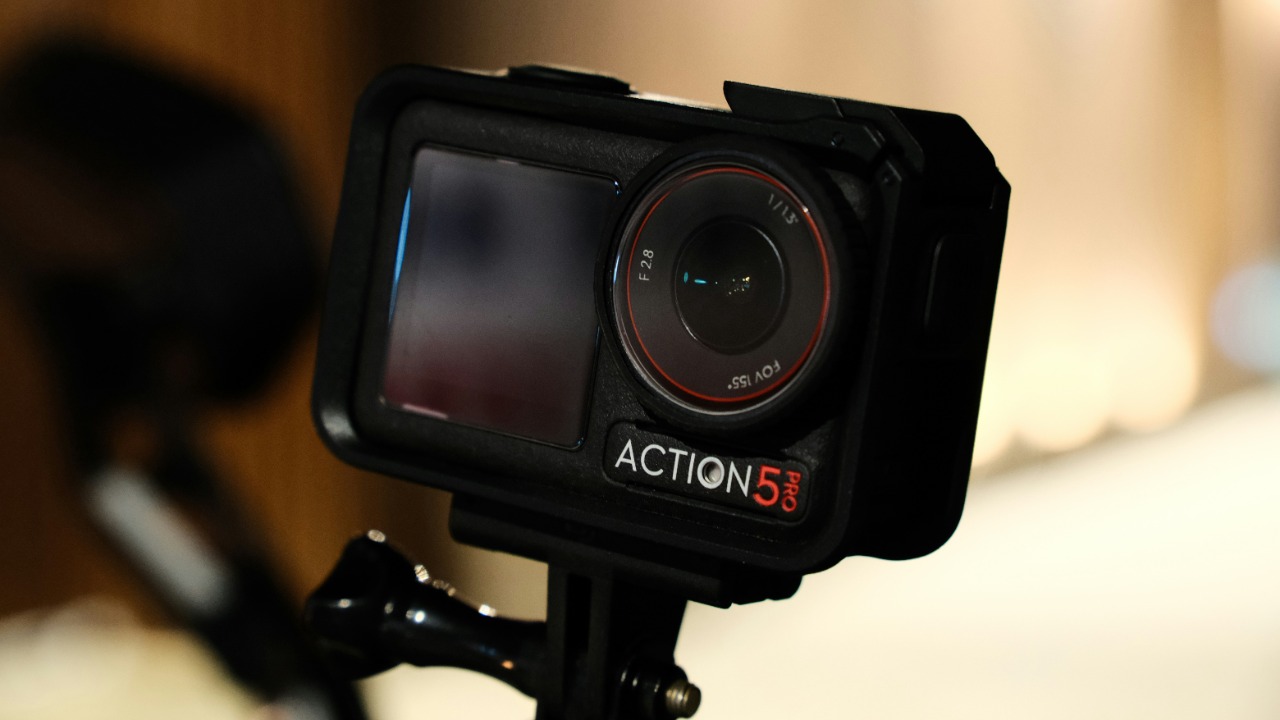

DJI’s smallest action camera has quickly become a reference point for wearable video, but its comfortable lead is about to be tested. A little known Chinese brand called Leaptic is preparing an 8K, AI‑driven rival that is set to debut around CES, promising to squeeze cutting edge resolution and smart features into a similarly tiny body. The clash between DJI’s refined ecosystem and a mystery challenger hints at a new phase in the action‑cam wars, where size, resolution and on‑device intelligence all matter just as much as brand loyalty.
DJI’s ultra‑compact strategy, from Osmo Nano to Action 5 Pro
DJI has spent the past year tightening its grip on the action‑cam market by attacking it from two directions: ultra‑compact wearables and more traditional, feature‑packed blocks. The Osmo Nano, described as an ultra‑compact, wearable concept, signaled how aggressively DJI wants to shrink cameras without sacrificing image quality or stabilization, positioning the device as a tiny companion for creators who already fly the company’s drones or use its gimbals. That same push to miniaturize is what makes the Nano the obvious reference point for any new pocketable rival that tries to undercut DJI on size while matching its video specs.
Alongside that wearable experiment, DJI has continued to refine its more conventional line with the Osmo Action 5 Pro, which leans on high‑end stabilization, robust build quality and a familiar GoPro‑style form factor to keep existing users inside the ecosystem. In practice, the Nano and the Action 5 Pro bracket the category: one is about disappearing on your helmet or chest, the other about being a dependable, all‑rounder camera that can handle everything from mountain biking to vlogging. Any newcomer that wants to challenge DJI’s “tiny action cam” has to understand that it is not just competing with a single product, but with a portfolio that already covers both extremes of size and capability.
Leaptic steps out of the shadows with an 8K teaser
Into this landscape steps Leaptic, a Chinese company that, until now, has barely registered on the global camera radar. The brand has started teasing a new action camera that is explicitly framed as an 8K rival to DJI’s smallest model, with early material pointing to a launch timed around CES in Las Vegas. The teaser positions the device as an “AI” camera, suggesting that Leaptic is not only chasing headline resolution but also leaning heavily on computational tricks to stand out in a crowded field of 4K and 5.3K competitors.
What makes the Leaptic story more intriguing is how little is known about the company itself, even as it tries to break into this competitive space. One report notes that Leaptic teases the camera as a direct answer to DJI’s tiny wearable, while another describes it simply as a mysterious Chinese entrant that wants to leverage AI and 8K to get noticed. That combination of high ambition and low public profile is unusual in a segment usually dominated by brands like DJI, GoPro and Insta360, and it raises the stakes for whatever Leaptic eventually shows on stage.
Instagram hints and the shape of Leaptic’s AI ambitions
Beyond the official teaser, the clearest hints about Leaptic’s hardware have come from social media. Another post shared on Instagram in September 2025 appears to show the company’s AI action camera, if indeed the product in that post is the same device now being teased for CES. The images suggest a compact body with a prominent lens and what looks like a front‑facing display, a layout that would immediately invite comparisons with DJI’s Osmo Nano and GoPro’s Hero line. The emphasis on AI in the caption hints at features like automatic scene detection, subject tracking or smart editing, all of which are becoming table stakes for premium action cams.
Those early glimpses also underline how Leaptic wants to be perceived: not as a budget knock‑off, but as a high‑tech alternative that blends 8K capture with the latest in AI. A separate report on the same teaser notes that Leaptic is explicitly trying to break into this competitive space by leaning on those buzzwords, which suggests that the company understands how crowded the hardware side of the market has become. If the final product can back up the marketing with reliable tracking, horizon leveling and automated highlight reels, it could appeal to creators who care more about what comes out of the camera than about the brand name on the front.
DJI’s 8K pivot with Osmo Action 6 and gesture‑driven control
Leaptic’s 8K pitch does not land in a vacuum. DJI has already moved its mainstream action line into 8K territory with the Osmo Action 6, which recently gained the ability to record at that resolution along with a suite of refinements to image quality. One detailed breakdown notes that gesture control on the Action 6 now extends beyond stills into webcam and live‑streaming scenarios, turning the camera into a more flexible tool for creators who want to wave a hand to start a broadcast or switch modes. That kind of usability upgrade matters just as much as raw resolution, especially for vloggers and streamers who are often working solo.
By pushing 8K into the Osmo Action 6 while keeping the Osmo Nano focused on ultra‑compact wearability, DJI has effectively split its strategy: one line chases maximum image quality and advanced control, the other chases minimal size and frictionless mounting. For Leaptic, that means any 8K wearable it brings to market will be judged not only against DJI’s tiny camera, but also against the more powerful Action 6 that already offers 8K and smart control in a slightly larger body. If Leaptic cannot match the stability, color science and gesture‑driven convenience that DJI has already unlocked, its higher resolution will look more like a spec sheet stunt than a genuine leap forward.
How Insta360 and GoPro set the 8K and AI benchmark
Leaptic is also stepping into a ring where Insta360 and GoPro have already been trading blows over resolution and AI. Insta360’s Ace Pro series has become a shorthand for computationally enhanced action footage, and the latest Ace Pro 2 is explicitly billed as an 8K Action Cam Co‑Engineered with Leica. That collaboration is framed as a way to set a new benchmark for action camera image quality, with a larger sensor that gathers more light and reduces noise, plus AI‑driven tools that help stabilize footage and optimize exposure. In other words, Insta360 is already doing what Leaptic says it wants to do: combine 8K capture with serious computational photography.
On the GoPro side, the Hero line remains the default choice for many athletes and filmmakers, even as the company navigates delays and shifting roadmaps. One detailed rumor rundown notes that the Hero 14 was earlier scheduled for a September announcement but was pushed back, with the same roadmap outlining a GoPro 2026 Vlogging Camera as a new entry into the vlogging market. Community reaction captured in a separate video has been mixed, with some fans frustrated by the delay and others excited that the extra time might lead to more ambitious features. That tension shows how high expectations have become in this segment: users now assume that each new flagship will bring not just better resolution, but smarter tools and more flexible shooting modes.
What 8K really means for creators in the field
For all the marketing heat around 8K, the practical benefits for action shooters are more nuanced. As filmmaker Enrique Pacheco points out in a detailed essay on high resolution, However, while broadcasters and production companies are still trying to adapt their workflows to 4K, this standard was already surpassed by 8K, which is now used to capture achievements and to set new quality standards. In practice, that means 8K gives editors more room to crop, stabilize and reframe without sacrificing final output quality, especially when delivering in 4K or 1080p. For action cams, where cameras are often mounted in less than ideal positions, that extra latitude can be a real advantage.
At the same time, 8K brings heavy storage and processing demands that can be punishing for everyday users. Memory cards fill faster, batteries drain more quickly and editing 8K footage requires powerful hardware that many hobbyists simply do not have. That is why many creators still treat 8K as a specialty mode rather than a default, using it for hero shots or complex reframes while relying on 4K for most of their day‑to‑day work. If Leaptic wants its 8K wearable to be more than a spec sheet brag, it will need to offer smart defaults, efficient codecs and perhaps AI‑assisted downsampling that makes the most of the resolution without overwhelming users’ workflows.
Market pressure: why every brand is racing to add AI and 8K
The broader market context helps explain why Leaptic is arriving with such an aggressive spec sheet. Analysts tracking the sector estimate that the global action camera market will reach USD 7,631 million by 2030, and they note that Manufacturers are constantly working to improve the features of their action cameras. Some of the innovations they highlight include higher resolution (up to 8K), improved image stabilization for smooth footage and better low‑light performance. In other words, 8K and AI‑driven stabilization are not just nice‑to‑have extras, they are becoming central to how brands justify new models and higher prices.
That same report underscores how Some of the most important differentiators now revolve around software as much as hardware, from horizon leveling and motion smoothing to automatic highlight reels. DJI, Insta360 and GoPro have all invested heavily in these areas, which means Leaptic cannot rely on 8K alone to stand out. To win over users who already own a Hero, an Ace Pro or an Osmo, it will need to show that its AI tools are at least as capable, whether that means better tracking for mountain bikers, smarter exposure for divers or more reliable face detection for vloggers.
How current flagships stack up against a mystery 8K wearable
To understand where Leaptic might fit, it helps to look at how reviewers and creators currently rank the top action cameras. One popular round‑up from August of 2025 highlights three leading models, including the Insta360 Ace Pro 2, and focuses on how each balances image quality, stabilization and ease of use. Another deep dive compares the Osmo Action 6 with the Osmo Action 5 Pro, describing the latter as a “cracking camera” with great stabilization and strong overall performance. That same video, which opens with “well first of all let’s talk about the Osmo Action 5 Pro,” reinforces how much goodwill DJI has built up among enthusiasts who value reliability as much as specs.
GoPro’s community, meanwhile, has been vocal about its expectations for the next flagship. A widely viewed breakdown of GoPro Hero 14 leaks notes that community reaction has been mixed, with some fans frustrated by the delay while others are actually excited, hoping this means GoPro is working on something big. That mix of impatience and optimism shows how high the bar has become for any new entrant. If Leaptic’s 8K wearable arrives without matching the polish, accessory ecosystems and app support that these established brands offer, it risks being dismissed as a curiosity rather than a serious alternative.
CES, AI everywhere and why Leaptic’s timing matters
Leaptic’s decision to align its launch with CES is not accidental. The show has increasingly become a showcase for AI‑infused hardware, from cameras to cars, and 2026 is shaping up to be no exception. The South Korean electronics giant LG, for example, is using the event in Las Vegas to present its AI Cabin Platform, an in‑car cockpit system built with Qualcomm that promises smarter interfaces and personalized experiences. That announcement, which will see The South Korean company show off its Cabin Platform at CES in Las Vegas between 6 and 9 January, underscores how AI has become the connective tissue across categories.
By positioning its camera as an AI‑driven device at the same show, Leaptic is effectively trying to ride that wave of attention, framing its product as part of a broader shift toward smarter, more context‑aware gadgets. The risk is that it will be competing for headlines not just with DJI and Insta360, but with everything from AI cars to smart home devices. To cut through that noise, Leaptic will need a clear story about what its AI actually does for action shooters, whether that is automatic editing, better stabilization or more intuitive control. Without that, its 8K claim could get lost in a sea of similar‑sounding announcements.
Wearables, launch cycles and the next year of action cams
Looking ahead, the timing of Leaptic’s move intersects with a busy launch calendar for the rest of the industry. A detailed preview of upcoming gear notes that the Insta360X4 Air and the Osmo Action 6 had their launch details revealed in a video that walks through the new #insta360x4air, which is being launched on 28OCT2025, and mentions that the Osmo Action 6 would arrive in early to mid November 2025. That same clip, which directs viewers to Amazon for preorders, shows how tightly choreographed these releases have become, with brands trying to avoid stepping on each other’s news cycles while still landing before key shopping periods.
DJI’s own schedule has been equally aggressive. A report on the Osmo Nano’s debut notes that DJI is not slowing down, even as it keeps US customers waiting on the Mini 5 Pro drone. The company pulled the wraps off that Mini 5 Pro, though not in every market, while also introducing the Nano as an ultra‑compact, wearable concept. That pattern of overlapping launches suggests that 2026 will be another year of rapid iteration, with DJI, Insta360 and GoPro all likely to refresh their lineups. Leaptic’s challenge will be to stay visible once the initial CES buzz fades and the incumbents roll out their next wave of hardware and firmware updates.
What buyers should watch for when the mystery 8K rival appears
For anyone considering a new action camera in 2026, the arrival of Leaptic’s 8K wearable is both an opportunity and a test of patience. On one hand, more competition usually means faster innovation and better value, especially when a newcomer tries to undercut established players on price or features. On the other, early adopters of first‑generation hardware often end up dealing with rough edges, from buggy firmware to limited accessory support. I would advise potential buyers to pay close attention not just to Leaptic’s launch specs, but to how quickly the company updates its software, how robust its mounting ecosystem looks and whether its mobile app feels as polished as those from DJI, Insta360 and GoPro.
It is also worth remembering that the best camera is the one that fits your specific use case, not necessarily the one with the highest resolution. A mountain biker who values a featherweight helmet cam might still gravitate toward the Osmo Nano or a similar wearable, while a filmmaker who wants maximum grading flexibility could be better served by an 8K block like the Osmo Action 6 or the Ace Pro 2. As more details emerge about Leaptic’s AI features, battery life and durability, the real question will be whether it can carve out a clear niche rather than simply chasing DJI’s tiny action cam on paper. If it succeeds, the next generation of action cameras could be defined as much by smart software and thoughtful design as by the race to 8K.
The quiet role of retail and pricing in the 8K showdown
Behind the spec sheets and teaser videos, retail positioning will quietly shape how much impact Leaptic can have on DJI’s dominance. Existing listings for action cameras on major platforms show how crowded the shelves already are, with multiple 4K and 5K models jostling for attention at overlapping price points. One example product listing, surfaced through a product search, illustrates how even mid‑tier cameras now tout high frame rates, waterproofing and basic stabilization as standard. For Leaptic, landing in the right price band relative to DJI’s Nano and Action 6 will be crucial if it wants to be seen as a viable alternative rather than an overpriced curiosity.
Accessory bundles and cross‑promotion will matter just as much. Another product listing shows how established brands lean on kits that include mounts, extra batteries and cases to sweeten the deal, something a newcomer will have to match if it wants to appeal to first‑time buyers. If Leaptic can pair its 8K and AI story with aggressive pricing and thoughtful bundles, it could force DJI and others to respond, potentially kicking off a new round of discounts and feature upgrades that benefits everyone shopping for a camera in the year ahead.
How reviewers and creators will shape Leaptic’s fate
Once Leaptic’s camera is in the wild, the verdict from reviewers and working creators will likely matter more than any CES stagecraft. Detailed comparison videos, like the one that pits the Osmo Action 6 against the Action 5 Pro, have become essential buying guides for many users, breaking down everything from stabilization and low‑light performance to menu design. Similarly, round‑ups that crown the top three action cameras of the year, such as the August of 2025 video that highlights the Insta360 Ace Pro 2, can quickly elevate or sideline a new entrant depending on how it performs in real‑world tests.
Leaptic will also have to contend with the expectations set by long‑running brands that have weathered multiple product cycles. When a creator spends twenty minutes unpacking launch details for the Insta360X4 Air and Osmo Action 6, they are not just reviewing specs, they are reinforcing the idea that these companies will be around to support their gear for years. For a mysterious Chinese brand like Leaptic, building that same trust will take time, firmware updates and a willingness to listen to feedback from the riders, divers and filmmakers who push action cameras hardest. If it can deliver on that front, its tiny 8K rival might do more than challenge DJI’s latest gadget, it could help redefine what users expect from the next wave of wearable cameras.
More from Morning Overview