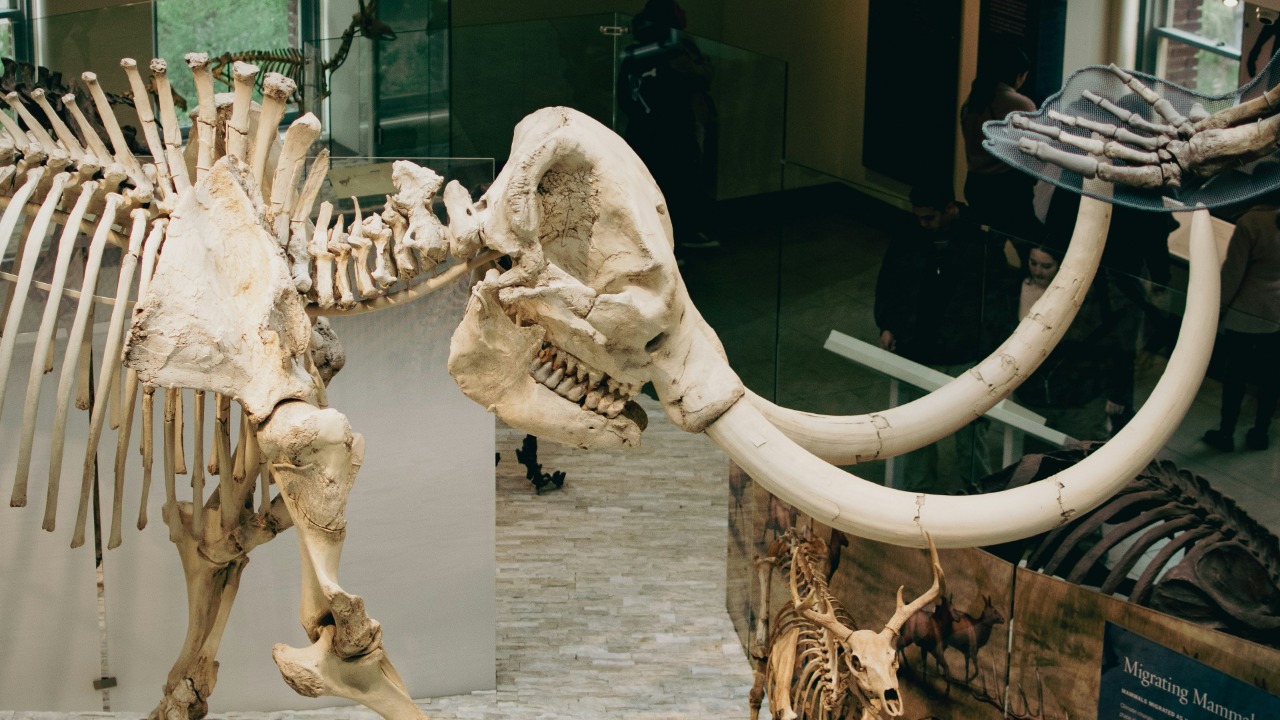

Something extraordinary happened near the end of the last Ice Age, when mammoths still roamed and early hunter gatherers were spreading across new continents. A growing group of researchers now argues that a cosmic explosion shattered that world, triggering abrupt cooling, continent scale wildfires and a wave of extinctions that reshaped human history. The idea is bold and controversial, but the evidence has become too detailed, and too global, to dismiss out of hand.
At the center of the debate is whether a space blast not only helped wipe out mammoths but also disrupted early human cultures at a pivotal moment. I want to trace how this hypothesis emerged, what the latest data actually show and why some scientists remain unconvinced that a single catastrophe, rather than a tangle of climate shifts and human pressures, finished off these Ice Age giants and some of the people who hunted them.
The radical claim behind the Younger Dryas Impact Hypothesis
The story starts with a climatic whiplash known as the Younger Dryas, a sudden return to near glacial conditions just as the planet was warming. According to a proposal known as The Younger Dryas Impact Hypothesis, fragments of a comet slammed into Earth roughly 12,800 years ago and set off that abrupt cooling. In this view, the impact did not leave a single obvious crater, but instead scattered energy and debris across the atmosphere and surface, igniting fires and injecting dust that dimmed sunlight.
Supporters of the hypothesis argue that this event was not a minor blip but a planetary scale shock that altered ecosystems and human societies. They point to the timing, around 12,800 years ago, when temperatures plunged, ice sheets stabilized and megafauna populations began to crash. The claim is that a cosmic encounter with Earth triggered a chain reaction, from atmospheric disruption to ecological collapse, that would have been visible to any humans unlucky enough to witness it.
A “craterless comet” and the puzzle of missing scars
One of the most counterintuitive aspects of the impact idea is the apparent absence of a smoking gun crater. Geologist and archaeologist Moore and colleagues have argued that the culprit may have been a “craterless comet,” a fragile object that exploded in the atmosphere or fragmented into many smaller impacts. In that scenario, the energy is still immense, but it is spread out, leaving chemical and mineral fingerprints rather than a single giant hole in the ground.
This idea helps explain why researchers are hunting for microscopic clues instead of obvious scars. Rather than a Chicxulub style basin, they look for layers of unusual minerals, melted spherules and other impact related debris in sediments that date to the onset of the Younger Dryas. If a comet broke apart before or during impact, it could have rained down material over a vast area, leaving a patchwork of subtle signatures that only become clear when sites from different continents are compared.
What Really Killed the Mammoths? Competing stories of extinction
For decades, the fate of mammoths has been framed as a tug of war between climate change and human hunting. New work has complicated that picture by tying their disappearance to a possible cosmic trigger. A recent synthesis, framed around the question What Really Killed the Mammoths, argues that the extinction of large Ice Age animals and the loss of the Clovis technocomplex occurred at the same time as the onset of the Younger Dryas. In that telling, an exploding comet about 13,000 years ago did not act alone, but it delivered a decisive blow to already stressed populations.
The same research notes that the Clovis culture, a distinctive stone tool tradition associated with some of the earliest widespread human groups in North America, vanishes from the archaeological record just as this environmental upheaval begins. Proponents of the impact hypothesis see this synchronicity as more than coincidence. They suggest that a sudden cooling, combined with habitat loss and disrupted food webs, could have pushed both mammoths and the people who relied on them past a tipping point.
Traces in the dirt: how sediments record catastrophe
To move beyond timing alone, scientists have turned to the ground beneath our feet. Evidence from key archaeological sites has been used to argue that a layer of unusual debris appears at the boundary where mammoths and the Clovis technocomplex disappear. One analysis of these layers, highlighted under the banner New Evidence Points, describes impact related materials that coincide with the loss of these animals and tools from North America’s archaeological record.
These sediment layers are not just dusty pages in a geological book, they are crime scenes frozen in time. Researchers report microscopic spherules, elevated levels of certain metals and other markers that are hard to explain through normal Earth bound processes. When those markers line up with the disappearance of mammoths and the end of a cultural tradition, the case for a shared cause grows stronger, even if it does not yet convince every skeptic.
“Something catastrophic” nearly 13,000 years ago
The broader framing of this debate is that something extraordinary happened nearly 13,000 years ago, an event powerful enough that its traces are still buried in ancient sediments. One recent overview puts it starkly, noting that Something catastrophic occurred that left a global layer of clues. In that narrative, a space explosion did not just affect wildlife, it also hammered early human communities that were already navigating the end of the Ice Age.
From my perspective, what makes this claim compelling is not the drama of a cosmic blast but the convergence of independent lines of evidence. Climate records, archaeological layers and geochemical anomalies all point to a sharp break in the planet’s trajectory around this time. Whether that break was caused by a comet, internal climate dynamics or some combination of both is the heart of the current scientific argument.
Why some scientists once took the “mammoth-killing blast” off the hook
The impact idea has not had an easy ride. Earlier critiques argued that the theory that a space blast wiped out the great beasts living in North America 13,000 years ago lacked solid evidence. Some researchers pointed out that mammoth populations had already been declining and that climate shifts and human hunting could explain their disappearance without invoking a cosmic disaster. In that phase of the debate, the “mammoth killing space blast” was effectively taken off the hook.
Those criticisms forced impact proponents to sharpen their case. They had to show not just suggestive timing but hard physical traces that could not be easily dismissed as products of wildfires, volcanism or normal sedimentation. The back and forth has been intense, but it has also driven more careful sampling, better dating and a broader search for impact markers beyond a handful of North American sites.
Platinum, spherules and the line between science and pseudoscience
One of the most contentious aspects of the Younger Dryas Impact Hypothesis is the interpretation of exotic materials in ice cores and sediments. Critics have warned that cherry picking such evidence risks sliding into speculation, while supporters argue that the presence of significant levels of platinum and other impact related materials in multiple records is hard to ignore. A detailed review under the blunt title Younger-Dryas Impact. Science or Pseudoscience? lays out how these anomalies raise legitimate questions that have scientific answers, even if those answers are still being contested.
From my vantage point, the key issue is not whether every claimed marker holds up, but whether a consistent pattern emerges across independent studies. When elevated platinum, unusual spherules and other impact style signatures show up in different cores and sites that all date to the Younger Dryas onset, the burden shifts to explaining them through known terrestrial processes. That is a high bar, and it is why the debate has moved from outright dismissal to a more nuanced argument over mechanisms and magnitudes.
Evidence of a world-changing comet in the ocean
Until recently, much of the impact discussion focused on land based sites, especially in North America. New work has pushed the search offshore. Researchers analyzing marine sediments have reported Evidence of World Changing Comet Explosion 12,800 Years Ago Found in The Ocean, specifically in cores from Baffin Bay near Greenland. These cores contain layers that appear to record an abrupt influx of material consistent with a high energy event at the very start of The Younger Dryas.
Ocean records matter because they are less likely to be disturbed by local fires or erosion, and they integrate signals over wide areas. If a comet exploded over or near the North Atlantic, the fallout would have settled into surrounding waters, leaving a chemical and physical trace. Finding a 12,800 year old anomaly in marine sediments that lines up with terrestrial evidence strengthens the case that something more than ordinary climate variability was at work.
Supporting Moore: platinum from Syria to South Carolina
On land, one of the most striking patterns comes from the distribution of rare metals. Researchers have reported that Supporting Moore’s argument are traces of platinum in sites across Syria and South Carolina, a rare metal but abundant in some types of cosmic debris. These layers coincide with the onset of the Younger Dryas cooling, namely, the YD, suggesting that a pulse of extraterrestrial material settled out of the atmosphere at that time.
Finding similar platinum spikes thousands of kilometers apart is difficult to explain through local geology or isolated fires. Instead, it points to a global scale dusting, the kind you might expect if fragments of a comet vaporized in the atmosphere and rained down fine particles. For impact supporters, this is one of the most persuasive lines of evidence, because it ties together distant regions under a single, time locked event.
Multiple killers: climate, humans and maybe a comet
Even if a cosmic blast occurred, it did not act on a blank slate. Mammoths were already navigating a world of shifting ice, changing vegetation and expanding human presence. One synthesis of their decline notes that the long lasting proximity between mammoths and humans suggested that our species was perhaps a factor in the beasts’ fate, especially as people altered the landscape at the end of the Ice Age. As one assessment put it, Mammoths faced profound climate change and human pressures at the same time.
I see the impact hypothesis as adding another layer to this already complex story rather than replacing existing explanations. A cometary explosion could have amplified stresses by rapidly cooling the climate, triggering wildfires and shrinking habitats, while humans continued to hunt and compete with mammoths for resources. In that sense, the space blast would be one killer among several, tipping a vulnerable species over the edge rather than acting as a solitary executioner.
In White Pond and beyond: a South Carolina case study
Some of the most vivid evidence for an extraterrestrial jolt comes from a quiet body of water in the southeastern United States. In White Pond, the researchers took samples from the sediment beneath the pond and dated them with care. Around the time of the Younger Dryas onset, they found a layer rich in microscopic spherules, charcoal and other signs of intense burning, which they interpret as fallout from an impact related event that sparked widespread wildfires and climate change. The detailed stratigraphy at this site, described in a report that begins with the phrase In White Pond, has become a touchstone for impact supporters.
What makes White Pond compelling is the tight coupling between the anomalous layer and broader environmental changes. Pollen records show shifts in vegetation, charcoal points to intense fires and the impact style particles sit right at the boundary. When a single site captures so many signals in one slice of mud, it becomes harder to argue that each is a coincidence. Instead, they look like different facets of the same abrupt event.
Firestone, PNAS and the formal review of impact evidence
The modern impact debate traces back to a provocative paper that tried to pull these threads together. In a landmark study, Abstract summaries note that Firestone et al., 2007, PNAS 104(41): 16,016–16,021, proposed that a major cosmic impact, circa 10,835 cal. BCE, triggered the Younger Dryas cooling. That paper cataloged a suite of impact style markers and argued that they lined up in time with the climatic shift and megafaunal extinctions, presenting them as supporting the impact hypothesis.
Subsequent reviews have dissected those claims, reanalyzing samples and challenging some of the original interpretations. Yet the basic framework laid out by Firestone and colleagues, linking a 10,835 BCE style event to the Younger Dryas, still underpins much of the current research. Whether future work ultimately upholds or overturns their conclusions, the debate they sparked has forced a deeper look at how fragile Earth’s climate and ecosystems can be in the face of sudden shocks.
Moore’s warning: Earth is hit more often than we think
Beyond the specifics of the Younger Dryas, some researchers see a broader lesson in the accumulating evidence. In a recent reflection on the topic, geologist Moore argued that Earth is impacted by celestial debris far more often than has been documented in the geological record. To look up or not to look up, as he framed it, is not just a philosophical question but a practical one, because recognizing past impacts can sharpen our sense of present day risk.
From my standpoint, that warning resonates. If a fragmented comet could help trigger a climatic jolt 12,800 years ago without leaving a single obvious crater, then our planet’s vulnerability to smaller, more frequent cosmic encounters may be underappreciated. The Younger Dryas debate is therefore not only about mammoths and ancient hunters, it is also about how seriously we take the sky as a source of sudden, transformative change.
More from MorningOverview