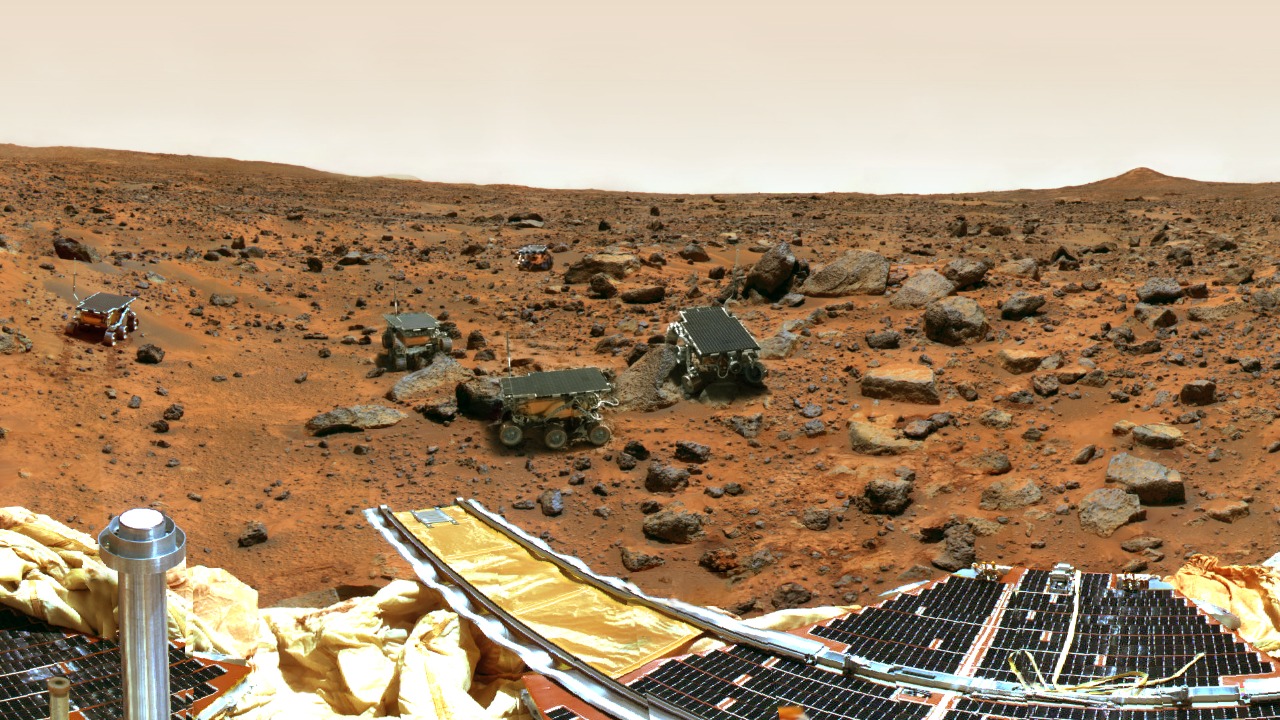

The latest panorama from NASA’s Curiosity Mars rover turns Mount Sharp from a distant backdrop into an overwhelming, all-encompassing landscape, the kind of view that makes Gale Crater feel like a real place rather than a dot on a mission map. Captured from high on the mountain’s flanks, the scene stitches together layers of rock, dust and sky into a single frame that doubles as both postcard and scientific roadmap. I see it as a milestone image, the visual proof of how far Curiosity has climbed and how much of Mars’ history is now spread out beneath its wheels.
Why this Mount Sharp panorama stands apart
Curiosity has been sending back sweeping Martian vistas for more than a decade, but the new Mount Sharp view stands out because of the vantage point it offers over Gale Crater and the surrounding terrain. From its elevated perch, the rover looks down across the crater floor and up into the higher slopes, compressing billions of years of Martian geology into a single horizon line. The panorama is not just pretty, it is a map of changing environments, from ancient lake beds to wind-sculpted ridges, all visible in one continuous sweep.
The image was captured after Curiosity had already spent years climbing the lower layers of Mount Sharp, turning what began as a distant central mound into the rover’s entire world. Earlier panoramas from this climb showed the crater rim as a low ring on the horizon, but in the latest view the rim appears as a distant wall while the foreground is dominated by intricate rock textures and steep slopes that underline how high the rover has come. That sense of altitude and immersion is what makes this panorama feel different from earlier wide shots of Mars, even compared with other dramatic looks at Mount Sharp.
Curiosity’s long climb into Gale Crater’s history
To understand why this view matters, I have to go back to Curiosity’s original target: Gale Crater and its central mountain, officially known as Aeolis Mons but widely called Mount Sharp. The mission was sent to Mars to read that mountain like a history book, with each layer of rock recording a different chapter in the planet’s environmental story. From the moment Curiosity landed on the crater floor, the plan was to drive toward the mountain, reach its base, then slowly climb through those layers to see how conditions changed over time.
That climb has been underway for years, and the new panorama is a payoff shot from high on the route. Earlier this year, NASA highlighted a view looking back down at the floor of Gale Crater from Curiosity’s position on the mountain, showing how the rover’s path now traces a long arc from the landing site up into the layered foothills. In that visualization, the rover’s cameras captured the crater floor and the distant rim in a way that helps scientists connect specific rock outcrops to the broader landscape, a perspective that is central to the Gale Crater story.
The cameras that turn raw terrain into a “postcard”
What makes the latest Mount Sharp vista so striking is not only where Curiosity is parked, but how it is looking around. The rover’s imaging toolkit includes navigation cameras for quick, wide-angle views and science cameras for detailed color mosaics, and mission teams have learned to combine them in creative ways. In one recent example, Curiosity used its black-and-white navigation cameras to capture panoramas at two different times of day, then blended those frames into a single composition that accentuates shadows and highlights, turning a routine survey into something that looks like a carefully composed landscape photograph.
That same sensibility is at work in the new Mount Sharp panorama, which uses careful stitching and processing to balance scientific clarity with visual impact. The navigation cameras provide the broad sweep of the terrain, while higher resolution instruments such as The Mast Camera, or Mastcam, fill in the fine details of rock layers and distant ridges. Earlier images from Mastcam, including a widely shared Dramatic View of Mars focused on Mount Sharp, showed how its telephoto lens can isolate specific strata on the mountain’s slopes, and that same capability now helps scientists zoom into features that appear as tiny textures in the wide panorama.
Reading the layers: what the vista reveals about ancient Mars
When I look at the panorama as a scientist would, the most important elements are not the sweeping sky or the distant crater rim, but the stacked layers of rock that step up the mountain’s flanks. Each band represents a different environment, from the mudstones that formed in long-lived lakes to sandstones shaped by wind and water, and the transitions between them record how Mars shifted from wetter conditions to the cold, dry world we see today. The new view captures several of these transitions in a single frame, letting geologists trace lines across the landscape and connect outcrops that Curiosity has visited with those it has yet to reach.
Curiosity’s path has already taken it across clay-rich units that point to sustained water activity and into sulfate-bearing layers that suggest more evaporative, drying conditions. The panorama’s vantage point makes it easier to see how these units stack and tilt, which in turn helps refine models of how Mount Sharp itself formed inside Gale Crater. Some of the most intriguing features are boxwork-like patterns and fractured ridges that hint at fluids moving through the rock after it formed, details that have been highlighted in recent “postcard” style images from the rover’s navigation cameras as it has been climbing since 2014, including a view from Mount Sharp’s boxwork region shared in Dec.
From dramatic stills to immersive animations
One reason this latest vista feels so immediate is that it is not confined to a single static frame. Mission teams have been turning Curiosity’s panoramas into zoomable, pannable experiences that let viewers sweep across the landscape as if they were standing next to the rover. In recent work, they built animations from two large mosaics captured in February and March, using smooth camera moves to guide the eye from the rover’s deck out to the crater rim and up the slopes of Mount Sharp. That same approach can be applied to the new panorama, transforming it from a flat image into a virtual walk across the Martian surface.
These animations are more than outreach tools, they also help scientists and engineers plan routes and contextualize specific targets within the broader terrain. By flying a virtual camera over the stitched images, teams can spot subtle changes in slope, identify potential hazards and pick out rock layers that deserve closer inspection. The recent Zoom and pan animations of Curiosity Mars panoramas from February and March 2025 show how effective this technique can be, and the Mount Sharp vista is an ideal candidate for the same treatment.
A rover that keeps redefining “mission lifetime”
The sheer quality of the new panorama is a reminder of how long Curiosity has been working on Mars and how much it has accomplished beyond its original design goals. The rover was built for a primary mission of about two Earth years, yet it is still operational and active on Mars for more than a decade after landing. As of early January 2026, Curiosity has been active on Mars for 4,769 sols, which corresponds to 4,900 total days and 13 years on the planet, a span that has turned it from a short-term experiment into a long-running observatory.
That longevity matters because it allows Curiosity to capture “before and after” views of the same landscape as it climbs, and to revisit earlier images with new context. The latest Mount Sharp panorama is not an isolated snapshot, it is part of a continuous visual record that stretches back to the rover’s first look at the crater rim from the landing site. Over those years, Curiosity has weathered dust storms, navigated treacherous terrain and adapted to hardware issues, yet it continues to send back high quality data and images that justify its extended mission status, as documented in the mission overview for Curiosity.
Scanning the crater rim and chasing mysteries on the slopes
From its current position on Mount Sharp, Curiosity is not only looking inward at the mountain’s layers, it is also casting its gaze outward toward the rim of Gale Crater. Recent imaging campaigns have focused on scanning that distant boundary, capturing the jagged outline of the crater’s edge and the intervening plains in high detail. In one widely shared clip, the rover’s cameras sweep across the horizon as the mission team invites viewers to “Check out the view from up here,” a phrase that neatly captures the sense of altitude and perspective that comes with Curiosity’s ongoing ascent of the flanks of Sharp.
At the same time, the rover is encountering features that raise new questions about the mountain’s history. Some images show unusual textures and formations that do not fit neatly into existing models, prompting mission scientists to talk about a “Mystery On Mount Sharp” as they study the upper slopes. One such scene, captured as Curiosity looked toward higher ground, highlights enigmatic patterns in the rock that could point to complex interactions between water, sediment and later erosion. That sense of ongoing discovery is reflected in analyses of the Curiosity Mars Rover images, which emphasize how each new vantage point on Mount Sharp can reveal puzzles that were invisible from lower down.
How this “mind-blowing” view reshapes our sense of Mars
For all its scientific value, the Mount Sharp panorama also works on a more visceral level. It is one thing to read that Mars once hosted lakes and rivers, and another to see a layered mountain rising from the floor of a vast crater, with the sky arching overhead and the ground dropping away beneath the rover. The image gives Mars a sense of scale and place that is hard to convey through numbers alone, turning abstract concepts like “sedimentary sequence” into something that looks like a hikeable trail up a real, weathered slope.
In that sense, the panorama continues a tradition of Curiosity images that blur the line between field notebook and travel photography. Earlier dramatic views of Mount Sharp, captured with Mastcam’s telephoto lens, already hinted at this dual role by framing the mountain in a way that would not look out of place in a terrestrial desert portfolio. The new vista, taken from higher on the mountain and stitched into a sweeping mosaic, pushes that effect further, inviting both scientists and the public to imagine standing on the rover’s deck and turning slowly in place to take in the full circle of the Martian horizon. For me, that is what makes it mind-blowing: it compresses years of exploration and layers of planetary history into a single, unforgettable look across Moun and the crater it dominates.
More from Morning Overview