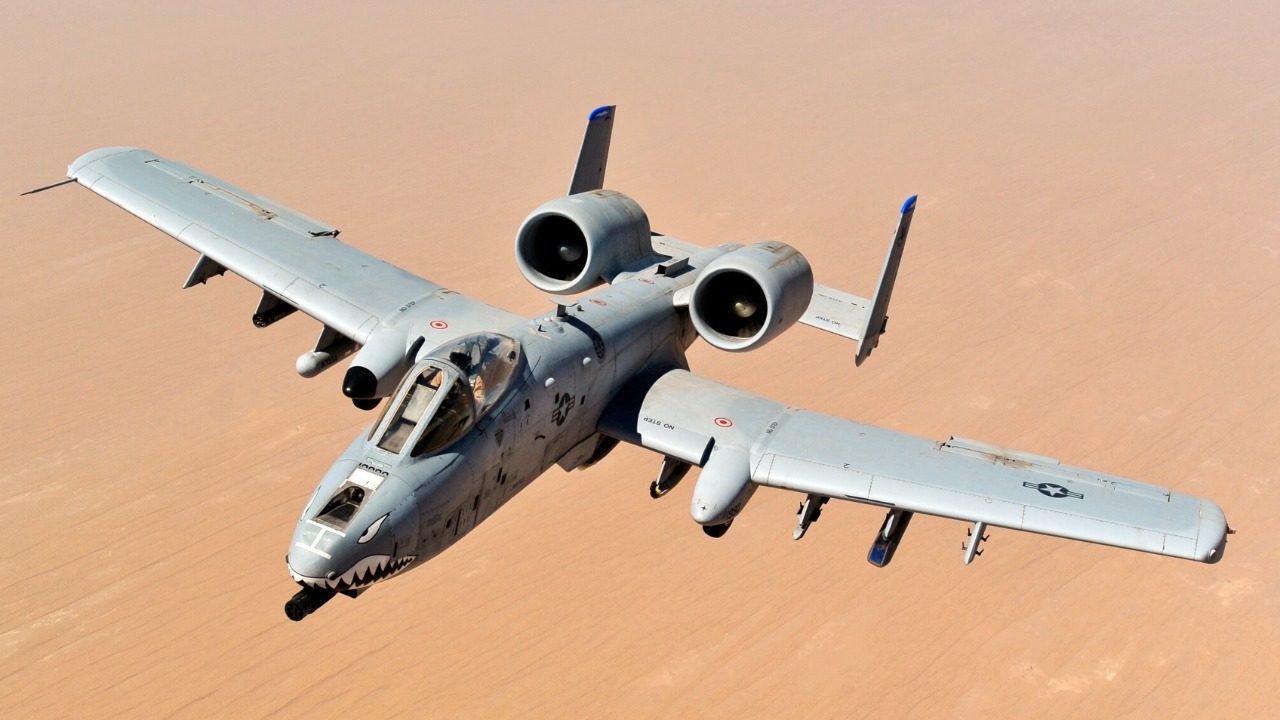

The United States is trying to phase out the A-10 just as Ukraine is being pounded by waves of Shahed drones, a timing that has fueled a fierce debate over whether the old close‑air‑support workhorse could be repurposed as a dedicated drone hunter. At stake is not only the survival of a beloved aircraft, but also how Western air forces think about low‑cost, high‑volume threats that do not look anything like the Soviet tank columns the jet was built to kill. I want to look at what the A-10 can actually do against Shahed‑type swarms, and why, despite that potential, the Air Force is still determined to send it to the Boneyard.
The A-10’s original mission and why it still matters
The A-10 was designed in the Cold War to fly low and slow over the battlefield, soaking up damage while shredding armored formations with its 30 mm cannon and a heavy load of bombs and missiles. That original close‑air‑support mission still matters in Ukraine, where ground forces on both sides are locked in attritional fighting and where survivable, persistent air cover near the front is in short supply. The jet’s rugged airframe, titanium “bathtub” around the pilot, and ability to operate from rough airstrips give it a kind of battlefield persistence that fast jets struggle to match.
Those same traits, especially the ability to loiter for long periods at relatively low cost, are what make many analysts argue that the A-10 is naturally suited to countering slow, low‑flying drones. In a region under UAS attack, a Warthog can orbit for hours, visually identify targets, and engage them with guns or guided rockets without burning through the flight hours of more expensive fighters. Advocates point out that Its combination of endurance, survivability, and heavy weapons load is rare among fixed‑wing aircraft, and that these attributes have already been leveraged in real counter‑UAS operations in the CENTCOM area of responsibility, where Shahed‑type kill markings have been observed on an A-10C, according to reporting on UAS engagements.
Why the Air Force wants the Warthog gone
Despite that battlefield relevance, the Air Force has been clear that it wants the A-10 out of the inventory. Service leaders have laid out a plan to retire all remaining Warthogs by 2029, with General Charles Q. Brown Jr., then the Air Force chief of staff, arguing that resources tied up in the aging fleet need to be shifted toward platforms that can survive and contribute in high‑end fights against peer adversaries. In his view, the service must move away from aircraft optimized for permissive environments and focus on capabilities that can operate inside heavily defended airspace, a point underscored in his comments about the retirement timeline reported in detail on Brown’s retirement push.
Budget pressure and strategic realignment are the other half of the story. Analysts note that a combination of constrained funding, the need to modernize for great‑power competition, and the evolution of warfare since the A-10’s introduction has convinced planners that the jet is a luxury they can no longer afford. A detailed assessment of the Warthog’s future explains that the Air Force is prioritizing stealthy, multi‑role aircraft and long‑range weapons, and that the A-10’s niche role and limited survivability against modern air defenses make it a poor fit for that future force, a judgment laid out in an analysis of why the service is saying goodbye to the aircraft on the Warthog’s phase‑out.
How Ukraine’s Shahed problem reframes the debate
Ukraine’s experience under constant Shahed attack has reframed the A-10 argument from a nostalgic fight over close air support into a very current question about cost‑effective air defense. Iranian‑designed Shahed‑type drones, used by Russia, are relatively slow and fly predictable routes at low altitude, but they are cheap enough to be launched in large numbers and are often used to saturate Ukrainian defenses. That has forced Kyiv and its partners to look for ways to intercept them without expending scarce high‑end missiles on every incoming drone.
In that context, some Western commentators have suggested that the A-10 could be the “unfinished business” in Ukraine, a platform that never made it to the fight but might still have a role to play. One detailed video analysis of the idea argues that the Air Force’s renewed push to retire the jet has collided with calls to send it to Ukraine, where its ability to loiter and carry large numbers of precision‑guided rockets could make it a valuable counter‑drone asset, a case laid out in a discussion of the A-10’s potential role in Ukraine’s defense. The core of that argument is that the Shahed threat is less about penetrating advanced integrated air defenses and more about having enough persistent, affordable shooters in the right place at the right time.
What the A-10 has already shown as a drone killer
The debate is not purely theoretical, because there is growing evidence that the A-10 has already been used successfully against drones in other theaters. Imagery and reporting from the CENTCOM region show A-10C aircraft carrying kill markings associated with Shahed‑type targets, suggesting that the jet has been tasked with counter‑UAS missions and has scored confirmed kills. Analysts who have examined these deployments argue that the Warthog’s ability to stay on station for extended periods, combined with its heavy weapons load, makes it well suited to hunting slow, low‑flying drones over permissive or semi‑permissive airspace, a point supported by the observation of Shahed‑type kill markers on an A-10C in the region described in detail in the CENTCOM case study.
Technical assessments of the aircraft’s performance in this role emphasize that, Compared with rotorcraft, the A-10 offers higher speed and better endurance, which can be crucial when responding to multiple drone tracks over a wide area. At the same time, it is cheaper to operate than front‑line fighters and can carry a mix of guns, missiles, and guided rockets that are more cost‑appropriate for shooting down low‑end drones than expensive air‑to‑air missiles. One detailed analysis of the Warthog’s emerging counter‑drone role notes that this combination of speed, survivability, and weapons flexibility has effectively turned it into a “drone killer” in practice, even if that was never its original design purpose, a conclusion explored in depth in a report on how the A-10 appears to have become a drone killer.
APKWS and the math of shooting down Shaheds
The real promise of the A-10 against Shahed swarms lies in pairing it with low‑cost precision weapons such as the Advanced Precision Kill Weapon System, or APKWS II. This system turns standard 70 mm rockets into laser‑guided munitions, allowing a pilot to engage small, slow targets like drones with far more accuracy than unguided rockets, and at a fraction of the cost of a full‑size missile. Analysts have calculated that if the A-10 were dedicated to a counter‑drone role, its numerous hardpoints could theoretically be used to carry 11 seven‑round 70 mm rocket pods loaded with APKWS II, giving a single aircraft dozens of guided shots against incoming drones, a loadout described in detail in a Ukrainian‑focused assessment of the A-10 and APKWS II combination.
That kind of magazine depth matters when facing Shahed‑type attacks, which are often designed to overwhelm defenses through sheer numbers rather than sophistication. A Warthog orbiting near a likely approach corridor could, in theory, engage multiple drones in a single sortie, using its sensors and targeting pod to cue APKWS II shots and its cannon as a backup. Proponents argue that this approach would be far more economical than firing high‑end surface‑to‑air missiles at each drone, and that it would free up ground‑based systems to focus on higher‑value targets like cruise missiles and aircraft. The cost‑exchange ratio, they say, is where the A-10 and APKWS II pairing could give Ukraine a real edge against Shahed swarms.
Loitering, survivability, and the limits of the airframe
Endurance is one of the A-10’s strongest selling points in the counter‑drone role. The jet was built to loiter over the battlefield, and that ability translates directly into more time on station to detect and engage drones before they reach critical infrastructure. A detailed look at the Warthog’s evolving mission set notes that it can now be configured specifically for counter‑unmanned aerial systems, with sensors and weapons tailored to spotting and killing drones while still retaining its core close‑air‑support capabilities, a flexibility highlighted in an analysis of how the Warthog Can Now Destroy Drones as part of a broader mission portfolio.
At the same time, the airframe’s age and design impose real limits. The A-10 lacks stealth and was never meant to penetrate dense, modern air defenses, which is why critics argue it would be too vulnerable in a high‑end fight against a peer adversary. One assessment of future airpower bluntly states that Lacking stealth, the A-10 can’t get into those areas where a fifth‑generation jet such as the F-35 can go, underscoring why planners see it as mismatched to the most demanding scenarios, a comparison drawn explicitly in a discussion of how the A-10 stacks up against the F-35. That vulnerability is less of a concern in Ukraine’s current drone fight, where Shaheds are typically flown along predictable routes and where Russian air defenses are focused on other threats, but it remains central to the Air Force’s long‑term calculus.
Why the Air Force still prefers to retire it, even with a drone role
Given the A-10’s demonstrated and potential value against drones, it is fair to ask why the Air Force is still so determined to retire it. Part of the answer lies in the opportunity cost: every dollar and maintainer hour spent keeping the Warthog flying is one not spent on newer platforms that can survive in contested airspace. A detailed video explainer on the retirement plan notes that the service wants to send its remaining 162 A-10s to the Boneyard starting in 2026, marking a deliberate effort to clear room in the budget and force structure for aircraft that align with its vision of future warfare, a plan laid out in a breakdown of why the Air Force is retiring the A-10 early.
There is also an institutional preference for multi‑role platforms that can perform air‑to‑air, strike, and electronic warfare missions in a single airframe, rather than specialized aircraft like the A-10 that excel in one niche. Senior leaders argue that other assets, from advanced fighters to ground‑based systems, can be adapted to the counter‑drone mission without keeping an entire fleet of aging jets in service. Critics counter that this mindset undervalues the unique combination of loiter time, survivability, and weapons capacity that the Warthog brings, especially in conflicts like Ukraine where the airspace is contested but not uniformly lethal. The tension between those views is at the heart of the current debate over whether to retire the jet or reimagine it as a dedicated drone hunter.
Could Ukraine realistically field A-10s against Shahed swarms?
Even if the A-10 is well suited to killing Shaheds on paper, turning that into reality for Ukraine would be complex. Kyiv would need not only the aircraft themselves, but also trained pilots, maintainers, spare parts, and the infrastructure to operate and protect the jets from Russian strikes. Integrating the Warthog into Ukraine’s existing air defense network would require careful planning so that it complements, rather than competes with, ground‑based systems and other aircraft. Advocates of the idea argue that these challenges are surmountable and that the payoff in terms of persistent, low‑cost drone defense would justify the effort.
Supporters also point to the Warthog’s adaptability as a reason it could be worth the investment. One Ukrainian‑focused analysis describes the aircraft explicitly as a Warthog as a drone hunter, emphasizing its ability to loiter, carry large numbers of guided rockets, and operate from relatively austere bases, all of which could be valuable in Ukraine’s dispersed and constantly shifting battlespace, a concept explored in depth in a discussion of the Warthog as a drone hunter. Whether Western governments are willing to transfer such a politically and symbolically charged aircraft, however, is a separate question, especially given the Air Force’s own plans to retire it.
What the A-10 debate reveals about future airpower
The argument over the A-10’s fate is really a proxy for a larger conversation about how air forces should balance high‑end capabilities with affordable mass. Ukraine’s experience with Shahed swarms shows that not every threat requires a stealth fighter or a billion‑dollar air defense system, and that there is still a place for rugged, specialized aircraft that can deliver a lot of firepower at relatively low cost. At the same time, the Air Force’s determination to retire the Warthog reflects a belief that future wars will demand platforms that can survive and contribute across the full spectrum of conflict, from permissive environments to the most heavily defended skies.
In that sense, the A-10 sits at the intersection of nostalgia, practicality, and strategic foresight. It is a proven killer of tanks and, increasingly, of drones, yet it is also a product of a different era, one that did not anticipate the rise of cheap loitering munitions or the centrality of stealth and networking in modern air combat. A detailed discussion of the jet’s “unfinished business” in Ukraine captures this tension, noting that the Air Force is finally pushing to retire the legendary platform even as some argue it could still play a decisive role in Kyiv’s defense, a perspective explored in a video analysis of whether the A-10 is the answer for Ukraine. Whether or not the Warthog ever flies under Ukrainian colors, the questions it raises about how to fight and fund the next war will outlast its final trip to the Boneyard.
More from MorningOverview