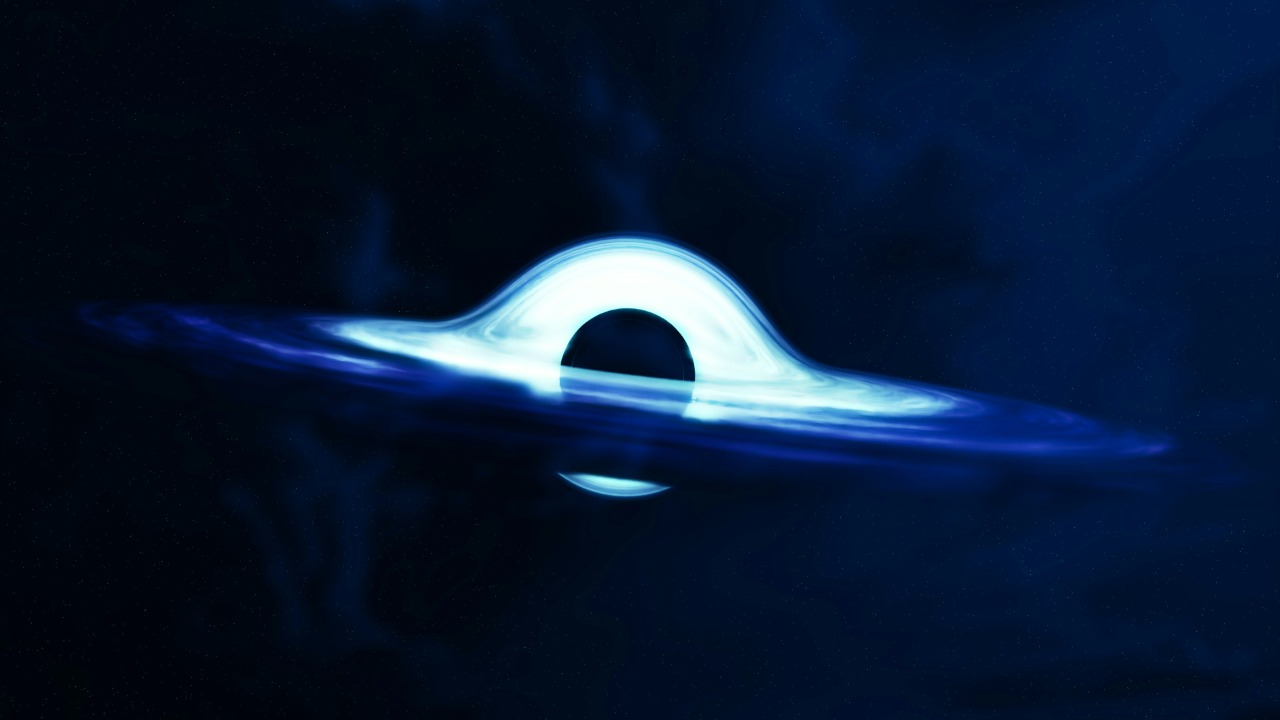

Cosmologists have long treated black holes and the Big Bang as separate extremes of physics, one swallowing light, the other birthing space and time. A provocative line of research now suggests those two ideas might be entangled, with our expanding universe potentially unfolding inside the event horizon of a much larger black hole. I want to trace how that possibility moved from fringe speculation to a serious, if controversial, way of thinking about what the cosmos really is.
Why black holes and the Big Bang keep getting compared
At first glance, a black hole and the early universe could not be more different: one is a compact region where gravity wins, the other an all-encompassing expansion where galaxies race apart. Yet the mathematics of general relativity links them through singularities, the points where the theory predicts infinite curvature of spacetime. In both a black hole and the Big Bang, the equations behind gravity, including the Penrose and Hawking theorems, drive toward a breakdown of predictability at a singular origin, which is why some theorists treat them as two faces of the same underlying physics, a connection that sits at the heart of black hole cosmology.
That shared singularity structure is not just a mathematical curiosity, it hints at a deeper symmetry between collapse and creation. If a black hole crunches matter into an ultra dense state, and the Big Bang begins from an ultra dense state, then it is natural to ask whether one could seed the other. In this picture, the violent birth of our cosmos might be reinterpreted as the interior evolution of a black hole formed in some larger “parent” universe, with the singularity acting as a bridge between the two regimes rather than a hard edge where physics simply stops.
How JWST revived a radical idea
The launch of NASA’s James Webb Space Telescope, or JWST, gave this old speculation fresh fuel by revealing the distant universe in unprecedented detail. As JWST mapped faint, early galaxies, some researchers argued that their distribution and rotation patterns could be read as subtle signatures of a deeper structure, with one analysis suggesting that the overall geometry of the cosmos might be consistent with our entire universe residing inside the event horizon of a much larger black hole, an idea explored in detail in a piece titled Is Our Universe Trapped Inside the Event Horizon of.
Another line of work focused on how galaxies spin in the deep sky that JWST opened up. In one study, the astronomer Lior Shamir examined 263 g galaxies and reported that the majority rotated in the same direction, with two thirds spinning clockwise. Shamir argued that such a large scale asymmetry could hint at a preferred axis or rotation inherited from a larger structure, a suggestion that some theorists link to the idea that our observable universe might be the interior of a spinning black hole whose own angular momentum imprints itself on the cosmic web.
What “inside a black hole” would actually mean
To make sense of the claim that we might live inside a black hole, I have to strip away the science fiction image of a tiny, deadly sphere lurking in space. In general relativity, a black hole is defined by its event horizon, the boundary beyond which light cannot escape, and by the extreme curvature of spacetime inside that boundary. If our universe were the interior of such an object, then the familiar expanding space between galaxies would correspond to the way spacetime behaves inside the horizon, with the singularity in our past playing the role of the Big Bang while the horizon itself would sit at the edge of the visible universe, conceptually similar to the cosmic boundary astronomers already call the horizon of what we can see.
That comparison is not just poetic. Cosmologists already describe the observable universe as being limited by an event horizon, a surface beyond which light has not had time to reach us since the Big Bang. Reporting on this idea notes that the visible cosmos is effectively circumscribed by such a horizon, a precipice beyond which nothing can influence us, a picture that closely mirrors how physicists talk about black holes and their boundaries, as explored in depth in a discussion of whether we are living inside a black hole. In that sense, the notion that our universe is “inside” a larger gravitational structure is less about being crushed and more about how far cause and effect can travel.
Gravity, density and why everyday life would feel normal
One of the most common objections I hear is simple: if we were inside a black hole, would not everything be torn apart by gravity. The answer from relativity is more subtle. The strength of gravity you feel depends on how quickly it changes from place to place, not just on the total mass involved. For a sufficiently large black hole, the average density inside the event horizon can be surprisingly low, even less than water, which means that tidal forces over human scales could be gentle, a point that physicists have highlighted in technical discussions of whether we might already be living in such an environment, including a widely cited Are we inside a black hole exchange.
That counterintuitive fact rests on how mass and volume scale. As a black hole grows, its radius increases faster than its mass, so the average density inside the horizon drops. In principle, a supermassive black hole large enough to host a universe like ours could have such a low mean density that local regions would look almost flat and calm, just as our cosmic neighborhood does. In that scenario, galaxies, stars and planets would form and evolve much as standard cosmology predicts, and no local experiment in a lab or with a spacecraft would easily reveal that the entire stage on which they unfold is the interior of a much larger gravitational object.
From collapsing stars to baby universes
The most ambitious versions of this idea go further and suggest that every black hole might spawn a new universe on the inside. In these models, when a massive star collapses and forms a black hole, the matter that falls inward does not simply hit a dead end at a singularity. Instead, the extreme densities and curvatures could trigger a bounce or phase transition that creates a new expanding region of spacetime, disconnected from the parent universe except through the shared history of the collapse. One popular explanation of this scenario frames it as a literal statement that physicists say we live in a black hole, not metaphorically or emotionally and not just during tax season but literally, a line that anchors a widely shared video titled Is Our Universe Inside a Black Hole? This Makes it Plausible.
Some theorists extend this into a full multiverse picture, where each black hole in a given universe buds off its own “baby” cosmos with slightly different physical constants. In that view, our own Big Bang would be the birth cry of such a child universe, with its properties shaped by the black hole that created it. A related discussion in a futurism focused community describes how, instead of a singular beginning from nothing, our universe could have formed inside a massive black hole, with matter within a collapsing star giving rise to a new expanding region whose properties then influence the formation and evolution of galaxies, a scenario introduced with the striking phrase Instead, they suggest our universe formed inside a massive black hole. According.
What the Big Bang looks like from inside a horizon
If I adopt the interior perspective, the Big Bang stops being a singular explosion in empty space and becomes the initial state of a region already trapped behind a horizon. In this reading, the early universe’s hot, dense plasma is simply the immediate aftermath of matter compressed by gravitational collapse in the parent cosmos. The rapid expansion that cosmologists infer from the cosmic microwave background and the distribution of galaxies would then be the natural evolution of spacetime inside that black hole, with the horizon of the visible universe mapping onto the event horizon that separates us from the outside. Some researchers have even suggested that the Big Bang may have been the explosive birth of space and time inside such a larger object, a possibility explored in work arguing that The Big Bang may have actually been the explosion of a black hole in a higher dimensional setting.
From that vantage point, familiar cosmological puzzles take on new flavors. The horizon problem, which asks why distant regions of the universe look so similar despite being far apart, might be reframed in terms of conditions in the collapsing star or parent universe that seeded our own. The flatness problem, which concerns why space appears so close to geometrically flat, could be tied to the parameters of the black hole that birthed us. While these connections remain speculative, they show why some cosmologists find the black hole interior picture attractive: it offers a single geometric framework in which the Big Bang, cosmic expansion and gravitational collapse are all different aspects of the same underlying structure.
Why many physicists still call it far fetched
For all its conceptual appeal, the idea that we live inside a black hole faces a hard test: it must produce predictions that differ from standard cosmology and can be checked. So far, most versions of the theory struggle to clear that bar. In professional and enthusiast forums alike, working astronomers often stress that such scenarios are quite far fetched and currently sit outside the scope of mainstream, testable cosmology, a caution that appears clearly in a detailed Dec discussion where experts walk through the limits of current evidence.
There is also the practical issue of observability. If the event horizon that bounds our universe coincides with the cosmic horizon we already know, then by definition we cannot see beyond it, which makes it extremely difficult to distinguish between “ordinary” expansion and life inside a black hole. Some theorists hope that subtle signatures, such as specific patterns in galaxy spins or in the cosmic microwave background, might eventually tip the scales, but until those are clearly identified and measured, the black hole interior picture remains an elegant story layered on top of a standard model that already fits the data well. That is why many cosmologists treat it as an interesting possibility rather than a conclusion.
How popular culture and online debates shape the question
Outside academic journals, the notion that our universe could sit inside a black hole has taken on a life of its own in videos, forums and social media threads. Explainers with cinematic animations walk viewers through a universe so dark, mysterious and unimaginably vast that it might itself be nested inside something even larger, asking what it would mean if our entire universe were inside a black hole and using that hook to introduce basic cosmology, a style exemplified by a widely viewed piece titled What If Our Universe Was Inside a Black Hole?. These presentations often blur the line between established physics and speculation, but they also reflect a genuine public appetite for grappling with the biggest possible questions.
On discussion boards, the idea becomes a springboard for even more layered speculation. One widely shared thread invites readers to imagine our entire universe as a black hole inside a larger universe, then to keep zooming out through ever bigger structures, while others debate whether such nesting could reconcile different models of dark matter and gravity. In that conversation, some contributors emphasize that this is just one possibility and that the same data could support other theories that have nothing to do with black holes, a point made explicitly in a post that begins with the phrase But that’s just one possibility. I see these debates as a kind of informal peer review, where wild ideas are stress tested against the collective memory of what physics actually allows.
What black holes really are, up close
To keep this conversation grounded, it helps to recall what black holes are in the more conventional sense. In these objects, mass is so densely concentrated that the curvature of spacetime creates a pull of gravity so strong that not even light can escape once it crosses the event horizon. The density at the black hole’s centre, at least in classical general relativity, is effectively infinite, which is why physicists treat that point as a singularity where the known laws of physics break down, a description laid out clearly in a technical overview that notes how In black holes, mass is so densely concentrated that spacetime itself is radically reshaped.
From the outside, black holes reveal themselves through their influence on nearby matter and light, not through any direct glimpse of the interior. Accretion disks of hot gas, jets of particles and the orbital dance of companion stars all betray their presence. The Event Horizon Telescope’s famous image of a black hole’s shadow in the galaxy M87 showed the silhouette of the horizon against a glowing ring of infalling material, but it did not and could not show what lies inside. That observational barrier is precisely what makes the “universe inside a black hole” idea so hard to test: the very physics that defines a horizon also hides whatever might be happening beyond it, whether that is a simple singularity or an entire expanding cosmos.
Where the theory goes next
Looking ahead, the fate of this idea will depend on whether it can be sharpened into a framework that makes clear, falsifiable predictions. Some researchers are exploring whether subtle anisotropies in galaxy spins, like the pattern Shamir reported, or in the polarization of the cosmic microwave background could betray a deeper rotational structure consistent with a parent black hole. Others are probing whether quantum gravity models that smooth out singularities naturally produce baby universes inside black holes, and if so, whether those models leave any imprint on observable quantities such as primordial gravitational waves. I find it telling that even critical analyses, such as a detailed Ask Ethan breakdown of whether our whole Universe could be a black hole’s interior, treat the question as worth answering carefully rather than dismissing it out of hand.
At the same time, mainstream cosmology continues to refine the standard picture with tools like JWST and large scale galaxy surveys, without needing to invoke a parent black hole at all. A separate report on JWST’s early work, for instance, describes how the $10 billion telescope, which began observing the cosmos in the Summer of 2022, has found that the vast majority of distant galaxies it sees are already surprisingly mature, a result that some commentators have linked to the idea that we might be born in a black hole and living near the horizon of the visible universe, a connection drawn explicitly in a piece framed around whether Born in a black hole could describe our cosmic origin. Whether or not that interpretation holds up, the fact that serious data now brushes up against such grand questions is a reminder of how quickly our picture of the universe can change.
More from MorningOverview