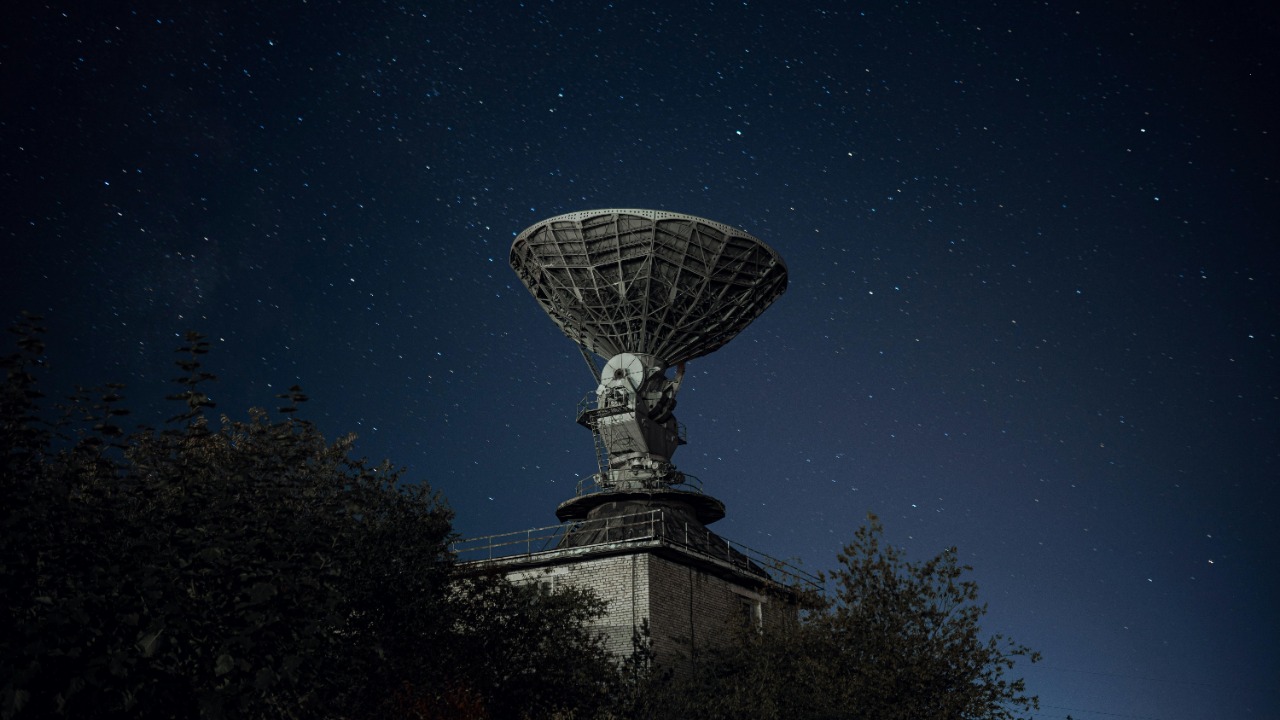

Radio telescopes have long scanned quiet patches of sky for a lone, artificial-sounding ping, but a growing body of research is pushing astronomers to look instead at the loudest neighborhoods in the universe. Rather than treating radio-bright galaxies as messy backgrounds to be filtered out, several teams now argue that these blazing beacons could be the very places where advanced civilizations are most likely to thrive. I see a shift underway, from searching for a single needle in a cosmic haystack to asking whether the haystack itself is trying to talk.
Why radio-loud galaxies are suddenly in the spotlight
The classic image of the search for extraterrestrial intelligence is a dish pointed at a quiet, Sun-like star, listening for a narrowband whistle that stands out against the cosmic hum. That strategy assumes that the best place to find technology is around stars that look like our own, in regions of the galaxy that are relatively calm. Recent work is challenging that assumption by arguing that entire galaxies that blaze with radio waves might be better hunting grounds, because they combine huge numbers of stars with energetic environments that could nurture or reveal advanced technology.
In this view, galaxies that shine with powerful radio emissions are not just astrophysical curiosities, they are statistical jackpots. A single radio-bright system can host billions of stars, each with its own planetary systems, and the intense activity that drives those emissions may correlate with conditions that accelerate the rise of complex life. Researchers have begun to suggest that aliens may be hiding in exactly these kinds of galaxies, turning what used to be treated as noisy backgrounds into prime real estate for targeted searches.
From single stars to whole galaxies as SETI targets
For decades, most organized searches for extraterrestrial intelligence have focused on individual stars, especially those that resemble the Sun and host Earth-sized planets in the so-called habitable zone. That approach made sense when telescope time and computing power were scarce, because it allowed astronomers to prioritize a short list of promising systems. The trade-off was that this strategy effectively ignored the broader galactic context, treating each star as an isolated experiment rather than part of a much larger statistical ensemble.
As instrumentation and data processing have improved, I have watched the field pivot toward a more ambitious scale, treating entire galaxies as single targets. Instead of asking whether one star out of a few thousand harbors a civilization, new surveys ask whether any civilization in a distant galaxy is broadcasting strongly enough to be detectable from Earth. This shift is evident in work that argues that galaxies with high radio emissions could be home to many advanced civilizations, reframing the search from a local neighborhood survey to a cosmic census.
What makes a galaxy “radio-bright” in the first place
To understand why these galaxies are attracting SETI interest, it helps to unpack what makes them so loud. A radio-bright galaxy typically hosts powerful astrophysical engines such as active galactic nuclei, where supermassive black holes feed on surrounding matter and launch jets that radiate intensely at radio wavelengths. Starburst regions, where stars form at unusually high rates, can also flood a galaxy with radio waves through supernova remnants and energetic particles spiraling in magnetic fields.
These natural processes create a complex tapestry of emission that, at first glance, seems like the worst possible backdrop for picking out an artificial signal. Yet the same conditions that drive strong radio output also imply dense stellar populations, rapid chemical enrichment, and long-lived energy sources, all of which could favor the emergence and survival of technological societies. The suggestion that galaxies with powerful radio emissions might conceal advanced life rests on this convergence of astrophysical richness and sheer numbers.
Breakthrough Listen’s galaxy-scale surveys
One of the most prominent efforts to operationalize this idea comes from Breakthrough Listen, a large search program that has begun to treat galaxies as unit targets. Instead of tuning in to a single star, its surveys sweep across entire extragalactic systems, looking for narrowband or otherwise anomalous signals that would stand out against the known astrophysical radio spectrum. By doing so, the project effectively asks whether any civilization in those galaxies, no matter where it is located within them, is transmitting strongly enough to be heard across intergalactic space.
The results of these surveys have been shared through a series of public releases that detail how the team filters out known sources of interference and natural emission. In its latest work, Breakthrough Listen has emphasized that galaxies with high radio emissions are especially interesting, because their intense output makes them easier to characterize and monitor over time. Even null results from such surveys are scientifically valuable, because they place upper limits on how many powerful transmitters can exist in those galaxies without having been detected.
SETI’s first low frequency search across 1,000 galaxies
The shift toward galaxy-scale SETI is not limited to high frequencies. Earlier work by the SETI Institute has launched what it describes as the first low frequency search for alien technology in distant galaxies, targeting a band of the radio spectrum that is often overlooked. Low frequencies are attractive because they can travel long distances through interstellar and intergalactic space, and because they may be energetically cheaper for a civilization to generate at very high power levels.In that project, researchers used a survey strategy that scanned more than 1,000 galaxies, treating each one as a potential host for powerful transmitters. The team highlighted that the SETI Institute Starts First Low Frequency Search For Alien Technology In Distant Galaxies effort took advantage of the fact that we know the distances to these galaxies, which allows any detected signal strength to be translated into a minimum transmitter power. That, in turn, provides concrete constraints on how energetic any hypothetical civilization would need to be in order to show up in the data.
Why low frequencies matter for hidden civilizations
Low frequency radio waves behave differently from the higher frequency bands that have dominated many past SETI efforts. They are more easily scattered and absorbed by local interference, but they can also propagate over enormous distances once they escape their home environments. If a civilization wanted to send a beacon that could be heard across intergalactic space, it might choose these frequencies precisely because they offer a favorable balance between energy cost and reach.
Recent work has underscored that a new survey operated at low frequencies while acknowledging that transmitters at higher frequencies cannot be ruled out. By scanning a wide swath of the spectrum, the team behind this survey aimed to avoid biasing the search toward any single technological choice. The description of how this new survey operated at low frequencies while leaving room for higher frequency possibilities illustrates how SETI is broadening its parameter space, rather than betting on a single favored band.
The Fermi Paradox meets radio-bright galaxies
All of this work unfolds under the shadow of the Fermi Paradox, the enduring puzzle that asks why, in a universe that seems hospitable to life, we have not yet detected any clear signs of advanced civilizations. The Fermi Paradox, first devised by physicist Enrico Fermi in the 1950s, frames the tension between the apparent abundance of habitable worlds and the silence we observe. If galaxies are teeming with life, the argument goes, then at least some of that life should have spread or signaled in ways we could notice.
By focusing on radio-bright galaxies, some scientists are effectively proposing a new way to probe that paradox. If even the most luminous, dynamic galaxies show no evidence of artificial signals, that absence would deepen the mystery and tighten the constraints on how common advanced civilizations can be. Reporting on how The Fermi Paradox, first devised by physicist Enrico Fermi, intersects with galaxies shining in radio highlights this tension, suggesting that either civilizations are rare, short-lived, or choosing communication strategies that are far more subtle than the beacons we are currently equipped to detect.
Could radio-shining galaxies really host numerous civilizations?
Some researchers have gone further, arguing that galaxies that already shine with radio signals from natural processes might also be the likeliest homes for numerous advanced civilizations. The logic is straightforward: more stars and more energetic environments mean more opportunities for life to arise, adapt, and eventually develop technology. If even a small fraction of those opportunities are realized, the cumulative number of civilizations in such a galaxy could be large, even if any one of them is relatively short-lived on cosmic timescales. Coverage of this idea has emphasized that Scientist Says Galaxies Shining With Radio Signals Could Indicate Numerous Advanced Civilizations, presenting the argument that the same conditions that make these galaxies bright also make them statistically rich in potential technological societies. I find this framing compelling because it turns a long-standing observational challenge, the difficulty of disentangling artificial signals from natural radio noise, into a feature rather than a bug: if civilizations are common in these environments, their collective output might be detectable even if no single one dominates.
How surveys sift artificial signals from natural noise
Searching for alien technology in radio-bright galaxies is not as simple as pointing a telescope and waiting for a clear, Morse-code-like pattern to appear. The data are dominated by natural astrophysical processes, terrestrial interference, and instrumental artifacts, all of which can mimic or mask the signatures that SETI teams are looking for. To cope with this, surveys rely on sophisticated algorithms that flag narrowband spikes, repeating patterns, or signals that drift in frequency in ways consistent with orbital motion, then cross-check those candidates against known sources of noise.
Both the Breakthrough Listen work and the low frequency projects have leaned heavily on survey methods that scan large numbers of targets and then apply consistent filters to the resulting data. In the case of the low frequency search that covered more than 1,000 galaxies, the team used its knowledge of each galaxy’s distance to estimate how powerful any detected transmitter would have to be, which helps distinguish plausible artificial signals from background fluctuations. The description of this survey of over 1,000 galaxies underscores how crucial careful calibration and statistical analysis are when the goal is to find a faint technological whisper in a roaring cosmic crowd.
What a detection in a radio-bright galaxy would actually tell us
If a clear artificial signal were ever found coming from a radio-bright galaxy, the implications would be profound but also constrained. Because these galaxies are so distant, any transmission we detect would be extremely old by the time it reaches us, reflecting the state of that civilization millions or even billions of years in the past. We would not be opening a real-time conversation so much as discovering a fossil record of technology, a snapshot of what was possible in another corner of the universe long ago.
Even so, such a detection would answer some of the biggest questions that animate the Fermi Paradox. It would prove that technological civilizations can arise and persist long enough to build transmitters powerful enough to be seen across intergalactic distances, and that at least one of them chose to use radio in a way that is recognizable to our instruments. The fact that researchers are now explicitly asking whether galaxies with high radio emissions could be home to many advanced civilizations signals a maturation of the field, one that is willing to grapple with the full scale of the cosmos rather than confining its hopes to the nearest stars.
More from Morning Overview