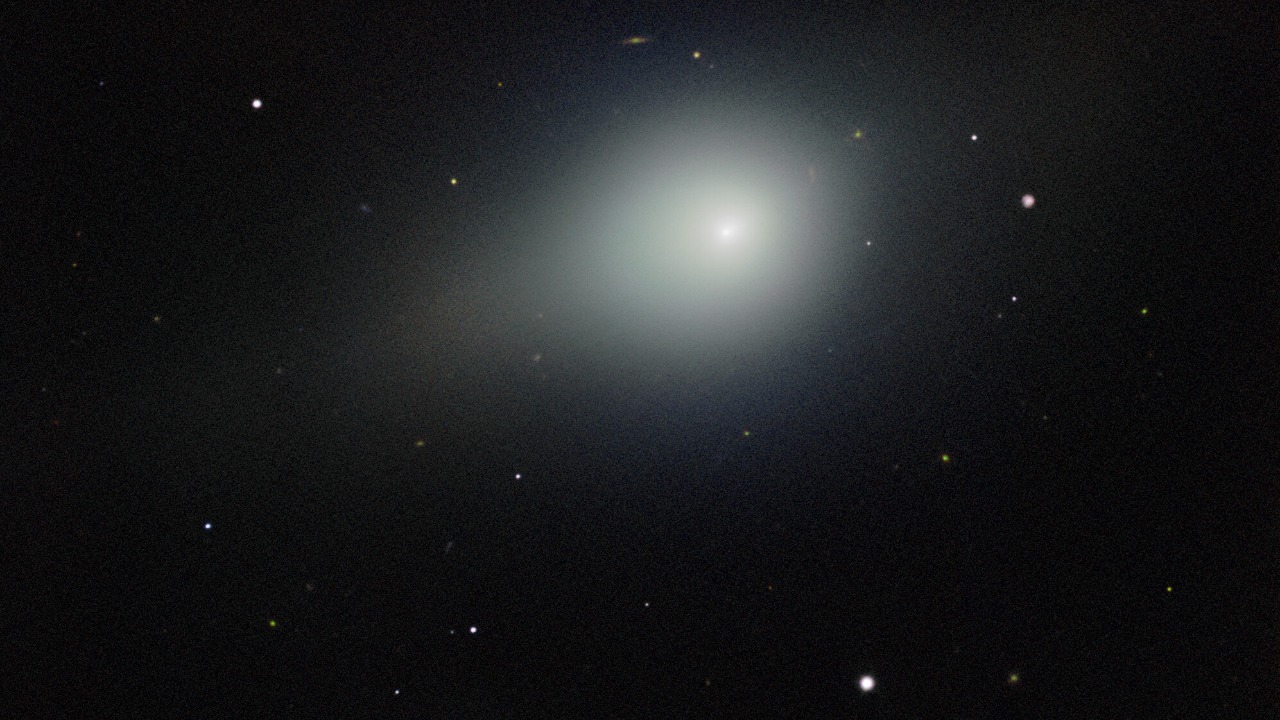

The Central Intelligence Agency’s refusal to say whether it holds records on the interstellar object 3I/ATLAS has turned a niche scientific puzzle into a pointed test of government transparency. While NASA publicly describes 3I/ATLAS as a comet of natural origin, the CIA’s decision to neither confirm nor deny any files on the object has fueled questions about why an intelligence service is brushing up against a deep space discovery at all.
At stake is more than one mysterious visitor from beyond the Solar System. The clash between NASA’s open scientific posture and the CIA’s secrecy touches on how the United States handles anomalous data, how much the public is allowed to know about interstellar objects, and whether intelligence agencies are quietly building their own picture of what is moving through the space around Earth the way they already do with aircraft and satellites.
NASA’s comet, the CIA’s silence
NASA has been clear in its public framing of 3I/ATLAS, describing the object as a comet and emphasizing that its behavior fits within a natural, if unusual, category of interstellar visitors. In that account, 3I/ATLAS is the third known interstellar object to pass through the Solar System, and its trajectory and outgassing mark it as a comet rather than something artificial. The agency’s language, including the way NASA explicitly calls it a comet, signals confidence that standard astrophysics can explain what is being observed, even if the object is rare and scientifically valuable.
The CIA, by contrast, has chosen the most guarded possible response. When asked about records related to 3I/ATLAS, the agency replied that it would neither confirm nor deny the existence of any such files, a classic “Glomar” answer that is usually reserved for sensitive intelligence programs. That stance, captured in coverage that notes how NASA calls it a comet but the CIA refuses to clarify files, does not prove the agency has a secret dossier on 3I/ATLAS. It does, however, confirm that the question of whether the CIA “looked into it” is itself treated as classified, which is an unusual posture toward what NASA insists is a natural comet.
Why 3I/ATLAS stands out among interstellar visitors
Interstellar objects are, by definition, rare. Before 3I/ATLAS, astronomers had only identified two such visitors, and each arrival has forced scientists to rethink assumptions about how material travels between star systems. 3I/ATLAS was detected in July, flagged as an object on a hyperbolic path that could not be bound to the Sun, and quickly categorized as the third interstellar object to be tracked in detail. That alone would make it a scientific prize, but the object’s behavior has been even more intriguing than its trajectory.
Observations described in a detailed analysis of how 3I/ATLAS just changed everything we know about comets highlight that far from Earth the object appears to be emitting a metal alloy that astronomers had never previously seen in a comet. For planetary scientists, that kind of signature raises questions about the conditions in the system where 3I/ATLAS formed, and whether standard models of comet composition are too narrow. For intelligence agencies, an object that behaves unlike any known comet, yet passes through the neighborhood of Earth the way Atlas did, could be enough to trigger interest, even if only to rule out exotic possibilities.
Jan Loeb’s challenge to official narratives
Into this gap between NASA’s confidence and the CIA’s silence stepped Jan Loeb, an astronomer who has made a career out of pressing institutions to take anomalous space data seriously. In a new blog post, Loeb pointedly argued that NASA is not the only government body that should be answering questions about 3I/ATLAS, and he directed his criticism at the CIA’s refusal to engage. By naming the agency and highlighting its noncommittal response, he framed the issue as one of accountability, not just scientific curiosity.
Loeb’s argument is straightforward: if NASA is prepared to say that 3I/ATLAS is a comet of natural origin, then intelligence agencies should be willing to say whether they have independently evaluated that claim. His post, which notes that NASA is not the government institution he is taking aim at, underscores that the real friction lies with the CIA’s decision to neither confirm nor deny records on 3I/ATLAS. By putting his own reputation behind the call for clarity, Jan Loeb has turned what might have been a quiet Freedom of Information Act exchange into a public debate over how the United States handles unusual data from deep space.
How a Glomar response shapes public perception
For anyone who follows intelligence policy, the CIA’s “neither confirm nor deny” language is familiar. It is the same formula the agency has used for decades to avoid acknowledging classified programs, from surveillance platforms to covert operations. Applied to 3I/ATLAS, that Glomar response has a predictable effect: it invites speculation that there is something in the files worth hiding, even if the underlying records are mundane. The very act of refusing to say whether the CIA looked at a comet-like object suggests that the agency treats interstellar visitors as potential intelligence targets.
In the context of 3I/ATLAS, that secrecy lands awkwardly next to NASA’s openness. When one arm of the government says “comet of natural origin” and another refuses to say whether it even checked, the gap becomes a breeding ground for conspiracy theories. The coverage that spells out what the CIA actually said, emphasizing that the agency would not clarify whether it had examined 3I/ATLAS, reinforces the sense that the intelligence community is out of step with the scientific one. For a public already primed by years of debate over unidentified aerial phenomena, the Glomar answer on a deep space object looks less like routine caution and more like a deliberate choice to keep the door to speculation ajar.
Scientific stakes: a metal alloy never seen before
Strip away the secrecy and 3I/ATLAS is still extraordinary on its own terms. The object’s reported emission of a metal alloy never before seen in a comet challenges long standing assumptions about how such bodies form and evolve. If the spectral data hold up, they suggest that the building blocks of planets and comets in other star systems can differ sharply from those in our own, which in turn affects models of how common Earth-like worlds might be. For planetary science, that is a profound implication, one that justifies intense scrutiny of every photon 3I/ATLAS reflects or emits.
The description of how Earth the interstellar object Atlas appears to be shedding this unusual alloy has already prompted calls for more targeted observations and for reanalysis of older comet data to see if similar signatures were missed. In that light, NASA’s insistence that 3I/ATLAS is a comet of natural origin is not an attempt to downplay its significance, but rather to situate it within a broader effort to map the diversity of interstellar debris. The more scientists can pin down the composition and behavior of 3I/ATLAS, the less room there is for speculation that its anomalies point to something artificial, and the more pressure there is on agencies like the CIA to explain why they treat questions about it as sensitive.
Why an intelligence agency might care about a comet
From an intelligence perspective, there are plausible reasons to pay attention to an object like 3I/ATLAS that have nothing to do with science fiction. The United States relies on a network of sensors, many of them classified, to track objects in space, from ballistic missiles to satellites and debris. An interstellar object on a fast, unusual trajectory can light up those systems in ways that resemble threats, at least until it is properly characterized. In that sense, the CIA’s interest, if it exists, could be purely about ensuring that exotic but harmless phenomena are not mistaken for hostile activity.
There is also a long history of intelligence agencies monitoring scientific developments that intersect with national security, from nuclear physics to satellite imaging. A comet that emits a never before seen metal alloy and passes through the inner Solar System might be of interest simply because it tests the limits of existing models and sensors. If the CIA commissioned or received internal assessments of 3I/ATLAS, those documents would likely be classified by default, even if they ultimately agreed with NASA that the object is natural. The problem, as the current controversy shows, is that a blanket refusal to acknowledge any records at all blurs the line between routine caution and unnecessary secrecy.
Transparency, FOIA, and the limits of openness
The fight over 3I/ATLAS records is also a test case for how far the Freedom of Information Act can reach into the space domain. FOIA is designed to pry loose government documents unless they fall into specific exempt categories, such as national security or intelligence sources and methods. When the CIA responds to a FOIA request about 3I/ATLAS with a Glomar answer, it is effectively saying that even the existence of responsive records would reveal something about how the agency collects or analyzes information, and that this, in itself, is too sensitive to disclose.
For advocates of transparency, that stance is hard to square with the nature of the subject. A comet that NASA openly discusses, and that astronomers like Jan Loeb analyze in public, hardly seems like the kind of topic where acknowledging an internal memo would endanger sources and methods. Yet the CIA’s refusal to confirm or deny records on 3I/ATLAS shows how broad the agency’s interpretation of FOIA exemptions can be. It also highlights a structural tension: as scientific instruments grow more powerful and more intertwined with national security systems, the boundary between open research and classified analysis becomes harder to maintain, and FOIA becomes a blunter tool for forcing clarity.
The narrative gap between science and secrecy
What makes the 3I/ATLAS episode resonate beyond a small circle of space enthusiasts is the narrative gap it exposes between scientific and intelligence cultures. On one side, NASA and researchers like Jan Loeb are comfortable putting their interpretations on the record, labeling 3I/ATLAS a comet, debating its composition, and inviting others to challenge their conclusions. On the other, the CIA is unwilling to say whether it even glanced at the same data, much less what its analysts might have thought. That asymmetry feeds a perception that the government is running parallel, hidden conversations about phenomena that the public is told are fully understood.
For now, the facts that can be verified are straightforward. NASA calls 3I/ATLAS a comet of natural origin. Jan Loeb has publicly criticized the CIA for refusing to confirm or deny records on the object. Reporting on the agency’s response makes clear that the CIA will not clarify whether it “looked into it,” even as scientific coverage stresses that 3I/ATLAS is emitting a metal alloy never before seen in a comet. Between those points lies a space filled with unanswered questions, where the boundaries between curiosity, caution, and classification are still being drawn.
More from Morning Overview