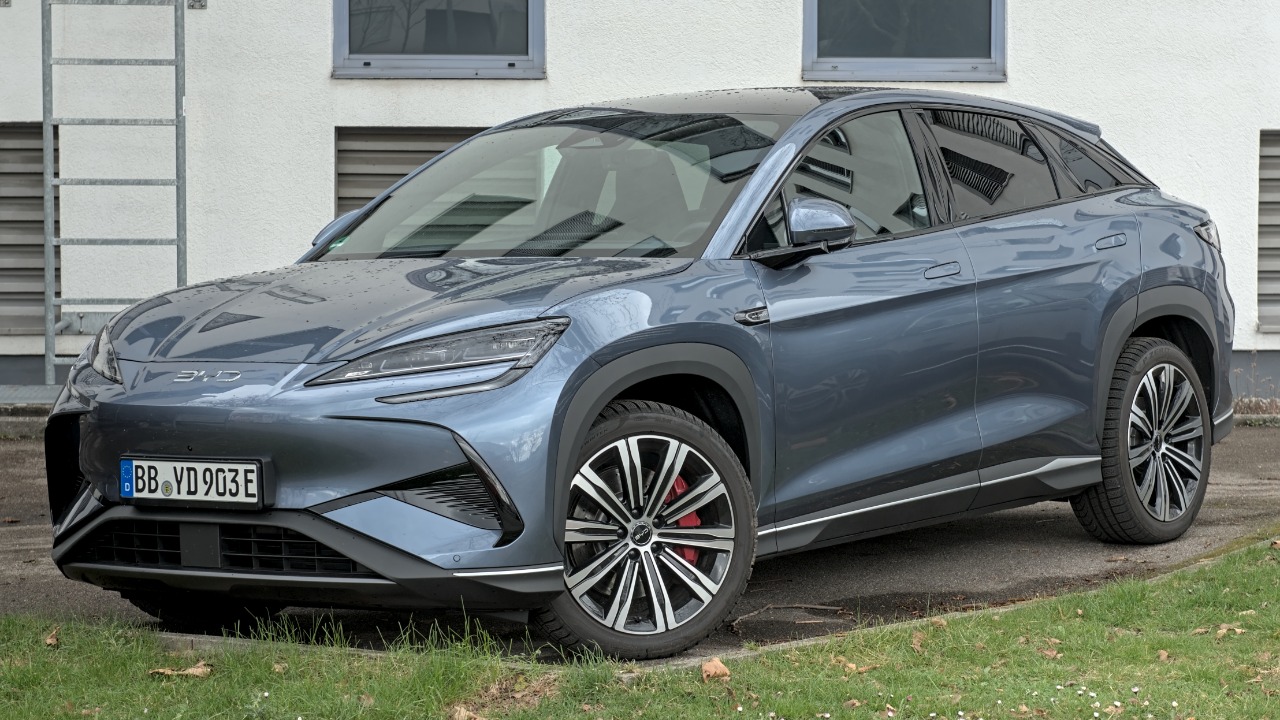

China’s latest electric SUV upgrade is built around a larger 82.7 kWh battery pack and a claimed driving range of 441 miles, figures that push the country’s homegrown models deeper into long‑distance territory. The move signals how quickly Chinese brands are closing the gap with, and in some cases overtaking, established rivals on the core metric that still defines EV appeal for many drivers: how far you can go on a single charge.
By stretching range while keeping performance and practicality in focus, the new configuration turns a once‑niche high‑tech experiment into a mainstream proposition for family buyers and commuters. I see it as a marker of how China’s electric vehicle industry is maturing, shifting from proving that EVs work to refining them into products that can replace combustion cars without compromise.
BYD’s Sealion 06 EV steps into the spotlight
The upgrade centers on the BYD Sealion 06 EV, a compact to mid‑size sport utility vehicle that sits in the heart of the market where global brands fight hardest for volume. BYD has already built a reputation for pairing aggressive pricing with in‑house battery technology, and this model extends that formula by pairing a practical SUV body with a long‑range powertrain. In a segment where buyers expect space, comfort, and a sense of security, the Sealion 06 EV is designed to feel familiar while quietly rewriting expectations about how far an electric SUV can travel.
What makes this particular refresh stand out is that it is not a halo supercar or a limited‑run experiment, but a mass‑market vehicle aimed at everyday drivers in China’s dense cities and sprawling suburbs. As Chinese automaker BYD leans on its scale and vertical integration, it can roll out a substantial battery and range increase in a model that competes directly with gasoline crossovers on usability and cost. That positions the Sealion 06 EV as a bellwether for how quickly long‑range electric SUVs could become the default choice in China and, potentially, in export markets that are watching these developments closely.
The 82.7 kWh battery: what the upgrade really changes
The headline figure in this refresh is the 82.7 kWh battery pack, a capacity that moves the Sealion 06 EV into the same energy class as many premium electric sedans and larger SUVs. For drivers, that number translates into more usable range headroom, especially at highway speeds where consumption rises and smaller packs can feel limiting. I see this as a deliberate attempt to remove “range anxiety” from the buying decision, giving owners enough buffer to handle daily commuting, weekend trips, and seasonal weather swings without constantly planning around chargers.
From a technical perspective, stepping up to 82.7 kWh also reflects BYD’s confidence in its battery chemistry and packaging. Larger packs add weight and cost, so manufacturers only make this move when they believe the trade‑offs are justified by efficiency gains and customer demand. In the Sealion 06 EV, the upgrade signals that BYD is willing to prioritize long‑distance capability in a high‑volume SUV, betting that Chinese buyers will reward the extra flexibility even if it nudges the vehicle slightly upmarket compared with smaller‑battery rivals.
Stretching to 441 miles of range
The other number that matters is the claimed 441 miles of driving range, a figure that places the Sealion 06 EV among the longest‑legged electric SUVs available in China. For context, that distance rivals or exceeds what many gasoline crossovers manage on a full tank, especially in urban stop‑and‑go traffic where electric drivetrains are most efficient. When I look at that 441‑mile claim, I see a psychological threshold being crossed: it is far enough that most drivers can imagine a full week of commuting or a long intercity journey without needing to recharge.
Of course, real‑world range will depend on driving style, temperature, and speed, and standardized test cycles often paint an optimistic picture. Even so, a rated 441 miles gives a comfortable margin for owners who routinely travel between major Chinese cities or who live in regions where charging infrastructure is still catching up. It also gives BYD a powerful marketing hook in a crowded field of electric SUVs, allowing the company to present the Sealion 06 EV as a long‑distance tool rather than a city‑only runabout.
Positioning in China’s high‑performance electric SUV class
BYD is not just chasing range for its own sake, it is using the Sealion 06 EV to stake a claim in China’s high‑performance electric SUV class. This segment blends brisk acceleration and advanced electronics with the practicality of a family vehicle, a combination that has proven popular among younger urban professionals. By pairing the 82.7 kWh pack with a capable powertrain and a chassis tuned for confident handling, BYD is signaling that buyers do not have to choose between efficiency and driving enjoyment.
In practice, that means the Sealion 06 EV is pitched against a wave of domestic rivals that are also pushing the boundaries of what an electric SUV can be. Chinese brands have been quick to adopt features like dual‑motor all‑wheel drive, sophisticated traction control, and adaptive suspension, and a long‑range battery gives those systems more room to shine on extended journeys. Within this context, the Sealion 06 EV’s combination of 82.7 kWh capacity and 441 miles of range helps it stand out as a complete package in the high‑performance electric SUV class, a positioning underscored by reporting on China’s high‑performance EV.
How BYD’s battery strategy shapes the Sealion 06 EV
BYD’s decision to equip the Sealion 06 EV with an 82.7 kWh pack is rooted in its broader battery strategy, which relies heavily on in‑house development and manufacturing. By controlling cell chemistry, module design, and pack integration, the company can optimize energy density and cost in ways that are harder for automakers that buy batteries from third parties. I see this vertical integration as a key enabler of the Sealion 06 EV’s long‑range capability, because it lets BYD push capacity without losing sight of affordability.
The company’s experience with large‑scale battery production also gives it confidence to deploy bigger packs across multiple models, spreading development costs and simplifying supply chains. In the Sealion 06 EV, that translates into a battery system that is not just larger, but also tuned to work efficiently with the vehicle’s power electronics and thermal management. This holistic approach helps explain how BYD can deliver a 441‑mile rating in a practical SUV format, rather than reserving such figures for low‑slung, ultra‑aerodynamic sedans.
Implications for China’s domestic EV competition
Within China, the Sealion 06 EV’s upgrade raises the bar for domestic competitors that have been racing to differentiate themselves on range, performance, and software. When one major player introduces an 82.7 kWh battery and a 441‑mile claim in a mainstream SUV, it pressures others to respond with similar or better specifications. I expect this to accelerate a specification arms race in the mid‑size electric SUV category, with range and charging speed becoming even more central to marketing and product planning.
At the same time, the move highlights how quickly Chinese brands are converging on a new baseline for what an electric family car should offer. Features that were once reserved for premium imports, such as long‑distance capability and advanced driver assistance, are increasingly standard in domestic models. The Sealion 06 EV’s upgrade therefore does more than boost a single vehicle, it helps redefine expectations across China’s EV market, making it harder for slower‑moving rivals to compete without similar investments in battery technology.
Global ripple effects and export ambitions
Although the Sealion 06 EV is tailored first to Chinese buyers, its specifications will not go unnoticed in overseas markets where BYD is expanding. A compact SUV with an 82.7 kWh battery and a 441‑mile rating is a compelling proposition in Europe, Latin America, and parts of Asia where charging networks are improving but still uneven. I see this model as a template for export‑ready variants that could challenge established brands on both range and price, especially in countries that are eager to accelerate EV adoption but sensitive to cost.
For global automakers, the emergence of such long‑range Chinese SUVs raises strategic questions about how quickly they must respond with comparable offerings. If BYD can ship vehicles with this level of capability into foreign markets at aggressive price points, it could erode the premium that legacy brands have long commanded for their electric crossovers. The Sealion 06 EV’s upgrade therefore has implications far beyond China’s borders, signaling that the next wave of EV competition will be fought on a global stage where Chinese technology and scale play a central role.
What it means for everyday drivers
For individual drivers, the practical impact of the Sealion 06 EV’s upgrade is straightforward: more freedom to drive without constantly thinking about the next charge. An 82.7 kWh battery and a 441‑mile rating mean that many owners can treat the vehicle much like a traditional gasoline SUV, refueling (or in this case, recharging) only a few times a month under typical commuting patterns. That shift in day‑to‑day experience is crucial for convincing skeptical buyers that an electric SUV can handle school runs, business trips, and holiday travel without added stress.
There are also subtler benefits that come with a larger battery, such as the ability to maintain higher speeds or use energy‑hungry features like cabin heating and air conditioning without worrying as much about range penalties. For families who live in colder or hotter regions of China, that extra buffer can make the difference between an EV that feels constrained and one that feels liberating. In that sense, the Sealion 06 EV’s upgrade is not just a technical milestone, it is a step toward making electric mobility feel normal and convenient for a broader slice of the population.
More from MorningOverview