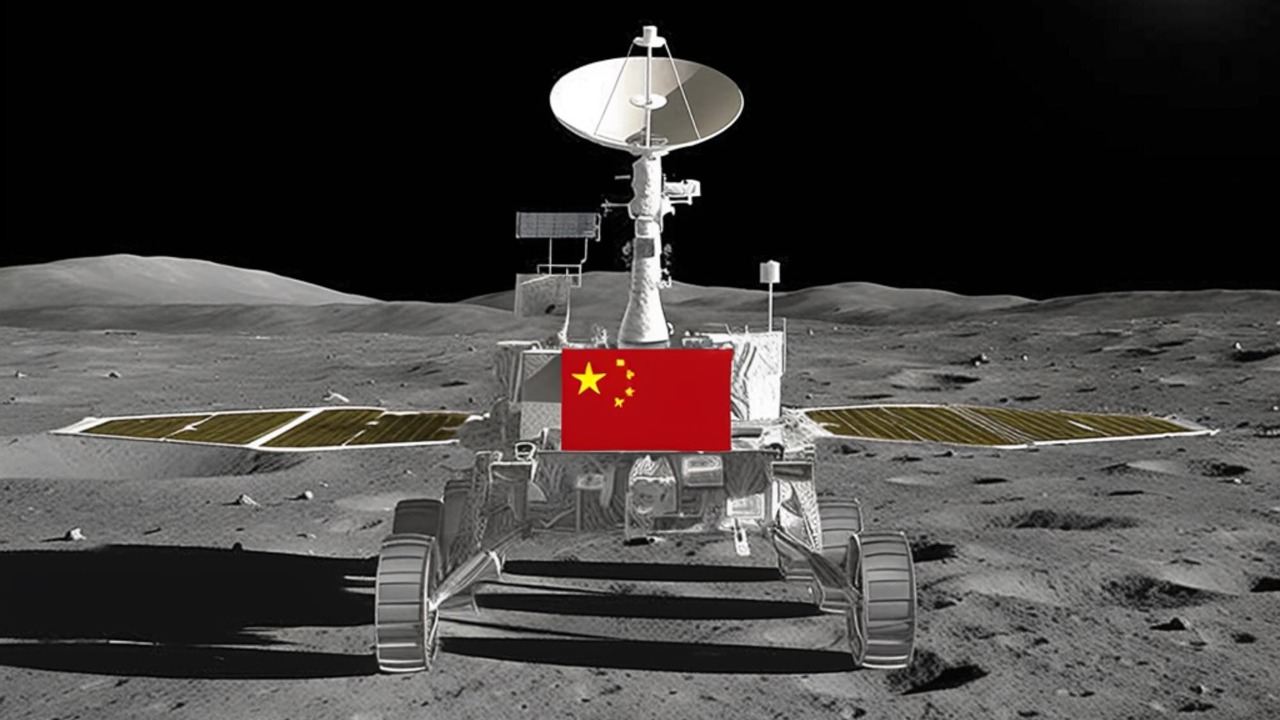

China has quietly taken a decisive step in the new space race by building what it calls the first software system capable of keeping clocks on Earth and on the Moon in sync. The tool is designed to solve a problem that used to be academic, but is now central to navigation, communications and safety as more nations and companies prepare to operate around the lunar surface. By turning relativistic physics into a practical timing standard, Chinese scientists are trying to define how time itself will be measured in the coming lunar economy.
At the heart of the project is a push to create a unified reference so that spacecraft, landers, rovers and future habitats can all agree on the same tick of the clock, even though time passes differently in the Moon’s weaker gravity. The new software is meant to bridge that gap, translating between terrestrial systems and a dedicated lunar timescale with nanosecond precision over centuries. If it works as described, it will give China a powerful role in setting the rules for how the rest of the world schedules life and work beyond Earth.
Why lunar time suddenly matters
For decades, the fact that clocks run at a slightly different rate on the Moon did not matter much, because missions were short and infrequent and could rely on ground control to reconcile any discrepancies. Engineers now warn that this approach will not scale as multiple countries plan overlapping landings, orbiters and crewed bases that must coordinate in real time. Reports on the new system stress that in the past, when lunar missions were rare, the relativistic drift between clocks on the Moon and clocks on Earth could be ignored, but that is no longer true as activity accelerates around the Moon and in cislunar space.
The new software is explicitly framed as a response to that shift, with Chinese planners positioning it as infrastructure for a dense network of future lunar clocks and navigation beacons. One account notes that the tool is intended to keep lunar clocks in sync for operations on and around the Moon, so that every vehicle and station can reference a common standard without constant intervention from Earth. By treating timekeeping as a shared service rather than a mission-by-mission patch, China is trying to lock in a technical foundation before rival systems from other space powers emerge.
The physics problem: clocks tick faster on the Moon
The core challenge the software tackles is rooted in Einstein’s relativity, which predicts that clocks in weaker gravity run slightly faster than those deeper in a gravity well. On the Moon, where gravity is about one sixth of Earth’s, that means a perfectly built atomic clock would gradually pull ahead of its twin on the ground. Chinese researchers emphasize that this is not a theoretical curiosity but a measurable effect that will compound over time, especially for high precision tasks like landing guidance and autonomous docking between lunar orbit and the surface.
To handle this, the system defines a dedicated lunar timescale and then provides a way to translate it back and forth with the terrestrial standard used on Earth. Technical descriptions explain that the method accounts for both the Moon’s gravity and its motion, so that clocks on the surface, in lunar orbit and on Earth can all be related through a single mathematical framework. One study reports that the resulting synchronization remains accurate to within a few tens of nanoseconds even over 1,000 years, a level of stability that would keep navigation and communication systems aligned across generations of missions.
Inside China’s world-first software
Chinese officials describe the new tool as the world’s first complete software package dedicated to synchronizing Earth and lunar time, rather than a patchwork of mission specific corrections. The work is credited to Researchers at the Purple Mountain Observatory in China, who have long experience in precise astronomical measurements and timing. According to technical summaries, the software takes inputs from reference clocks and orbital data, then outputs a unified time signal that can be distributed to spacecraft, landers and surface infrastructure.
Developers say the system is designed to support both Earth and Moon operations, with algorithms that can be embedded in onboard computers or run from ground stations. One detailed account notes that China develops world-first software to synchronize Earth and moon time as part of a broader strategy to support navigation, communications and scientific experiments in the lunar environment. Another report highlights that the method is robust against small perturbations in the fabric of space-time, which is why it can maintain nanosecond precision even as the Earth and Moon move through the solar system.
Nanosecond precision and long-term stability
What sets the Chinese approach apart is the level of accuracy it claims to deliver over very long periods. Technical reporting on the project states that the synchronization method remains accurate to within a few tens of nanoseconds over 1,000 years, a figure that would normally be associated with the most advanced terrestrial atomic clock networks. That kind of stability is not just a scientific bragging right, it directly affects how safely spacecraft can navigate and how reliably data can be timestamped for scientific analysis and legal or commercial records.
Engineers involved in the work argue that nanosecond precision is essential once multiple actors are operating simultaneously around the Moon, because even tiny timing errors can translate into significant positional uncertainty over long distances. One analysis of the system notes that it delivers nanosecond precision by rigorously modeling relativistic effects and validating the results against independent astronomical observations. Another report on the same project explains that the method was detailed in a peer reviewed issue of Astronomy and Astrophysics, underscoring that the claims are being scrutinized within the scientific community rather than only in internal program documents.
Strategic stakes in the new lunar economy
Behind the technical achievement sits a clear geopolitical calculation. Commentators on the project point out that a new global space race is heating up, with multiple countries and private companies vying for influence in the upcoming “lunar economy.” By moving first on a practical standard for synchronizing Earth and Moon time, China is positioning itself to shape how future lunar navigation networks, communication constellations and even financial systems will operate. Control over timekeeping has always been a form of soft power, from maritime chronometers to GPS, and the same logic now applies beyond Earth orbit.
In China, officials frame the software as a contribution to international cooperation, but the timing and scope of the project make it clear that it also serves national interests. One report from In China stresses that to accurately measure time on the Moon and keep it aligned with Earth, a dedicated system was needed, and that Chinese scientists have now figured out how to synchronize lunar and Earth time in practice. Another account notes that the software is meant to make it easy for future missions to standardize their clocks, which would naturally encourage partners to adopt the Chinese framework rather than develop competing standards.
More from Morning Overview