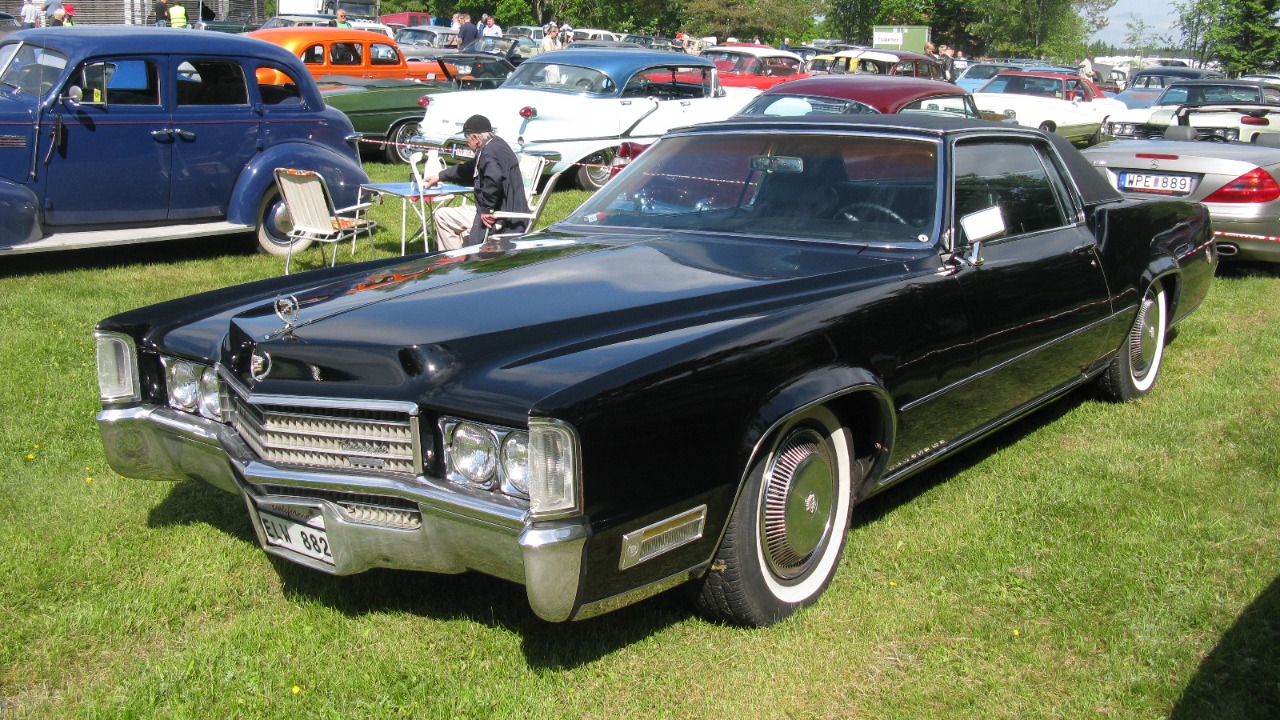

Cadillac has never been shy about chasing excess, but one of its boldest engines never made it to the showroom. In the 1960s the brand developed an overhead cam V12 so large and complex that it effectively outgrew the cars and regulations it was meant to power, leaving a family of prototypes as proof of how far the company was willing to go. That aborted giant sits at the center of a longer story about how Cadillac used multi‑cylinder engines to define luxury, lose its way, and then try to reclaim its image with ever more spectacular hardware.
From silent luxury to cylinder-count one‑upmanship
Cadillac built its reputation in the first half of the twentieth century on refinement rather than raw speed, but refinement quickly became a numbers game. In the early 1930s the company created a V16 that stacked two V‑8 cylinder banks on a common crankcase, a layout that gave buyers a level of smoothness and quiet operation that conventional engines could not match. Period accounts describe the Engine structures of the day as multi‑piece affairs, and Cadillac leaned into that complexity to deliver a flagship powerplant that could move heavy formal bodies while still feeling almost electric from behind the wheel.
That V16 did more than move limousines, it set off a prestige arms race that made cylinder count a shorthand for status. Cadillac General Manager Lawrence Fisher even leaked word that the company would build a V12, a Series 370 and later a 1936–1937 Series 80/85, in part to distract rivals and the press from the true scale of the V16 project. In that era, offering both twelve and sixteen cylinders let Cadillac bracket the luxury market and signal that it could out‑engineer European marques that had dominated multi‑cylinder design. The template was set: when Cadillac wanted to make a statement, it reached for more cylinders and more displacement.
The original Cadillac V‑12 and the prewar peak
The first production Cadillac V‑12 arrived as a companion to the V16, aimed at buyers who wanted the cachet of a multi‑cylinder engine without the full cost and complexity of the sixteen. The twelve used a similar architecture but with fewer cylinders, giving it a slightly lighter and more compact footprint that still delivered the velvety power delivery wealthy customers expected. It slotted into the lineup as the Series 370 and later the Series 80/85, reinforcing the idea that Cadillac could tailor its engineering to different tiers of the luxury market while keeping the same aura of technical excess that surrounded its flagship engines.
That prewar V‑12 also helped define how American luxury brands thought about performance. Contemporary observers noted that, although some European manufacturers returned to twelve‑cylinder layouts after the war, multicylinder engines largely disappeared from mainstream American cars with more than eight cylinders. The Cadillac twelve and sixteen were therefore not just products, they were cultural markers of a time when the U.S. industry believed that the path to prestige ran through ever more elaborate engine bays. When that era ended, Cadillac had to find new ways to express the same ambition.
Why Cadillac went hunting for a new V12 in the 1960s
By the middle of the 1960s, Cadillac faced a different kind of challenge. Big cars and soft rides still sold, but they no longer guaranteed respect among enthusiasts or younger buyers who were starting to look at European sedans and sports cars as benchmarks. The brand wanted to prove that it could deliver modern engineering as well as traditional comfort, and that meant revisiting the idea of a multi‑cylinder flagship with contemporary technology rather than prewar nostalgia. A new V12, this time with overhead camshafts and a focus on high‑speed refinement, looked like a way to reconnect with its heritage while signaling that Cadillac was ready for the next era.
Internal engineers began sketching an engine that would sit above the familiar V‑8s and give Cadillac a technical halo similar to what exotic brands enjoyed. Reporting on that period describes how Cadillac chased a new kind of respect, recognizing that image alone would not be enough as regulations tightened and foreign competition grew sharper. The company wanted a powerplant that could cruise effortlessly at highway speeds, meet anticipated emissions rules, and still feel special enough to justify its place at the top of the range. On paper, the new V12 promised all of that, but the reality would prove far more complicated.
The overhead cam V12 that almost made it
The heart of the project was an overhead camshaft design that broke with Cadillac’s traditional pushrod engines. Engineers settled on a 60-degree bank angle, a configuration that offered good balance and packaging for a twelve‑cylinder layout. Six prototypes were built as part of the development program, each using chain driven camshafts and hydraulic finger followers to keep valvetrain noise and maintenance in check. The goal was to create an engine that felt as smooth and sophisticated as anything from Europe while still being robust enough for American driving habits and service intervals.
Those prototype engines shared key traits, including a single overhead camshaft on each of the cylinder banks, which were split 60 degrees, and induction handled by Three Rochester 2GC two‑barrel carburetors. The combination promised both smoothness and serious power, with the triple carburetor setup hinting at strong high‑rpm breathing. From a technical standpoint, the package looked ready to give Cadillac a modern flagship engine that could sit comfortably in large sedans and limousines. The problem was not whether the V12 could run, it was whether the rest of the car, and the market around it, could accommodate such a machine.
When an engine is literally too big
The new V12 did not fail because it was underdeveloped, it failed because it was overbuilt for the world it was about to enter. The block and heads were physically large, and once accessories, cooling hardware, and exhaust routing were added, the engine bay of a typical Cadillac sedan started to look cramped. Engineers found that the sheer size and weight of the unit made it difficult to integrate without compromising other aspects of the car, from crash structures to steering geometry. In effect, the engine that was supposed to crown the lineup threatened to distort the entire vehicle around it.
Size was only part of the problem. The V12’s displacement and complexity made it expensive to produce and thirsty at a time when fuel economy and emissions were becoming political issues rather than engineering footnotes. Internal assessments concluded that the engine would struggle to meet the next wave of regulations without costly revisions, and that its appetite for fuel would be hard to justify even to affluent buyers. Accounts of the program describe how it was judged to be too big in every sense, from physical dimensions to regulatory risk. Faced with that reality, Cadillac quietly shelved the project, leaving the prototypes as artifacts of an ambition that had overshot its moment.
How the V12 that never was shaped Cadillac’s later thinking
Even though the overhead cam V12 never reached production, it left a mark on Cadillac’s engineering culture. The experience taught the company that chasing prestige through sheer scale could backfire when regulations and market expectations were shifting. Engineers who had worked on the twelve carried those lessons into later programs, focusing more on how to package advanced engines within realistic vehicle envelopes and cost structures. The failure of the giant V12 did not kill Cadillac’s taste for dramatic powertrains, but it did make the brand more cautious about how far it could push hardware without undermining the rest of the product.
That caution helps explain why, in the decades that followed, Cadillac often chose to express performance through tuned versions of its V‑8s rather than jumping straight to another twelve‑cylinder production engine. At the same time, the company never fully abandoned the idea of using extreme cylinder counts as a design statement. The memory of the aborted V12 lingered as a kind of unfinished business, a reminder that Cadillac had once tried to build an engine that was literally too much for its time. When the brand eventually returned to multi‑cylinder excess in the 2000s, it did so in a way that acknowledged both the allure and the limits of that approach.
The Cadillac Sixteen and the return of outrageous cylinders
The most dramatic expression of that return was the Cadillac Sixteen, a concept car that revived the idea of a sixteen‑cylinder flagship for the modern era. The Cadillac Sixteen was equipped with a massive V16 engine and a body that stretched the brand’s design language into something almost theatrical, with a curb weight listed at 5,005 lb (2,270 kg). Unlike the 1960s V12, this engine was never intended for mass production, which freed designers and engineers to prioritize spectacle over practicality. The car existed as a rolling manifesto that Cadillac could still imagine itself at the top of the luxury hierarchy.
The V16 at the heart of the concept was shaped by a team that included Wayne Cherry, Brian Smith, Tom Stephens, and the rest of the GM design group. They built an engine that could shut down cylinders to save fuel and used the car’s long hood and rigid structure to turn its mechanical excess into a visual centerpiece. In doing so, they sidestepped the packaging and regulatory traps that had doomed the earlier V12, because the Sixteen did not have to meet production constraints. It was a concept that learned from the past by refusing to be bound by it.
Inside the Cadillac Sixteen Concept’s V16
Technically, the Sixteen’s engine was as ambitious as its styling. The Cadillac Sixteen Concept used a 32‑valve V16 that combined traditional American displacement with modern control systems, including cylinder deactivation that allowed it to run on fewer cylinders under light load. The design delivered towering torque figures while still nodding to efficiency, a balance that would have been unthinkable in the era of the 1960s V12 prototypes. By framing the engine as a technological showcase rather than a production commitment, Cadillac could indulge in the kind of mechanical theater that had once defined its prewar flagships.
The Sixteen’s powertrain also served as a bridge between Cadillac’s heritage and the broader General Motors ecosystem. Its layout and control strategies echoed ideas being explored in high‑end trucks and performance cars, suggesting that lessons from the concept could filter into more attainable products. In that sense, the Sixteen inverted the logic of the abandoned V12: instead of trying to force an oversized engine into a conventional sedan, it built an entire car around the engine as an object of fascination. The concept showed that Cadillac could still play in the realm of outrageous cylinders, but only when it treated that excess as a design narrative rather than a volume business plan.
GM’s last production V12 and the limits of mega‑engines
While Cadillac flirted with multi‑cylinder concepts, the wider General Motors family did put one last twelve‑cylinder engine into limited production. GMC developed the Twin Six, an 11.5‑liter V12 that was used in heavy‑duty applications rather than luxury sedans. The first, and largest, obstacle was cost, since it was quite expensive for GMC to produce the Twin Six due to its sheer size and complexity. That engine underscored how difficult it had become to justify such hardware outside of specialized niches, even when the target market cared more about torque than image.
The Twin Six also highlighted the regulatory and economic pressures that had boxed in Cadillac’s 1960s V12. If a workhorse engine built for trucks struggled to make financial sense, a refined overhead cam twelve for passenger cars faced even steeper odds. The fact that the Twin Six has not been used on public roads since its limited run shows how far the industry has moved away from multi‑cylinder excess as a mainstream solution. In that context, Cadillac’s decision to cancel its oversized V12 looks less like a missed opportunity and more like an early recognition of where the market was heading.
Why Cadillac’s “too big” V12 still matters
Looking back, the V12 that was too large for its own good captures a turning point in American automotive history. It represents the moment when a company built on the idea that more cylinders meant more prestige ran into the hard limits of packaging, regulation, and cost. The engine’s Although it never reached showrooms, its development forced Cadillac to confront the reality that the old formula could not simply be scaled up indefinitely. That realization shaped everything from the brand’s later V‑8 performance sedans to its decision to use concepts like the Sixteen as storytelling tools rather than production blueprints.
For enthusiasts, the story of that abandoned V12 is a reminder that engineering bravado and business pragmatism are always in tension. I see it as a cautionary tale about how even a company with Cadillac’s resources can build something technically impressive that has nowhere to go. At the same time, it is hard not to admire the audacity of an era when engineers could sketch a 60‑degree overhead cam twelve with Three Rochester carburetors and try to make it fit under the hood of a luxury sedan. The engine may have been too big for its time, but the ambition behind it still looms large over Cadillac’s past and its ongoing search for a new kind of greatness.
More from MorningOverview