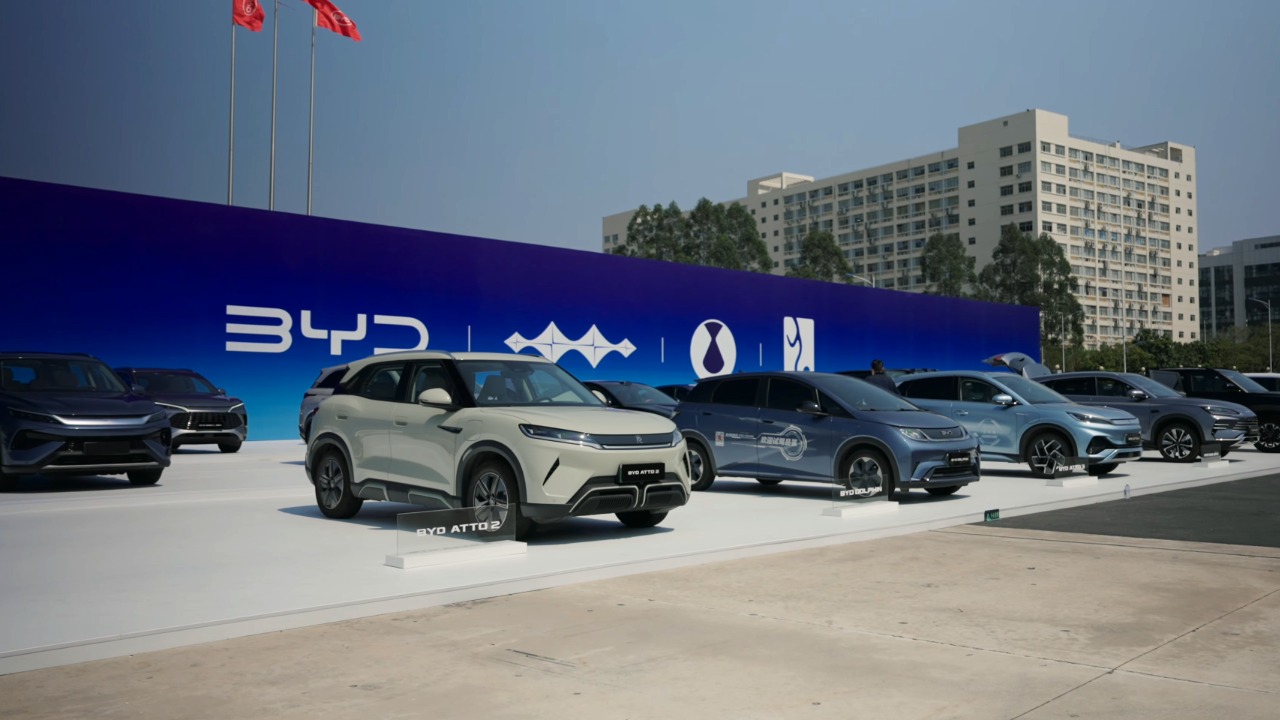

For the first time since the modern electric car boom began, Tesla is no longer the world’s dominant battery‑electric brand. China’s BYD has surged past its longtime rival on global sales, capping a year in which Tesla’s deliveries fell and the broader EV market shifted toward cheaper, mass‑market models. The changing of the guard signals a new phase in the industry, one defined less by early‑adopter hype and more by price discipline, manufacturing scale, and geopolitical fault lines.
BYD’s ascent is not a blip in quarterly data but the culmination of a multi‑year strategy built around vertical integration, aggressive pricing, and a deep home‑field advantage in China. Tesla’s stumble, by contrast, reflects a second straight year of slowing growth, a 9% annual sales drop, and policy changes that have eroded its edge in key markets. I see this moment as a pivot point that will reshape how automakers, investors, and governments think about the future of electric mobility.
How BYD pulled ahead on the numbers
The headline shift is simple: BYD now sells more fully electric vehicles than Tesla. China’s BYD delivered 2.26 m EVs in 2025, giving it the top global spot and ending Tesla’s long run as the default leader in battery‑powered cars. Tesla, which had once been shorthand for the global EV market itself, saw its own deliveries fall for the year, underscoring how quickly momentum has swung toward its Chinese rival.
Other data points reinforce the scale of that shift. Company figures show that BYD’s full‑year 2025 BEV sales were strong enough to seize the global crown at the same time Tesla’s deliveries dropped sharply in the final quarter, with Q4 global volumes down 15.61%. That combination of BYD’s surge and Tesla’s contraction is what turned a long‑running rivalry into a clear changing of the guard rather than a marginal statistical tie.
Tesla’s second straight sales slump
Behind the headline loss of leadership is a deeper story of Tesla’s weakening growth profile. The company has now logged a second consecutive annual decline in deliveries, a stark contrast with the double‑digit expansion that once defined its trajectory. Analysts had already warned that the end of key incentives and a maturing early‑adopter base would create a “hangover” effect for Tesla, and the 9% drop in annual sales confirms that the brand is no longer riding an effortless demand wave.
That slowdown is visible on the ground as well as in spreadsheets. A Tesla store in Colma, California, captured in a widely circulated image by Photographer David Paul Morris, has become a visual shorthand for a company that is still highly visible but no longer untouchable. Reporting on Tesla’s latest results notes that the company’s global deliveries slipped from 2024 to 2025 even as BYD’s climbed, with Wall Street’s Jan commentary framing the year as a clear step down from Tesla’s previous dominance.
Policy shocks and the end of easy subsidies
One of the most immediate catalysts for Tesla’s reversal has been the changing policy environment in its core markets. In the United States, the removal of the federal EV purchase incentive hit demand for higher‑priced models particularly hard. In September 2025, the US scrapped the $7,500 federal EV tax credit, and the effect was immediate, cooling orders for Tesla vehicles that had relied on that subsidy to stay within reach of mainstream buyers.
Europe has been no easier. As incentives have been scaled back in markets such as France, Spain, and Sweden, demand for premium EVs has softened, a trend that has weighed more heavily on Tesla than on lower‑priced competitors. Analysts tracking the company’s performance have highlighted how this policy reset, flagged in AI Emphasis Wall Street commentary, has exposed the vulnerability of a business model that leaned heavily on subsidies to bridge the gap between aspirational pricing and mass‑market affordability.
BYD’s China advantage and global push
BYD’s rise is rooted in its home market, where China has built the world’s most extensive EV ecosystem. With dense charging networks, strong domestic supply chains, and a policy environment that has consistently favored electrification, China has given BYD a platform to scale far faster than most Western rivals. The company’s ability to dominate at home has provided the volume base and cash flow needed to expand abroad, turning it into a global contender rather than a purely local champion.
That domestic strength is now translating into international clout. Reports on how China’s BYD overtook Tesla emphasize that the company, which Elon Musk once dismissed by laughing at its prospects, has built a portfolio that spans affordable city cars, family crossovers, and commercial vehicles. That breadth, combined with China’s manufacturing muscle, has allowed BYD to push into Europe, Latin America, and parts of Asia with a mix of aggressive pricing and increasingly competitive technology.
Price, product mix, and the mass‑market pivot
What really separates BYD from Tesla at this moment is not just volume, but the structure of that volume. BYD has leaned into lower‑priced models that appeal to cost‑conscious buyers, a strategy that has paid off as early‑adopter enthusiasm gives way to mainstream pragmatism. Its compact EVs and plug‑in hybrids have become fixtures in Chinese cities, while its all‑electric offerings have steadily improved in range and quality without chasing the ultra‑luxury segment.
Data on all‑electric sales underline how decisively BYD has embraced this mass‑market pivot. One analysis notes that BYD officially crushes Tesla in all‑electric sales for 2025, securing the global BEV crown with a commanding share of the market. Tesla, by contrast, remains heavily concentrated in a narrower lineup of higher‑priced vehicles, a positioning that looks increasingly exposed as subsidies fade and buyers focus more on total cost of ownership than on brand cachet.
Reputational headwinds and the Elon Musk factor
On top of market and policy pressures, Tesla has been grappling with reputational challenges that are harder to quantify but impossible to ignore. Public outrage over comments and behavior by Elon Musk has coincided with the company’s sales slowdown, raising questions about how much the CEO’s personal brand is now weighing on the cars he sells. In key markets, particularly among more progressive urban buyers who once formed Tesla’s core fan base, that association has become more complicated.
Coverage of Tesla’s loss of leadership to China’s BYD has explicitly linked the Decline in sales to both the end of US electric vehicle tax breaks and the backlash around Elon Mu, a shorthand reference to the controversies swirling around Elon Musk. At the same time, other reporting notes that Tesla CEO Elon has been increasingly focused on ambitious projects like robotaxis and artificial intelligence, a pivot that some investors and customers interpret as a distraction from the core task of building and selling compelling cars.
Investor sentiment and the “dethroned” narrative
Markets are quick to turn a data point into a story, and Tesla’s loss of the EV crown has crystallized a broader shift in investor sentiment. Where Tesla was once treated as a near‑untouchable growth stock, it is now being evaluated more like a mature automaker with cyclical risks and execution challenges. The language around the company has changed, with analysts and commentators increasingly describing 2025 as a “dismal” year that exposed structural weaknesses rather than a temporary bump in the road.
One widely shared analysis framed the moment bluntly, noting that Tesla has been dethroned as the world’s longtime leader in electric vehicles. That same commentary, written by a Writer and editor who somehow won an Emmy, highlighted how Musk has pivoted to robotaxis at the very moment when competitors like BYD are doubling down on the bread‑and‑butter business of selling reliable, affordable EVs. For investors, the question is no longer whether Tesla can dominate the future of mobility, but whether it can execute on its increasingly ambitious promises while defending share in a far more crowded field.
What this means for the global EV race
BYD’s new status as the top EV seller has implications that go well beyond a single corporate rivalry. It underscores the extent to which the center of gravity in clean‑tech manufacturing has shifted toward Chinese companies, which now control large chunks of the battery supply chain, critical minerals processing, and mid‑market vehicle production. For Western policymakers, the fact that Tesla loses its status as the world’s largest seller of battery‑powered EVs to a Chinese company is a reminder that industrial policy, trade rules, and climate goals are now tightly intertwined.At the same time, the shift raises questions about how other automakers will position themselves in a market no longer defined by a single American disruptor. Legacy brands in Europe, Japan, and the United States have been racing to electrify their lineups, but they now face a landscape in which BYD sets the pace on price and scale while Tesla tries to redefine the game around software and autonomy. The outcome of that contest will shape not only who sells the most EVs, but also which standards, technologies, and business models become dominant as the world moves away from internal combustion.
The road ahead for Tesla and BYD
Looking forward, I see Tesla and BYD pursuing sharply divergent strategies that will test very different theories of what matters most in the EV era. Tesla is betting that advanced software, features like Full Self‑Driving, and a future robotaxi network will justify premium pricing and restore its growth trajectory, even if near‑term vehicle sales remain under pressure. BYD, by contrast, appears focused on relentless manufacturing efficiency, incremental product improvement, and geographic expansion, a playbook that has already delivered the volumes needed to overtake its rival.
Neither path is guaranteed. Tesla still has a powerful brand, a global charging network, and a track record of defying skeptics, while BYD must navigate trade tensions, potential tariffs, and growing scrutiny of Chinese industrial power. Yet the fact that Jan reports now routinely describe BYD as the global EV leader, while other coverage notes that a shareholder‑approved deal could hand Elon Musk a payout of as much as £740 billion, captures the contrast between a company focused on scale and one increasingly defined by its charismatic, polarizing chief executive. The next phase of the EV race will reveal whether investors and consumers ultimately reward vision, value, or some balance of the two.
More from MorningOverview