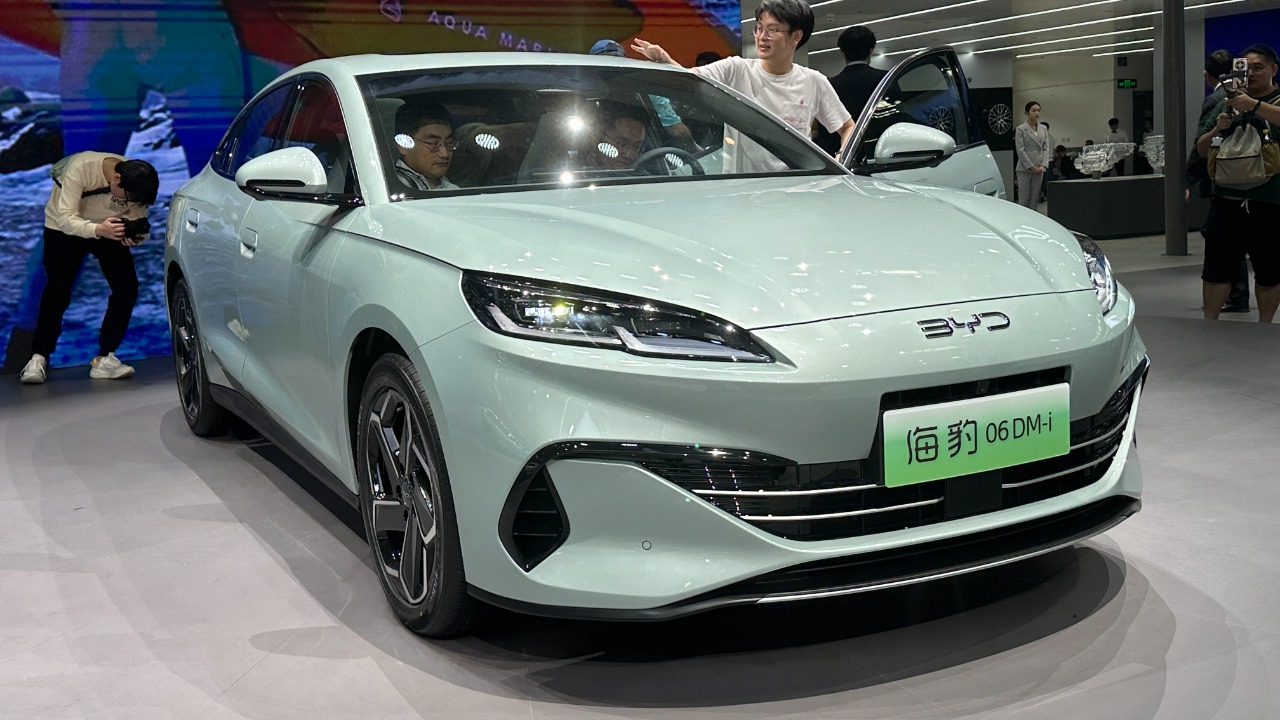

China’s BYD is raising the bar for plug-in hybrids, promising new versions of its gasoline-electric models that can travel much farther on battery power alone. The move signals a fresh phase in the competition between hybrids and full battery-electric cars, with longer electric range turning plug-in models into credible daily EVs rather than occasional zero-emission commuters.
By stretching electric-only driving and pairing it with efficient engines, BYD is betting that many drivers still want the security of a fuel tank while expecting EV-like performance in cities. I see this as a strategic attempt to lock in buyers who are curious about electric mobility but not yet ready to rely entirely on public charging networks.
BYD’s new pledge on longer-range plug-in hybrids
China’s BYD has publicly committed to launching new versions of four plug-in hybrid models that can travel significantly farther on their batteries before the engine cuts in. The company has said that on Wednesday it would roll out updated Qin L DM-i, Seal 06 DM-i, Seal 05 DM-i and Seal 07 DM-i variants, each designed to extend electric-only driving and reduce fuel use in everyday conditions, a pledge that underscores how central plug-in hybrids have become to its strategy in China. According to reporting on the plan, China and BYD are explicitly positioning these cars as a way to keep internal combustion relevant while still cutting emissions and fuel bills for mass-market buyers, a balance that reflects the realities of charging access outside major urban centers.
The promise of longer battery operation is not just a technical footnote, it is a direct response to how people actually use their cars. BYD is targeting drivers whose daily mileage can be covered almost entirely on electricity, while still offering the reassurance of a gasoline engine for longer trips. In statements highlighted by one report, China’s BYD said in Wednesday it will introduce these new versions with longer range on batteries, a clear signal that the company sees extended electric capability as a competitive differentiator rather than a niche feature, and that it expects plug-in hybrids to remain a core part of its lineup even as pure EVs grow in share, a message captured in detail in coverage of how China’s BYD said in Wednesday it will upgrade these four plug-in hybrids.
Four long-range PHEVs and the 210 km benchmark
The most striking detail in BYD’s latest rollout is the headline electric-only range figure. The company plans to Add Four Long plug-in hybrids that can travel up to 210 km on battery power alone, a distance that would put them at the top of the plug-in hybrid market and allow many owners to drive for days or even weeks without burning fuel. The models, including the Seal 06 DM-i and its siblings, are being repositioned as vehicles that operate as pure EVs for most daily use, with the engine acting as a backup rather than the primary power source, a reversal of the traditional hybrid hierarchy that could reshape how buyers think about plug-ins.
That 210 km figure matters because it changes the economics and psychology of ownership. With such a long electric-only range, a driver with home or workplace charging can treat the car like a battery-electric model for commuting, school runs and errands, only relying on gasoline for long-distance travel or when charging is unavailable. Reporting on the plan notes that BYD will Add Four Long range PHEVs with 210 km Electric Only Range, a step up from earlier plug-in hybrids that often offered between 55 km and 128 km of electric driving, and that shift is likely to make these cars more attractive in markets where fuel prices are volatile and charging infrastructure is still patchy, as detailed in coverage of how BYD to Add Four Long range PHEVs with 210 km Electric Only Range and how those figures compare with earlier models.
Inside BYD’s Super DM and Blade Battery strategy
Longer electric range in a plug-in hybrid is only possible if the underlying technology can deliver high energy density, efficient power management and robust safety, and BYD is leaning heavily on its in-house systems to make that happen. At the heart of its approach is the Blade Battery, a lithium iron phosphate pack designed to be thinner, more space efficient and more resistant to thermal runaway than conventional cells, which allows engineers to fit more usable capacity into the same footprint while maintaining safety margins. The company pairs this hardware with its Super DM architecture, a plug-in hybrid system that prioritizes electric drive and uses the engine mainly as a generator or supplemental power source, a configuration that naturally supports longer battery-only operation.
From my perspective, the key to understanding BYD’s confidence lies in how tightly it integrates these components. The three core elements of its plug-in hybrid setup are the Blade Battery, the Super DM control system and the e-Platform that underpins the vehicle’s structure and electronics, a trio that is marketed as a cohesive Technology stack rather than a collection of parts. Official descriptions of BYD’s plug-in hybrid approach emphasize that the Blade Battery, LEARN MORE prompts and Super DM branding are all part of a broader Platform strategy to deliver efficient, durable PHEVs, and that the three core components of this hybrid technology are designed to deliver strong performance and long range, a claim laid out in detail in BYD’s own overview of how BYD, Blade Battery, LEARN MORE, Super DM and Platform fit together in its latest plug-in hybrids.
How Super DM works in real driving
Beyond the branding, Super DM (for Dual Mode) is BYD’s attempt to rethink how a plug-in hybrid behaves on the road. Instead of treating the engine and electric motor as equal partners, the system is calibrated so that with a fully charged battery the vehicle becomes pure electric, using the motor for propulsion and keeping the engine off in most scenarios. Only when the state of charge drops below a set threshold does the engine step in, either to drive the wheels directly at higher speeds or to act as a generator that tops up the battery, which keeps fuel consumption low and allows the car to operate as a conventional hybrid when needed.
In practice, that means a driver experiences the car as an EV in city traffic, with quiet operation and instant torque, and as a fuel-efficient hybrid on longer highway journeys. BYD’s own technical material describes Super DM as a Dual Mode PHEV system that prioritises electric power with minimal reliance on fuel, offers greater energy efficiencies and lower fuel consumption, and creates a quiet and comfortable ride while still supplying high-power performance and responsiveness when demanded. The company highlights that with a fully charged battery the vehicle becomes pure electric, and when SOC is low it transitions to a low fuel consumption hybrid vehicle, a set of behaviors that are central to how Technology, BYD, Super DM, Dual Mode and PHEV are being marketed to buyers who want both environmental benefits and long-distance flexibility.
From 5th-generation DM tech to 2,100-km range claims
BYD’s promise of longer-range plug-in hybrids does not come out of nowhere, it builds directly on a rapid cadence of hybrid technology upgrades. Earlier this year the company unveiled its 5th-generation DM hybrid system, claiming that in ideal conditions a car equipped with this setup could achieve a combined driving distance of 2,100-km on a full tank and full charge, a figure that dramatically exceeds the range of most conventional gasoline vehicles. That headline number is as much a marketing statement as an engineering milestone, but it illustrates how aggressively BYD is pushing efficiency gains in both its engines and electric components to stretch every unit of energy as far as possible.
The 5th-generation DM rollout also reflects a longer history of iteration. BYD first introduced its DM hybrid technology platform in 2008 and by 2021 had already moved to a fourth-generation system that split the lineup into more performance-oriented DM-p variants and efficiency-focused DM-i versions, a structure that laid the groundwork for the current emphasis on long-range plug-in hybrids. Reports on the latest upgrade note that BYD releases 5th-generation DM hybrid technology with 2,100-km range and that the company has used each generation to cut fuel consumption, improve electric performance and triple the range compared with some earlier models, a trajectory detailed in coverage of how BYD, Xinhua, Updated and Visitors were showcased at the launch, and further explained in analysis of how BYD has evolved its DM platform since 2008.
New models, upgraded hardware and lower prices
Longer range is only part of the story, because BYD is also using its latest hybrid technology to refresh specific models and sharpen their value proposition. The company has already launched new variants of its Seal 07 DM-i sedan that incorporate updated chassis tuning, driver-assist systems and battery configurations, with the goal of delivering both better performance and more competitive pricing. In practice, that means the updated Seal 07 DM-i now comes in four variants with longer battery range and BYD’s latest chassis and driver-assist technologies, a combination that aims to make the car more appealing to buyers who might otherwise consider traditional fuel sedans from joint ventures or rival domestic brands.
Other models are receiving similar treatment, often paired with hardware changes that reduce weight and improve efficiency. One example is the adoption of an innovative 12V lithium iron phosphate battery in place of a traditional lead-acid unit, a seemingly small change that can still shave kilograms and improve reliability over the life of the vehicle. Reports on BYD’s hybrid rollout note that the company has launched two new models with revolutionary 5th-generation DM technology and that, additionally, an innovative 12V lithium iron phosphate battery has replaced the traditional lead-acid battery, part of a series of hardware upgrades intended to help these cars compete directly with fuel vehicles from joint ventures, as described in detail in analysis of how Jun, Additionally and Upgra capture the broader strategy, and in coverage of how BYD, Launches Updated Seal and With New Tech And Lower Prices The sedan is being repositioned.
Pricing pressure and the competitive hybrid landscape
As BYD extends the electric range of its plug-in hybrids, it is also using pricing as a weapon in an increasingly crowded market. The company has launched new variants of its two sedans with lower prices, a move that has already prompted rivals to respond with their own discounts and promotions. One notable reaction came when Wuling followed BYD by cutting the price of a hybrid sedan by about 830 dollars, a sign that the competitive pressure from BYD’s aggressive pricing and product updates is rippling through the broader Chinese hybrid segment and forcing other manufacturers to rethink their positioning.
From my vantage point, this combination of longer range and lower prices is designed to squeeze both traditional fuel cars and less advanced hybrids at the same time. By offering plug-in models that can function as daily EVs while undercutting or matching the cost of some conventional sedans, BYD is challenging the assumption that electrified vehicles must carry a significant price premium. Market commentary notes that BYD (OTCMKTS: BYDDF) has launched new variants of its two sedans with lower prices and that the ripple effects from that move are starting to show, particularly as competitors like Wuling adjust their own pricing strategies, a dynamic captured in analysis of how BYD, OTCMKTS and BYDDF are influencing the broader hybrid market.
Why longer-range PHEVs matter for BYD’s sales mix
For BYD, plug-in hybrids are not a side project, they are a central pillar of its sales and profit engine. The company has indicated that these upgraded PHEVs with longer-range batteries are expected to account for roughly half of its total sales, a proportion that underscores how important this technology is to its overall business model. By committing to a new wave of long-range plug-in hybrids, BYD is effectively betting that many buyers will continue to prefer the flexibility of a hybrid layout even as charging networks expand and battery-electric models become more common.
That bet is grounded in a realistic reading of infrastructure and consumer behavior. In regions where fast chargers remain scarce or unreliable, a plug-in hybrid that can cover most daily driving on electricity while still offering the security of a fuel tank is a compelling compromise, especially when the electric-only range reaches triple digits. Reporting on BYD’s latest announcement notes that the company will roll out upgraded plug-in hybrids with longer range batteries and that these models are expected to account for about half of its total sales, a projection that highlights how central PHEVs are to its growth plans, as detailed in coverage of how Jan marked the latest step in that rollout and in analysis of how the BYD Seal 06 DM-i PHEV is one of the models to get a longer-range battery, a detail highlighted in reporting that described the Seal 06 DM-i as part of a broader push by Jan, Gift Article, The BYD Seal, PHEV and BYD to increase battery range across its plug-in lineup.
More from Morning Overview