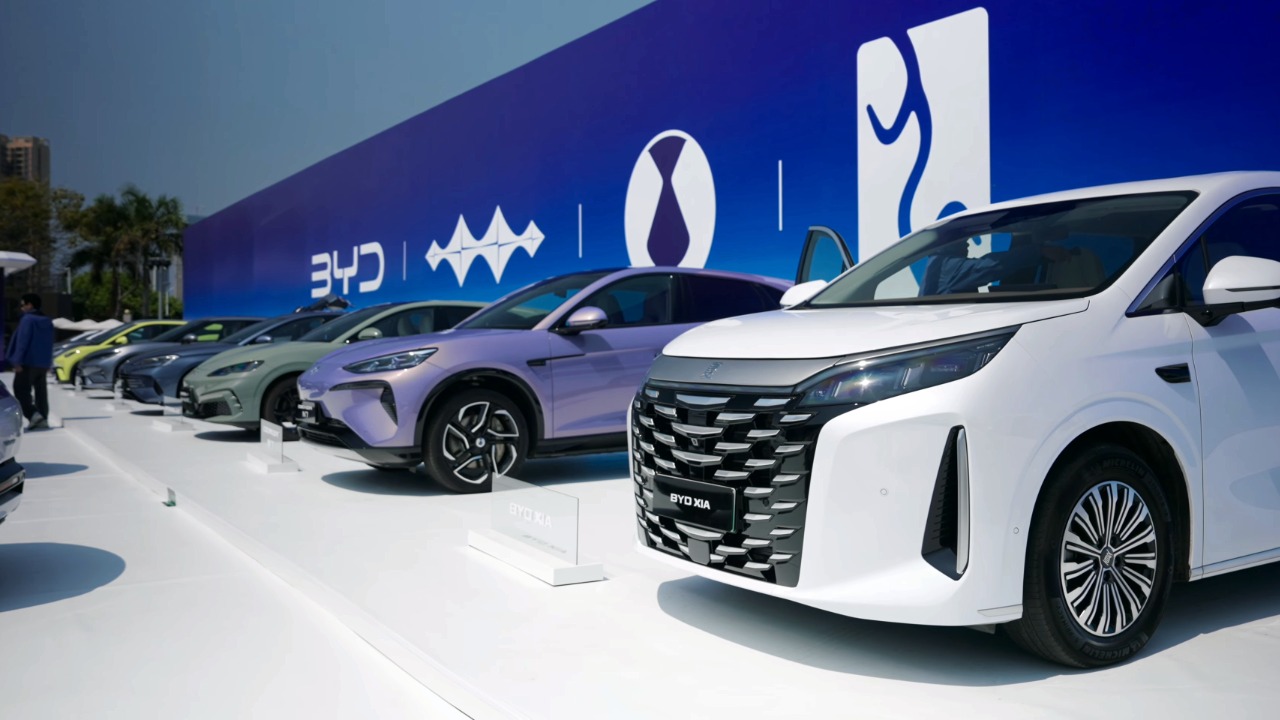

For the first time since the modern electric car boom began, Tesla is no longer the company everyone else is chasing. China’s BYD has surged past its American rival in global battery‑electric sales, turning a decade of disruption on its head and forcing investors, policymakers, and drivers to rethink who leads the next phase of the EV transition. The shift is not just about one company selling more cars than another, it is about a different playbook for price, scale, and supply chains reshaping the market.
BYD did not win this race overnight. It spent years building out factories, batteries, and shipping capacity while Tesla focused on premium margins and software‑heavy promises. Now those choices are colliding with a tougher demand environment, expiring subsidies, and intensifying Chinese competition, and the result is clear: BYD has taken the EV crown, and Tesla is suddenly the challenger again.
The moment BYD pulled ahead of Tesla
The clearest sign of the power shift is the scoreboard. BYD has officially overtaken Tesla in global electric vehicle sales, recording over 2.25 m vehicles sold worldwide compared with about 1.64 million for Tesla. That gap is not a rounding error, it is a decisive lead that reflects how aggressively the Chinese group has pushed into mass‑market segments while still expanding outside its home base. Analysts now describe BYD as the world’s leading seller of electric vehicles, a label that would have seemed improbable when Tesla was still adding factories in Shanghai, Berlin, and Texas.
On the battery‑electric side, where Tesla once defined the category, the story is even starker. BYD has secured the global BEV crown after years of trading quarterly leads with its American rival, and recent data shows it outsold Tesla by over 600,000 all‑electric vehicles in 2025 alone. While Tesla’s deliveries slipped by 7.9% compared with 2024, BYD’s all‑electric volumes jumped by roughly 150% from the previous year, according to the same set of figures. That divergence in growth rates is what turns a one‑off upset into a structural changing of the guard.
China’s EV champion goes global
BYD’s rise is inseparable from its home market. China has become the center of gravity for electric cars, and Chinese EV makers are now reshaping the global race. Reports describe how China based automakers were regularly increasing their share of worldwide EV sales as global volumes reached around 4.6 million vehicles, with BYD at the front of that wave. In this context, Tesla’s earlier dominance looks less like an unassailable lead and more like a head start that Chinese rivals have methodically closed.
Within that broader surge, BYD has become China’s largest new‑energy vehicle and battery manufacturer, building a broad lineup of cars, buses, and commercial vehicles that run on batteries or plug‑in hybrid systems. A profile of About BYD Stock notes that the company is China’s largest new‑energy vehicle and battery manufacturer, underscoring how deeply it is embedded in the country’s industrial strategy. That domestic scale has given BYD the volume, cost base, and political backing to expand into Europe, Southeast Asia, Australia, and Latin America at a pace Tesla has struggled to match.
How BYD’s integrated model beat Tesla at its own game
BYD’s strategy has been to control as much of the value chain as possible, from raw materials to finished vehicles, and that has turned into a decisive advantage as EVs move from early adopters to the mass market. Analysts have highlighted how critical it has been for BYD (short for Build Your Dreams) to manufacture its own batteries and most of its own components. That vertical integration lets the company cut costs, move quickly on design changes, and avoid some of the supply bottlenecks that hit rivals when demand spiked and chip shortages rippled through the industry.
By contrast, Tesla pioneered the idea of an EV company that looked more like a software platform, with a heavy emphasis on over‑the‑air updates, autonomous driving, and premium branding. That model worked brilliantly when demand was outstripping supply and buyers were willing to pay a premium for a Model 3 or Model Y. But as the market has matured, the ability to churn out affordable, good‑enough EVs at scale has become more important than being first with a new software feature. In that environment, BYD’s integrated manufacturing base in China has allowed it to undercut Tesla on price while still making money, effectively beating Tesla at the game of building desirable EVs at scale.
Price, product mix, and the mass‑market pivot
One of the most important differences between the two companies is how they think about the middle of the market. BYD has leaned into compact and mid‑size models that can be sold profitably at prices comparable to a petrol car, while Tesla has remained heavily reliant on the Model 3 and Model Y, which still sit above many mainstream budgets in emerging markets. A detailed look at How BYD overtook Tesla notes that Chinese buyers can now choose from a wide range of BYD models that cost less to run than filling up a petrol tank, which is exactly the kind of value proposition that wins over cost‑conscious households.
That product mix has translated into hard numbers. Chinese EV giant BYD has become the world’s largest electric car maker, with its global sales rising sharply while Tesla’s deliveries have started to slip. A LinkedIn Senior Editor for Sustainability and climate coverage pointed out that Chinese EV giant BYD saw its global sales rise by 28% last year, even as Tesla’s growth slowed. That 28% jump reflects not just demand in China but also growing exports to Europe and other regions where BYD’s lower‑priced models are undercutting both Tesla and legacy automakers.
Tesla’s slowdown and the end of its first EV era
While BYD has been accelerating, Tesla has been hitting the brakes. The company’s 2025 vehicle deliveries fell 15.6% in the fourth quarter and 8.4% for the year, a rare contraction for a business that once seemed to grow effortlessly. Those figures capture a mix of factors, from intensifying competition in China to the end of some tax credits in the United States that had previously boosted demand. They also show how sensitive Tesla’s volumes are to pricing decisions, given its relatively narrow product lineup.
The sales decline has now lasted for two consecutive years, and Tesla has lost its position as the world’s biggest electric vehicle maker as a result. One report on how Tesla loses its title notes that the company’s sales have fallen for a second year in a row, eroding the dominance that once helped make its chief executive the world’s richest man. That kind of reversal is not just a blip in quarterly numbers, it is a sign that Tesla’s first era of unchallenged EV leadership has ended.
Policy shifts, tax credits, and the China factor
Government policy has played a quiet but powerful role in this reshuffle. In the United States, the phase‑out and tightening of federal tax credits for EVs has made some Tesla models more expensive relative to their Chinese‑made rivals, especially as new rules around domestic content and final assembly have come into force. A detailed analysis in the Deseret News notes that China’s BYD became the world’s leading EV seller as U.S. tax credits were changing, while its own sales jumped by 28% over 2024. That juxtaposition highlights how policy can tilt the playing field, even when companies are competing globally.
At the same time, China has treated EVs as a strategic industry, backing domestic champions with subsidies, infrastructure, and export support. One striking example is BYD’s investment in super‑sized car carriers designed to ship its vehicles to markets like Australia and Europe. A report on BYD’s super‑sized car carriers describes how the business stunned observers with ships measuring some 220 metres long, built to move thousands of vehicles at a time. That kind of logistics investment is not glamorous, but it is exactly what a company needs if it wants to turn domestic success into global dominance.
What the sales data really says about demand
Looking under the hood of the sales numbers, it is clear that the EV market is fragmenting rather than collapsing. Tesla sold around 480,000 of its Model 3 and Model Y in the third quarter and around 400,000 in the fourth quarter, according to one detailed breakdown. Those are still enormous volumes for just two models, and they show that there is plenty of demand for Tesla’s core products. The problem is that the rest of the market is growing faster, especially in segments and price points where Tesla does not yet compete.
Global EV sales have been shaped by very different drivers in each region, from environmental rules in Europe to fuel‑economy standards in the United States and industrial policy in Asia. A review of the market by Strategy& notes that the driving factors behind market development vary significantly, requiring automakers to adjust their product offering for each region. BYD has been more willing than Tesla to tailor its lineup to those local conditions, offering smaller city cars in Europe, affordable sedans in Latin America, and right‑hand‑drive models for markets like Australia and the United Kingdom. That flexibility helps explain why its sales are rising even as some Western brands complain of an EV “slowdown.”
Investor expectations and Tesla’s robotaxi bet
For Tesla, the loss of the EV sales crown has sharpened the focus on its next big promise: autonomous driving and robotaxis. The company has long argued that its true value lies not in selling cars but in turning those cars into self‑driving vehicles that can earn money for their owners. A recent stock analysis notes that, yet, investors have abandoned the sour views that knocked off a quarter of Tesla’s stock value early in the year and are now looking to autonomy as a defining theme for 2026. The report on Tesla stock 2026 describes how expectations for self‑driving robotaxis are central to the company’s valuation, even as its vehicle sales growth has slowed.
BYD, by contrast, has focused more on incremental improvements in battery technology, manufacturing efficiency, and model variety than on headline‑grabbing autonomy claims. That does not mean it is ignoring software or driver‑assistance features, but it suggests a different balance between near‑term execution and long‑term moonshots. As investors weigh the two approaches, Tesla looks more like a high‑risk, high‑reward technology bet, while BYD resembles a scaled industrial powerhouse. The fact that BYD officially crushes Tesla in all‑electric sales for 2025 only intensifies that contrast, because it shows that the industrial strategy is already paying off in hard numbers.
What BYD’s win means for the next phase of the EV race
BYD’s victory over Tesla in global EV sales is not the end of the story, but it does mark the beginning of a new chapter in which Chinese manufacturers set the pace and Western brands scramble to adapt. A detailed news analysis by Osmond Chia and Danielle Kaye describes how China’s BYD has overtaken Tesla as the world’s top EV seller, signalling an increasingly gloomy outlook for some Western automakers that once saw EVs as their path back to growth. That shift will have ripple effects on jobs, trade policy, and climate targets as governments decide how to respond to a world in which Chinese brands dominate the fastest‑growing part of the auto market.
For Tesla, the challenge now is to prove that losing the volume crown does not mean losing the future. The company still has a powerful brand, a loyal customer base, and a lead in software features that many rivals are struggling to match. But as Tesla loses the EV crown to BYD, it must show that it can compete on price and variety without sacrificing the margins and innovation that made it a market darling. BYD, for its part, has to navigate growing political pushback in Europe and the United States, where concerns about Chinese overcapacity and unfair subsidies are already prompting talk of tariffs and import restrictions. The EV race is far from over, but the scoreboard has changed, and for now, BYD is the company everyone else is chasing.
More from Morning Overview