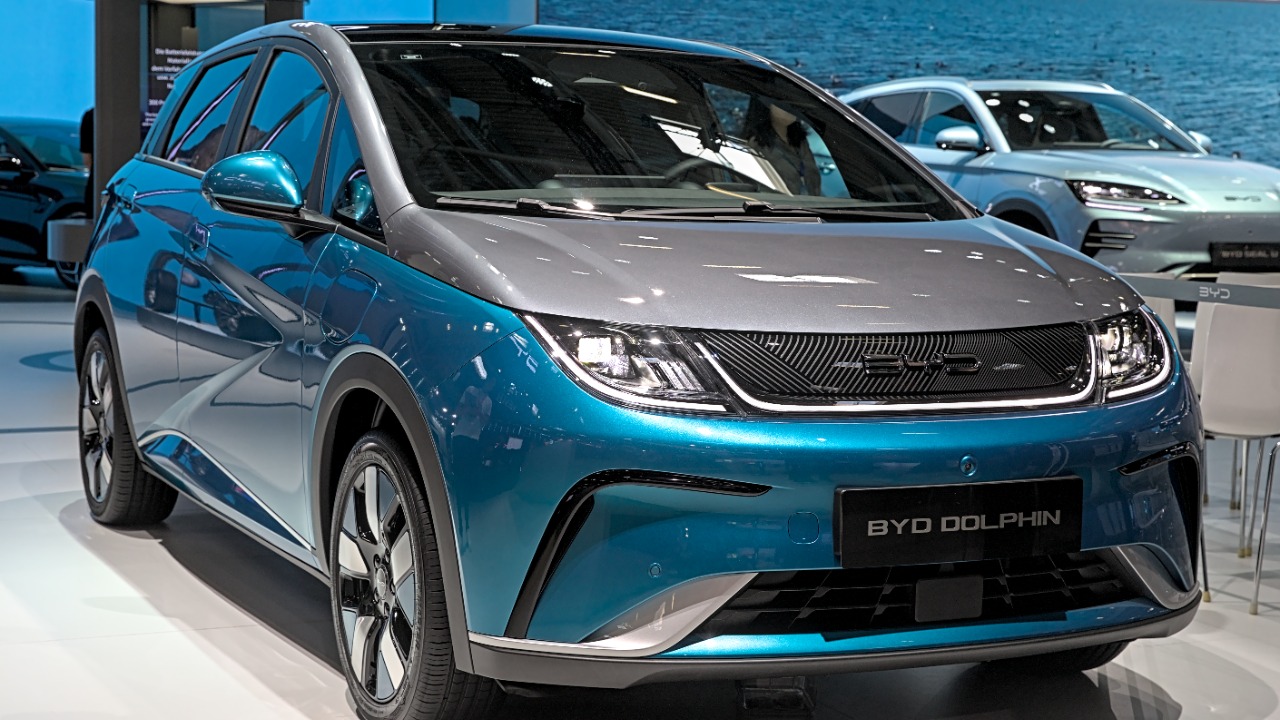

For the first time since the modern electric car boom began, Tesla is no longer the automatic answer to who leads global EV sales. China’s BYD has converted years of rapid expansion into a clear volume edge, turning what once looked like a one‑horse race into a genuine contest for dominance. The shift is not just about bragging rights, it is reshaping how and where the next generation of Electric vehicles will be built, priced, and sold.
As BYD closes on Tesla fast in the global EV sales fight, the numbers now show a Chinese manufacturer setting the pace in a market that Silicon Valley once defined. That reversal reflects diverging strategies on price, product mix, and geography, and it is forcing every other automaker to decide whether to follow BYD’s playbook, double down on Tesla’s approach, or find a third way.
BYD’s breakout year turns momentum into a lead
The clearest sign that the balance of power has shifted is BYD’s sheer scale. Over the past year, the company has turned its aggressive push into mass‑market EVs into a global lead, moving from fast follower to pace‑setter. BYD sold 4.55 m vehicles worldwide in 2025, a total that captures both its electric and hybrid lineup and underscores how deeply it has penetrated its home market and a growing list of export destinations.
Within that total, the company’s pure electric volumes are what matter most in the head‑to‑head comparison with Tesla. BYD’s 2025 tally included 2.25 m EVs, compared with Tesla’s 1.63 m deliveries, a gap that confirms the Chinese group has outpaced its American rival on battery‑only cars as well as overall volume, according to figures cited in a regional report on BYD global sales. That same report notes that BYD’s total vehicle sales rose 7.1%, evidence that it is still growing even as many EV markets cool.
Tesla’s slip from the top spot
Tesla’s loss of the global EV crown is not the result of a collapse so much as a slowdown that coincided with BYD’s surge. After years of double‑digit growth, Tesla’s global deliveries have come under pressure from intensifying competition and a maturing market for its core models. Data compiled on its recent performance show that Tesla’s worldwide deliveries fell sharply at the end of 2025, with global volumes dropping 15.61% in the fourth quarter compared with a year earlier.
That pullback came as BYD’s battery‑electric business accelerated, with BYD’s full‑year 2025 BEV sales reaching 2,256,714 units and surpassing Tesla’s total, according to figures summarized in an analysis of Tesla global deliveries. The same data set highlights that BYD’s BEV sales grew even as Tesla’s slipped, a divergence that explains why the American company is now playing catch‑up in a segment it once dominated.
How BYD’s product mix undercuts Tesla
One reason BYD has been able to overtake Tesla is that it has built a portfolio aimed squarely at the middle of the market. While Tesla has focused heavily on the Model 3 and Model Y, BYD has filled showrooms with a wide range of compact and mid‑size EVs and plug‑in hybrids that appeal to cost‑conscious buyers. That strategy has allowed BYD to chase volume in segments where price sensitivity is highest, particularly in China and emerging markets where first‑time EV buyers are less willing to pay a premium.
Tesla, by contrast, still leans heavily on a relatively narrow lineup. Earlier this year, Tesla sold around 480,000 of its Model 3 and Y in the third quarter and around 400,000 in the fourth quarter, figures that show how dependent it remains on just two core vehicles, according to a detailed breakdown of Tesla Model sales. BYD’s broader mix, which spans everything from small city cars to larger crossovers and includes both BEVs and plug‑in hybrids, gives it more levers to pull on pricing and more ways to respond when demand shifts between segments.
China’s industrial machine and the global EV race
BYD’s rise is inseparable from China’s broader push to dominate the EV supply chain. The company has benefited from a domestic ecosystem that stretches from battery minerals to final assembly, allowing it to control costs and scale production faster than many rivals. In one Brazilian plant, Workers clean vehicles at BYD’s factory in Camacari, Brazil, a vivid example of how the company is exporting not just cars but also its manufacturing footprint as it looks beyond its home market.
That outward expansion is part of a larger story in which China is reshaping the global EV race by backing companies like BYD that can produce affordable models at high volume. Reporting on how China and BYD have overtaken Tesla highlights how state support, domestic competition, and a vast local market have combined to create a powerful export engine. As BYD plants flags in places like Camacari, Brazil, it is turning that industrial strength into global market share, putting pressure on incumbents in Europe and North America that face higher costs and more fragmented supply chains.
Price pressure and the new EV economics
The shift in leadership is also a story about pricing power. BYD has leaned on its cost advantages to sell EVs at prices that undercut Tesla in many markets, forcing the American company to respond with its own discounts and promotions. That dynamic has eroded some of Tesla’s margins and made it harder to sustain the kind of profitability that once set it apart from legacy automakers.
Analysts tracking the market note that Tesla feels pressure from BYD in the EV sales race as the Chinese manufacturer ramps up output and keeps prices keen. BYD said its sales of battery‑powered cars surged almost 28% in 202, a figure that underscores how quickly it is adding volume even as it competes aggressively on price, according to a recent assessment of how Tesla feels pressure from its Chinese rival. For Tesla, the challenge is to balance the need to defend market share with the imperative to fund new products and technologies, a balancing act that becomes harder when a competitor is willing and able to grow rapidly at lower price points.
From symbol to statistic: Tesla’s changing role
For much of the past decade, Tesla functioned as a symbol of the EV transition as much as a carmaker, its sales figures treated as a proxy for the health of the entire sector. That symbolism is now colliding with the reality that other manufacturers can match or exceed its volumes. Recent coverage of the global market notes bluntly that Tesla is no longer the world’s top EV seller, with BYD surpassing it on annual deliveries of battery‑powered cars.
In that context, the fact that BYD sold more electric cars than Tesla in 2025 is more than a leaderboard update, it is a sign that the center of gravity in the EV industry is shifting toward companies that can combine scale, cost control, and local manufacturing in multiple regions. A concise summary of how BYD surpasses Tesla notes that Tesl delivered fewer cars than the year before, a reversal that would have been hard to imagine when Tesla was setting record after record. I see that shift as a turning point, where Tesla moves from being the uncontested face of Electric vehicles to one heavyweight among several.
Global politics, Donald Trump, and the EV rivalry
The contest between BYD and Tesla is unfolding against a backdrop of geopolitical tension and industrial policy, particularly between China and the United States. As BYD expands abroad and Tesla navigates its own global footprint, governments are weighing tariffs, subsidies, and local content rules that could tilt the playing field. In the United States, President Donald Trump has made industrial competitiveness a central theme, and EVs sit squarely at the intersection of climate policy, manufacturing jobs, and national security concerns.
Reporting on how China’s BYD has overtaken Tesla as the world’s biggest electric car seller notes that this shift is occurring just as policymakers in Washington and other capitals debate how to respond to a wave of Chinese EV imports and investments, with Donald Trump’s administration under pressure to protect domestic producers while keeping the energy transition on track, as highlighted in the broader discussion of China BYD Surpasses Tesla. I read those political cross‑currents as a reminder that the BYD‑Tesla rivalry is not just a corporate story, it is also a test of how open the global trading system will remain as the auto industry electrifies.
What the new pecking order means for the next decade
With BYD now ahead on global EV volumes and Tesla adjusting to life as a challenger rather than an automatic leader, the next phase of the market will likely be defined by how both companies respond. BYD will need to prove it can sustain quality, brand strength, and profitability as it scales up in regions far from its home base. Tesla, for its part, faces pressure to refresh its lineup, push into lower price brackets, and maintain its technological edge in software and charging while fending off rivals that have learned from its playbook.
For consumers and regulators, the upside of this intensifying competition is a faster rollout of Electric vehicles at a wider range of price points and body styles. The fact that BYD’s 2025 BEV sales grew while Tesla’s global deliveries dropped 15.61% in the fourth quarter, and that BYD’s full‑year 2025 BEV sales reached 2,256,714 units compared with Tesla’s 1.63 m EVs, suggests that the market is no longer dependent on a single company’s fortunes, as seen in the combined data on China reshaping EVs. I expect that as BYD closes on Tesla fast, and in some metrics already pulls ahead, the real winners over the next decade will be drivers who gain more choice and, ultimately, lower costs in the shift away from combustion engines.
More from MorningOverview