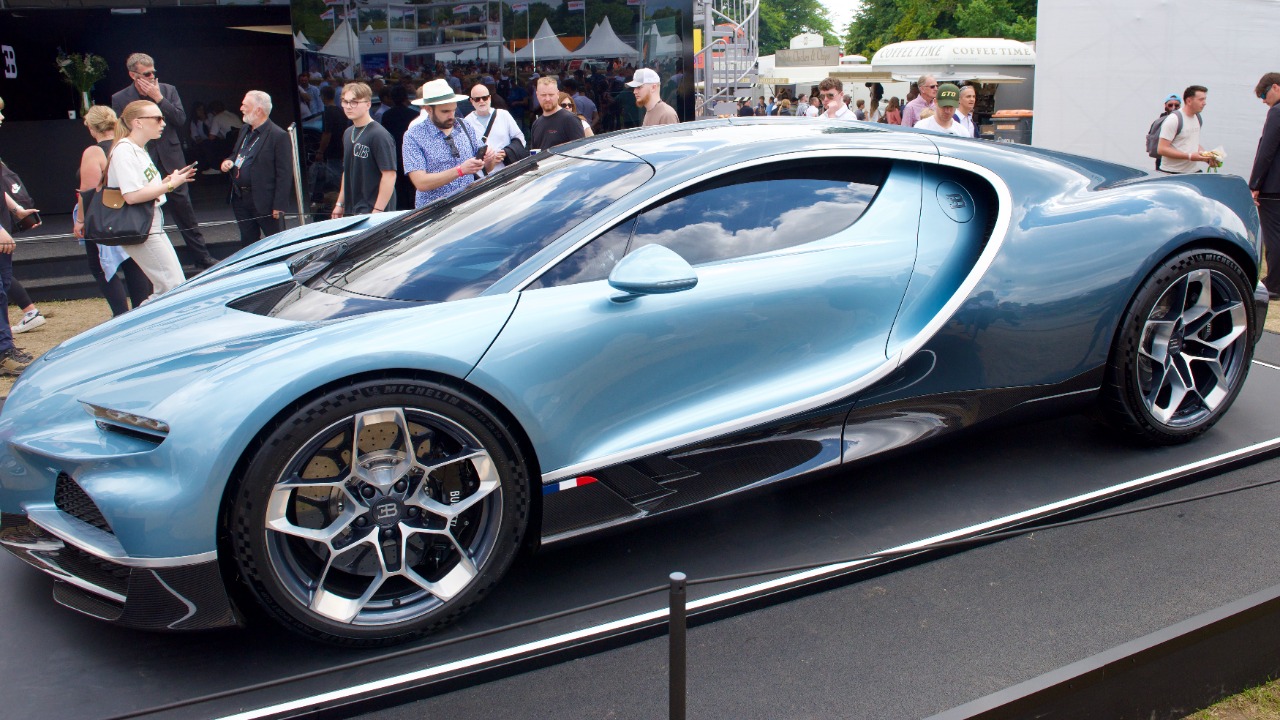

Bugatti has barely finished unveiling the Tourbillon, a V16 hybrid hypercar that starts around $4.5 million before taxes, yet the car is already being virtually stripped of its factory wheels and fitted with aggressive aftermarket designs. The $4.5 million figure alone would usually guarantee that owners tread carefully, but the first renderings from wheel specialists suggest that customization will begin even before the first customer cars leave the factory. I see this early rush to reimagine a not‑yet‑released model as a revealing snapshot of how the hypercar world now treats exclusivity, design purity, and social‑media spectacle.
Bugatti’s next V16 statement piece
Before getting to the wheels, it is worth understanding what Bugatti is building with the Tourbillon. The company has positioned it as a V16‑powered hybrid hypercar, a successor to the Chiron that is meant to carry the brand’s performance and luxury credentials into a new era of electrified powertrains. Reporting on the prototype describes the Tourbillon as Bugatti’s next big reveal, a car that costs from U.S. $4 million and is engineered to combine a naturally aspirated sixteen‑cylinder engine with electric assistance for both brutal acceleration and effortless cruising, even in challenging conditions such as snow and dense fog, where development cars have already been spotted cutting through winter test routes, according to one detailed look at a Tourbillon prototype.
That engineering story is being shaped in public by Mate Rimac, whose leadership of the brand has brought a more open, social‑media‑driven approach to development. In a clip shared to Instagram, Rimac showed off a Tourbillon development mule marked “VP1” in a snow‑covered parking lot, using the video to underline how the car behaves in low‑grip conditions and to tease the hybrid system’s potential long before journalists get full test drives. The fact that Rimac chose Instagram for this reveal, and that the car in question is still a prototype, underscores how much of the Tourbillon narrative is being written visually and virally, as seen in the way that the Rimac Tourbillon video has already become part of the car’s lore.
A $4.5 million canvas for customization
On paper, a hypercar that starts around $4.5 million before taxes sounds like the last object anyone would want to modify, yet the Tourbillon is being treated as a blank canvas by both Bugatti and the aftermarket. Coverage of the model’s pricing emphasizes that Bugatti’s Tourbillon starts around $4.5 million, a figure that does not include local taxes or the inevitable options list that will push many builds far higher. That number, repeated in multiple reports, frames the car as one of the most expensive new production vehicles on sale, and it is precisely that stratospheric price that makes the early rush to change its wheels so striking, as highlighted in a piece noting that Bugatti’s $4.5M hypercar is already trying on aftermarket wheels and that the $4.5 million starting point is only the beginning.
Bugatti itself is not shy about layering on additional cost for personalization, which sets the tone for owners to think of the Tourbillon as a platform rather than a finished object. One striking example is the Equipe Pur Sang option, a package that, according to the Instagram page that revealed the new package, adds $240,000 to the Bugatti and gives the Tourbillon eight exhaust pipes, echoing the dramatic tail treatment of one‑off models like La Voiture Noire. When a factory‑approved option like Equipe Pur Sang can cost $240,000 on top of an already multimillion‑dollar base price, it is easier to understand why some buyers and tuners see the car as a playground for extreme visual statements, a mindset captured in coverage of the Equipe Pur Sang package.
Vossen steps in before production even starts
Into this environment steps Vossen, a wheel maker that has moved faster than almost anyone to claim visual territory on the Tourbillon. The Bugatti Tourbillon has not even gone into production yet, and aftermarket wheel manufacturer Vossen is already showcasing designs specifically tailored to its proportions, treating the unreleased hypercar as a digital show car. Reporting on these early renderings notes that the project was highlighted by Jan and Swapnil and that the images present the Tourbillon with a set of intricate, multi‑spoke wheels that are meant to complement its flowing bodywork and the complex surfaces around the fenders, as described in coverage of how Vossen showcases its Bugatti Tourbillon concepts.
What makes this move unusual is the timing. Typically, aftermarket companies wait until at least a few customer cars exist before investing in detailed fitment data and marketing imagery, but Vossen is effectively betting that Tourbillon buyers will be eager to swap out factory hardware almost immediately. The renders show the car in a variety of stances and finishes, suggesting that Vossen expects demand for both subtle and extreme looks, and that it wants to be the first name associated with non‑OEM Tourbillon wheels. In that sense, the company is not just selling metal, it is selling the idea that even a Bugatti can and perhaps should be personalized from day one, a narrative that aligns with the broader push toward bespoke builds that Bugatti itself encourages through options like Equipe Pur Sang.
The Instagram moment: LC3 wheels and Brushed Gloss Clear
The most vivid expression of this early aftermarket push arrived on social media, where a short clip turned the Tourbillon into a rolling billboard for Vossen’s latest designs. In a post shared at the start of the year, the caption spelled out “@vossen LC3-11T Front And LC3-01T Rear Wheels On The V16 Bugatti Tourbillon,” making it clear that the car was wearing a split setup with different wheel models at each axle. The same caption highlighted that the Wheels Finished were in Brushed Gloss Clear, a detail that matters because it shows how much emphasis is being placed on finish and texture as part of the car’s identity, not just the basic shape of the spokes, all of which is visible in the Front And Rear Wheels On The Tourbillon clip.
From my perspective, that Instagram post crystallizes how the Tourbillon is being marketed as much through lifestyle imagery as through traditional performance metrics. The mention of Brushed Gloss Clear in the caption is not a technical specification, it is a mood, a way of signaling that the owner who chooses this setup cares about the way light plays across the wheel faces when the car is parked outside a hotel or idling in a valet line. It also reinforces the idea that the Tourbillon’s audience is already fluent in wheel jargon, comfortable parsing LC3-11T versus LC3-01T, and eager to differentiate the front and rear visually, even if the car’s stock configuration has been obsessively tuned by Bugatti’s own designers and engineers.
Aggressive split setups and the V16 silhouette
Beyond a single Instagram clip, Vossen has built out a more comprehensive vision of how its wheels might reshape the Tourbillon’s stance. In a detailed breakdown of the project, the company’s take is described as bold, with renders that show a split setup instead of a single wheel design, using different patterns and concavities at the front and rear to accentuate the car’s proportions. Up front, the Tourbillon wears a more intricate, directional design that visually pulls the nose down toward the tarmac, while the rear wheels are chunkier and more muscular, emphasizing the power being sent to the back axle, a contrast that is central to how Vossen reimagines the V16 Bugatti Tourbillon.
I find that this split approach does more than simply add visual drama, it subtly rewrites the car’s proportions. The Tourbillon’s long hood and sweeping roofline are already dramatic, but pairing a lighter, more open front wheel with a denser rear design exaggerates the sense of rear‑biased power, almost like a mid‑engined race car squatting over its driven wheels. It is a choice that might appeal to owners who want their Bugatti to look more like a track weapon than a grand tourer, even if the underlying chassis tuning remains unchanged. At the same time, it raises questions about how far one should go in altering the visual balance of a car that Bugatti’s own team spent years perfecting, especially when the wheels are such a dominant part of the side profile.
When critics say “leave the factory wheels alone”
Not everyone is convinced that swapping wheels on a Tourbillon is a good idea, and some commentators have been explicit in urging owners to think twice. One detailed analysis of the Vossen renderings, written by Brad Anderson, argues that Bugatti’s Tourbillon starts around $4.5 m and that the factory wheels are integral to the car’s design language, making aftermarket replacements a risky move aesthetically and potentially dynamically. The same piece reiterates that the car’s price is around $4.5 million before taxes and suggests that the original wheels were developed alongside the suspension and aerodynamics, so changing them could upset the carefully tuned relationship between ride quality, steering feel, and high‑speed stability, a concern that underpins the argument that you should not add aftermarket wheels to the Tourbillon.
I think that critique taps into a broader tension in the hypercar world between factory intent and owner expression. On one hand, Bugatti’s engineers have spent countless hours ensuring that the stock wheel and tire package can handle the car’s top speed, braking loads, and thermal demands, especially given the hybrid system’s weight and the V16’s power. On the other hand, the kind of buyer who can afford a Tourbillon is unlikely to be satisfied with a configuration that looks identical to every other example, particularly when social media rewards visual differentiation. The debate over Vossen’s designs is therefore less about whether the wheels are attractive in isolation and more about whether it is appropriate to treat a car of this caliber as a modifiable object rather than a finished piece of industrial art.
Bugatti’s broader luxury ecosystem and the Vossen connection
The Tourbillon’s early customization story also sits within a wider Bugatti ecosystem that increasingly blends cars, real estate, and lifestyle branding. One striking example is Bugatti Residences by Binghatti Sells Record, a development in Dubai that has been promoted with headlines about a Breaking Penthouse for $150 M, a figure that is also described as $150 Million in coverage of the project. That kind of real‑estate pricing makes even a $4.5 million hypercar look almost modest by comparison, and it shows how Bugatti is positioning itself as a name that can anchor ultra‑luxury experiences across multiple asset classes, a strategy that is evident in reporting on how Bugatti Residences and other ventures are marketed.
In that context, Vossen’s involvement with the Tourbillon looks less like a niche tuning exercise and more like a collaboration within a shared luxury language. Buyers who are considering a penthouse priced at $150 Million are the same kind of clients who might commission a Tourbillon with Equipe Pur Sang and a bespoke wheel setup, treating the car as one more curated object in a portfolio of statement pieces. I see the aggressive split wheel designs and Brushed Gloss Clear finishes as part of that ecosystem, where every surface, from a building’s façade to a hypercar’s spokes, is an opportunity to signal taste, wealth, and alignment with a particular aesthetic. The fact that these conversations are happening before the Tourbillon even reaches showrooms only reinforces how much of the car’s value now resides in its image as much as its engineering.
Why the Tourbillon is a test case for future hypercars
Looking ahead, the Tourbillon’s wheel saga feels like a preview of how future hypercars will be launched and personalized. The sequence is telling: Mate Rimac shares a VP1 development mule on Instagram, Jan and Swapnil highlight Vossen’s early renderings, and then a flurry of commentary debates whether owners should touch the factory wheels at all. At each step, the car exists as much in pixels as in metal, and the aftermarket is no longer waiting for physical deliveries to start shaping public perception. I expect that other brands will watch this closely, because if Vossen’s Tourbillon offerings prove popular, it will validate a model where third‑party companies invest heavily in pre‑launch digital content to capture the attention of ultra‑wealthy buyers who are already planning their spec sheets.
For Bugatti, this dynamic cuts both ways. On one side, the buzz around aftermarket wheels and packages like Equipe Pur Sang keeps the Tourbillon in the conversation, reinforcing its status as a cultural object rather than just a machine. On the other, it risks diluting the carefully curated image that the brand has built, especially if the most widely shared images of the car feature modifications that Bugatti did not design or endorse. As I see it, the Tourbillon is becoming a test case for how much control a manufacturer can realistically exert over a product once it enters a world where Instagram clips, Brushed Gloss Clear finishes, and $240,000 exhaust packages shape the narrative as powerfully as any official press release.
More from Morning Overview