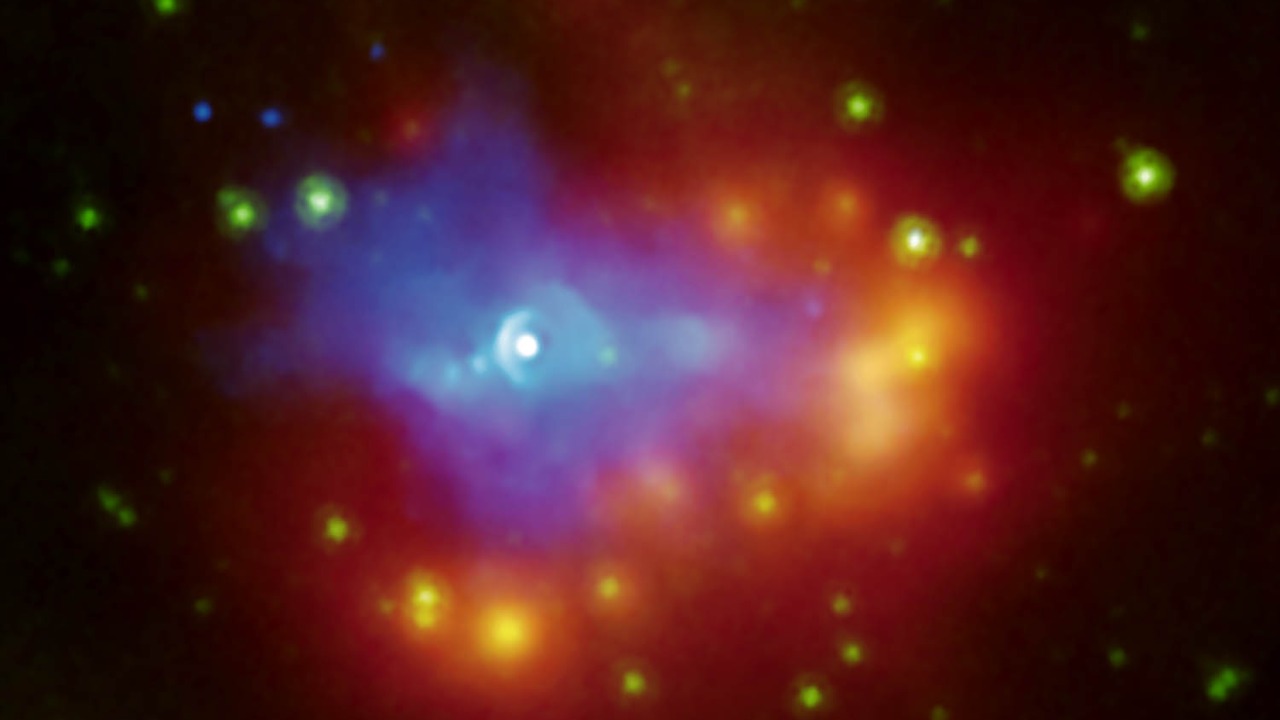

A dead star in our galactic neighborhood has produced a shimmering, ringed structure that looks uncannily like a cosmic rainbow, and the effect has left astronomers scrambling to explain what they are seeing. Instead of the gentle arc of colors familiar from a rainy afternoon on Earth, this feature wraps around a compact stellar remnant and appears to be sculpted by violent shocks in gas and dust. I see it as part of a broader shift in how scientists read subtle patterns of light in space, using rainbow-like signatures to decode everything from dead stars to worlds that rain molten iron.
The dead star at the center of the mystery
The strange display surrounds RXJ0528+2838, a compact “dead” star that has exhausted its nuclear fuel and now races through the Milky Way on a high-speed orbit. As it plows through the interstellar medium, the object generates a bow-shaped disturbance that, in detailed images, takes on a layered, prismatic appearance reminiscent of a halo of color. In zoomed-in views of RXJ0528+2838, the shock front curls around the star like a luminous shell, giving the impression of a rainbow frozen in space rather than painted across a sky.
The geometry is not just pretty, it is physically revealing. The arc traces where material from the star slams into surrounding gas, compressing and heating it into a glowing wave. A dedicated sequence of images, assembled into a video that zooms toward RXJ0528+2838, shows how the shock structure sharpens as the view tightens, highlighting the thin, bright edge where the interaction is most intense. That visual tour of the dead star and its strange shock wave underscores why researchers compare the feature to a rainbow, even though the underlying physics is far more violent than sunlight refracting through raindrops.
How shock waves paint a cosmic “rainbow”
To understand why RXJ0528+2838 looks the way it does, I have to start with the basic ingredients: stellar outflows and the thin gas between stars. When a compact object sheds material or drags a stream of particles behind it, that flow can collide with the ambient medium and create a shock front, a boundary where density, temperature, and magnetic fields jump abruptly. In the case of this dead star, the interaction is so strong that it carves a bow-shaped wave, with different layers of compressed gas emitting at different wavelengths, which the eye interprets as bands of color when the data are rendered in composite images.
Researchers studying RXJ0528+2838 describe how Gas and dust flowing from stars can, under the right conditions, clash with their surroundings and create exactly this kind of shock wave. As the system rotates around our galaxy’s centre, the dead star effectively rams into the interstellar medium, piling up material in front of it. The resulting structure is not a rainbow in the meteorological sense, but the layered emission from the shocked gas can be mapped into color channels, producing a multihued arc that visually echoes the familiar spectrum in Earth’s sky.
Rainbows beyond Earth: from hellish exoplanets to alien “glories”
The spectacle around RXJ0528+2838 is part of a growing catalog of rainbow-like phenomena far from Earth, many of them tied to exoplanets. Earlier work on the ultra-hot world WASP‑76b, a gas giant so close to its star that it likely rains molten iron, has revealed a subtle brightening pattern that behaves like a distorted rainbow in the planet’s atmosphere. Astronomers have used this effect to infer how light scatters in the high-altitude clouds of WASP‑76b, turning a distant point of light into a laboratory for extreme weather and exotic chemistry.
In detailed analyses of this system, Astronomers report an “alien atmosphere rainbow” on an exoplanet that rains molten iron, describing how the brightness pattern on the dayside of WASP‑76b shifts as it orbits its star. On the fiery limb of the planet, the scattering of starlight by atmospheric particles produces a signature that, while not a rainbow in the everyday sense, encodes similar information about droplet sizes and cloud structure. On the nightside, where temperatures drop enough for metals to condense, the same physics that makes a rainbow over a summer storm on Earth helps reveal how iron clouds form and fall on this distant world.
From glories to “cosmic rainbows”: decoding light curves
Another breakthrough came when scientists spotted what they interpret as a “glory” on a world beyond our solar system, a phenomenon more commonly seen as a halo of colored rings around the shadow of an airplane on clouds. In exoplanet data, this effect appears as a sharp kink in the planet’s phase curve, the graph of brightness versus orbital position, which signals that light is being backscattered by droplets in a very specific way. I see this as a turning point, because it shows that even small, rapid changes in reflected light can betray the presence of clouds and the stability of an atmosphere on a world that no telescope can resolve directly.
One team highlighted that “this is the first time that such a sharp change has been detected in the brightness of an exoplanet, its phase curve,” and used that signal to argue that the atmosphere has a stable temperature and a particular distribution of cloud particles. The researcher Demangeo, quoted in that work, emphasized how the glory-like feature opens a new window on atmospheric microphysics far from the solar system. The detection of this exoplanetary glory effect shows that the same scattering principles that shape a rainbow around a dead star’s shock front can also reveal the size and composition of droplets in alien skies.
New instruments chasing subtle color signatures
None of these discoveries would be possible without a new generation of instruments designed to track tiny variations in light. The European mission Cheops, for example, was built to measure the brightness of known exoplanets with exquisite precision, turning small dips and rises into clues about planetary atmospheres and surfaces. By repeatedly watching the same targets, Cheops can pick out phase curves and scattering signatures that hint at clouds, hazes, or even rainbow-like features in reflected starlight, especially when combined with other telescopes that cover different wavelengths.
The mission’s focus on high-precision photometry has already paid off in detailed studies of hot Jupiters and smaller worlds, where slight color-dependent changes in brightness reveal how starlight interacts with atmospheric particles. The spacecraft’s design and observing strategy, described in material on Cheops, make it particularly well suited to catching the kind of sharp phase-curve changes associated with glories and other scattering phenomena. As more data accumulate, I expect similar techniques to be applied to systems like WASP‑76b, tightening the link between the rainbow-like signals seen in light curves and the physical conditions in those extreme atmospheres.
Cosmic rainbows in dust: from zodiacal light to shock fronts
Rainbow analogues are not confined to planets and dead stars. Within our own solar system, a delicate band of brightness called zodiacal light, produced when sunlight scatters off dust grains in the inner solar system, has become a testbed for understanding how particles reflect and polarize light. NASA’s PUNCH mission, a set of small spacecraft designed to image the outer solar corona and the solar wind, has captured a “cosmic rainbow” effect in this zodiacal glow, revealing subtle color and brightness variations across the dust cloud that surrounds the Sun.
In early observations, the PUNCH spacecraft recorded the zodiacal light as a structured, multicolored band against a backdrop of stars, a view that mission teams shared through outreach channels that invite readers to Share, Join the conversation, Follow updates, Add the mission as a preferred source on Google, and sign up for a Newsletter. Those images, described as a cosmic rainbow in the zodiacal light, help scientists calibrate how dust scatters sunlight at different angles. The same scattering laws apply when gas and dust are swept up around RXJ0528+2838, so insights from the inner solar system feed directly into models of the bow-shaped shock that makes the dead star’s surroundings look like a rainbow painted on the dark.
Why a dead star’s rainbow matters for exoplanet science
What ties all of these threads together is the physics of scattering, the way particles redirect light depending on their size, composition, and arrangement. Around RXJ0528+2838, the bow shock’s layered emission shows how gas density and temperature change as the dead star barrels through the interstellar medium, turning a violent interaction into a structured, almost decorative pattern. On exoplanets like WASP‑76b, similar scattering signatures in phase curves and spectra reveal where clouds form, how heat is transported, and whether droplets or aerosols dominate the upper atmosphere.
Researchers studying rainbow-like phenomena on a “hellish exoplanet” have already argued that such signals may be the first direct evidence of cloud droplets outside our solar system. In that work, Astronomers describe a huge rainbow-like phenomenon that, if confirmed, would mark the first such detection beyond the planets orbiting the Sun. When I look at the bizarre halo around a nearby dead star in that context, it feels less like an isolated curiosity and more like another data point in a new era of “color science” in astronomy, where every strange arc and glory in the sky is a coded message about the matter that shapes it.
More from Morning Overview