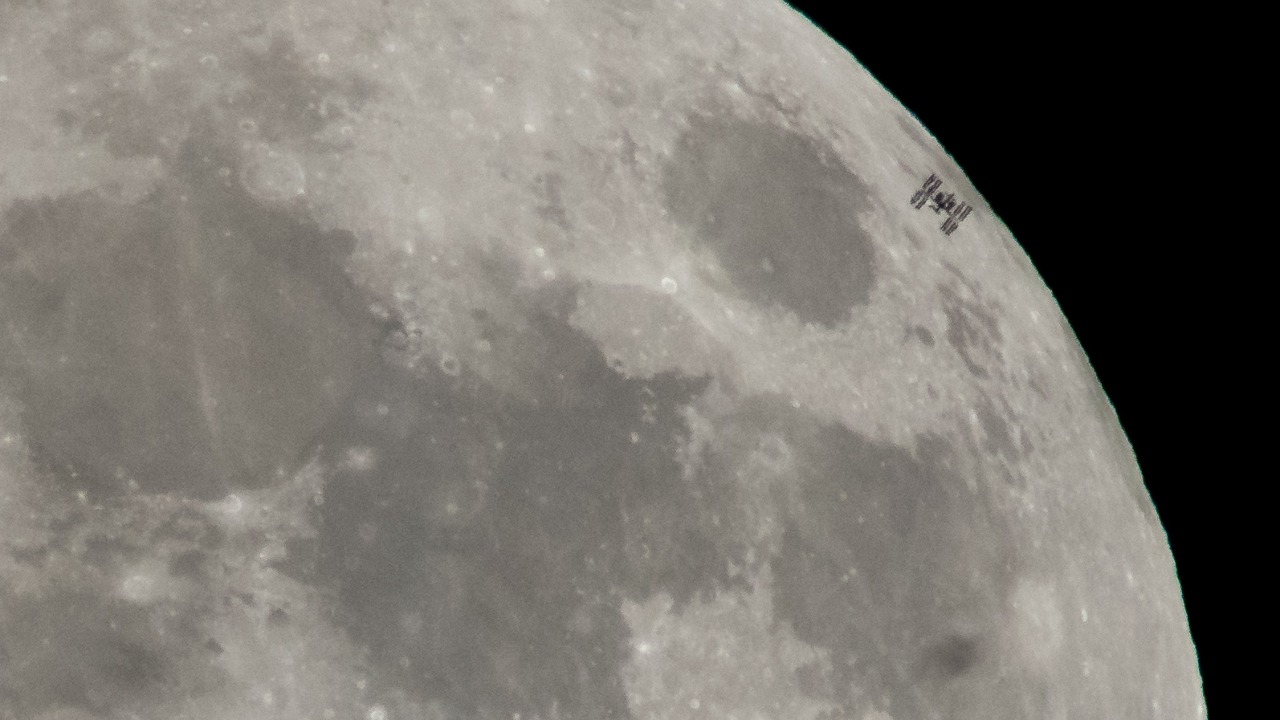

The International Space Station slicing across the face of the Moon is one of the most fleeting sights in the sky, a blink-and-you-miss-it alignment that lasts less than a second yet can define an astrophotographer’s career. When someone manages to freeze that moment in razor-sharp detail, it is not just a pretty picture, it is proof of meticulous planning, technical mastery, and a deep understanding of orbital mechanics. I see these “insane” transit shots as the purest intersection of art and engineering that amateur astronomy has to offer.
What looks like a simple silhouette is in reality the end result of scouting, travel, and split-second timing, often coordinated across hundreds of kilometers on Earth while the station itself races overhead at thousands of kilometers per hour. From high-resolution digital rigs to old-school 35mm film, photographers are pushing every tool they have to catch the International Space Station at the exact instant it crosses the Moon’s bright disk.
The split-second ballet of an ISS lunar transit
To understand why a single frame of the International Space Station in front of the Moon feels so improbable, it helps to picture the geometry involved. The station orbits at roughly low Earth altitude and crosses the lunar disk for any given location for less than a second, so the photographer has to be standing inside a narrow ground track only a few kilometers wide at the precise moment the orbit lines up. One detailed account describes how, during a February observation, the Earth-orbiting laboratory skimmed across the Moon “like a water strider on a pond,” with the shooter having barely half a second to record the scene before it was gone, a reminder that even a tiny delay can ruin the attempt on a given night, as described in one vivid transit.
That unforgiving timing is why astrophotographers talk about these events with a mix of awe and dread. One practitioner recounted how a waxing crescent daylight transit ranked as “One of the” hardest shots they had ever attempted, with the ISS barely visible against a bright sky and the margin for error measured in fractions of a second, a challenge captured in a candid post. Another photographer, reflecting on a favorite attempt, described how the International Space Station crossed the Moon in just 0.56 seconds during a recent Sunday session, a figure that underlines how little room there is for hesitation when the station sweeps across the lunar disk, as detailed in a separate account.
Planning the shot: from backyard to 30-mile road trips
Landing a clean transit frame starts long before the shutter fires, with orbital predictions and weather forecasts dictating everything from where to stand to which lens to pack. I have seen photographers drive tens of miles to position themselves under the narrow path where the station’s shadow will cross the Moon, treating the event like a mini scientific expedition. One tutorial-style breakdown describes a mission that began at home and then required traveling 30 miles away to reach the optimal vantage point, a level of preparation that turns a simple night of stargazing into a carefully choreographed field operation, as shown in a detailed walkthrough.
Even with that planning, the sky does not always cooperate, which is why so many of the most striking examples feel like a mix of calculation and luck. A recent clip shared in Oct framed the International Space Station as it passed directly in front of the Moon, with the creator openly asking whether the result came from pure luck or perfect calculation, a nod to the reality that both factors usually play a role in these rare alignments, as seen in a widely shared reel. Another observer in Jun described catching The International Space Station crossing the moon at 7:20am on Sunday from Williamsdale NSW, noting that the outpost was at an altitude of 420 km and flying at orbital speed, a reminder that even a tranquil-looking frame is built on fast-moving, high-altitude dynamics, as documented in a detailed observation.
Digital precision and the allure of 35mm film
Most of the viral ISS transit images rely on high-speed digital cameras and long focal length telescopes, which can rattle off dozens of frames in the fraction of a second the station is in view. That is how one photographer in Sep described capturing The International Space Station going across the Moon, explaining that the final composite came from multiple images taken at rapid speed to freeze the tiny silhouette as it marched across the cratered surface, a technique showcased in a striking sequence. Another shooter described how, on April 26, 2021, the International Space Station created a stunning sight as it crossed the Moon during a lunar transit, a moment that was captured in a carefully timed series of frames and later shared with the note that the ISS had traced a crisp path across the lunar face, as recounted in a detailed post.
Yet even in this era of ultra-fast sensors, some astrophotographers are deliberately embracing older technology to give these scenes a different texture. One practitioner chose a Nikon F5, described as the last 35mm SLR that NASA used in space, to record the station’s passage on film, leaning on the camera’s mechanical reliability and the aesthetic of grainy emulsion rather than digital pixels, a choice explained in a detailed profile. Another specialist, De Freitas, pushed the concept even further by becoming the first person to capture the station crossing the Sun on 35mm film, extending the same obsessive timing and framing to a solar transit and later inviting viewers to explore more of that work on Instagram and a dedicated website, as highlighted in a focused feature.
From viral disbelief to NASA-grade validation
When a transit image is sharp enough to show the station’s solar arrays and modules, it often triggers a wave of disbelief from casual viewers who underestimate what modern optics and planning can achieve. One viral discussion in Sep centered on Photographer Andrew McCarthy, who skillfully captured the International Space Station passing in front of the Moon, prompting some skeptics to dismiss the frame as fake even as others pointed to the meticulous preparation and repeatability behind his work, a reaction documented in a heated thread. I see that skepticism as an unintended compliment, a sign that the image has crossed the threshold from “nice photo” into “this looks too good to be real,” which is exactly where cutting-edge astrophotography often lives.
Professional space agencies have helped legitimize the genre by sharing their own versions of the same phenomenon. NASA has highlighted how its cameras have spotted a spectacular ISS transit across the full Moon, describing how the ISS, also known as the International Space Station, can be seen as a tiny but distinct shape against the lunar disk when the timing is right, a perspective laid out in an accessible overview. Another report notes that Astrophotographers relish the challenge of snapping an ISS transit, citing NASA photographer Bill Ingalls and other specialists who have repeatedly captured the International Space Station in front of the Moon, reinforcing that what amateurs are doing from their driveways is fundamentally the same kind of work being carried out with agency-grade gear, as described in a detailed analysis.
Why these fleeting silhouettes resonate so strongly
Part of the appeal of these images is emotional rather than technical, a sense that humanity’s fragile hardware is briefly sharing the frame with a timeless celestial body. One photographer in Sep described how it had been a while since they had taken the camera out, and how seeing The International Space Station going across the Moon rekindled that sense of wonder, with the final composite showing the station stepping across the lunar surface in a series of crisp silhouettes, a feeling captured in a widely shared sequence. Another observer, reflecting on a Feb event, likened the station’s motion to a water strider gliding over a pond of lunar light, a metaphor that captures how delicate and improbable the alignment feels even when you know the orbital math behind it, as described in a richly detailed account.
These scenes also connect the everyday sky to the broader story of human spaceflight. When I look at a frame where the ISS is crisply outlined against the Moon, I see not just a technical achievement but a reminder that there are people living and working in that tiny shape, circling Earth every ninety minutes. Earlier examples, such as a Jan description of the ISS crossing the Moon during a lunar transit and a Jan note about Last Sunday’s most detailed International Space Station lunar transit photograph to date, show that this pursuit has been evolving for years, with each new attempt pushing resolution, timing, and creativity a little further, as reflected in detailed reports and candid reflections. When an astrophotographer “nails” one of these shots, they are not just winning a timing challenge, they are capturing a fleeting alignment between Earth, the Moon, and a human-built outpost that will never repeat in exactly the same way again.
More from Morning Overview