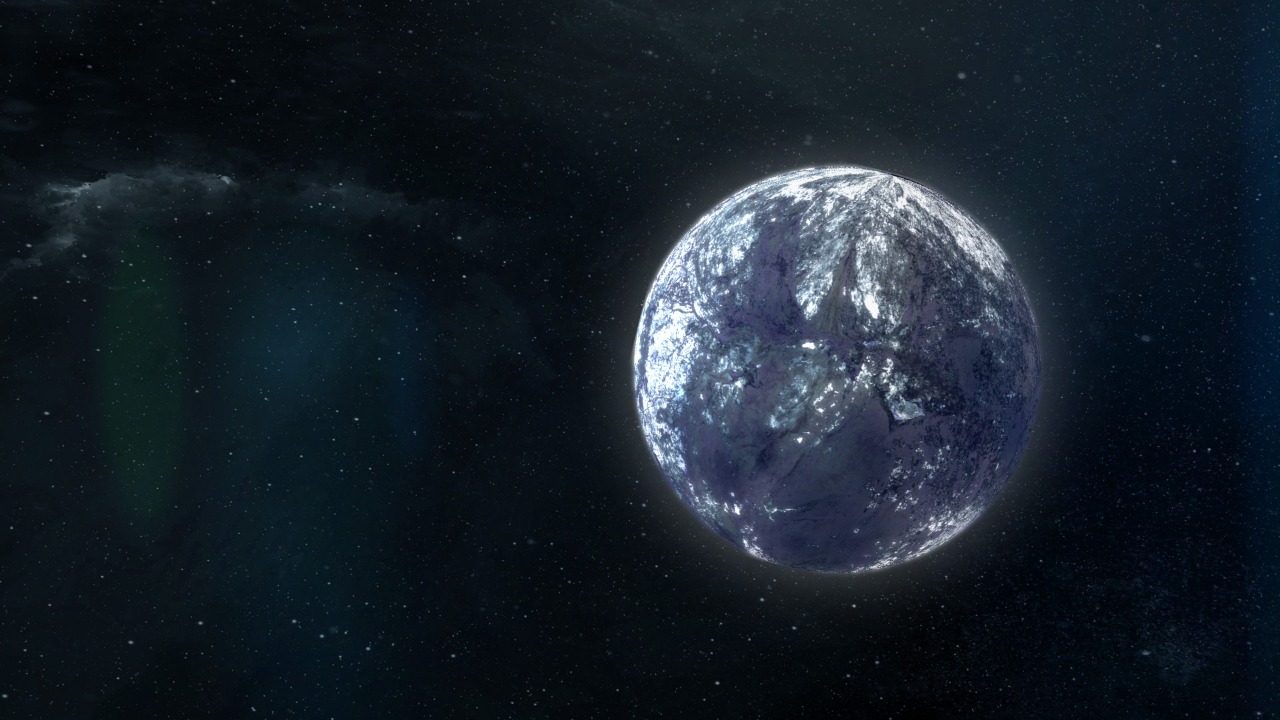

Astronomers have caught a solitary world in the act of doing something planets are not supposed to do once they are fully formed: it is gorging on material and rapidly gaining mass while drifting through space without a star. The newly highlighted rogue planet is not only starless, it is also growing at a rate that challenges standard ideas of how and where planets are built. I see this discovery as a rare window into a phase of planetary evolution that is usually hidden inside bright, blinding disks around young stars.
What makes this rogue planet so unusual
Most planets we know are locked into orbits around stars, but this object is a true loner, a free-floating world that has been kicked out of its birthplace or formed in isolation. What sets it apart from other candidates is that Astronomers have identified it as undergoing an enormous growth spurt, with material falling onto the planet at a rate that is extreme even by cosmic standards. Instead of quietly cooling in the dark, it is actively reshaping itself, which gives researchers a rare chance to watch planetary construction in real time.
According to detailed measurements, the planet is accumulating roughly six billion tonnes of gas and dust every second, a figure that turns an abstract “fast” into something concrete and staggering. That rate, described in technical reports as a record-breaking accretion flow, is why one team framed the discovery as a Six billion tonnes a second event and another as a Rogue Planet in a Runaway Growth Spurt. I read those numbers as a clear sign that this is not a quiet, settled exoplanet, but a dynamic, still-forming body that blurs the line between planet and failed star.
How Astronomers spotted a planet with no star
Finding a planet that does not orbit a star is inherently difficult, because there is no host sun to backlight it or to wobble under its gravitational pull. In this case, Astronomers relied on the planet’s own activity, picking up the glow from hot material as it spiraled down onto the object and heated up. That emission, combined with the way the surrounding gas and dust responded to the planet’s gravity, allowed teams to isolate the signal of a compact, planetary-mass body rather than a full-fledged star.
Earlier work has shown that even completely starless worlds can be detected if their gravity briefly magnifies the light of a more distant star, a phenomenon predicted by Einstein and used in several recent surveys. One group described how Einstein’s Theory Helps Astronomers Spot Mysterious Free worlds by turning the universe into a natural lens, and another emphasized that Rogue planets can be picked out when They act as tiny gravitational lenses themselves. I see the new detection as part of that same toolkit, but with the added twist that the planet’s own feeding frenzy makes it brighter and easier to study than a cold, dormant rogue.
Runaway Growth Spurt: a planet that will not stop eating
Once Astronomers realized they were looking at a free-floating planet, the next surprise was just how aggressively it was accreting material. The inflow of gas and dust is not a gentle drizzle, it is a torrent that has been described as a runaway growth phase, in which the more mass the planet gains, the more efficiently it pulls in additional matter. That feedback loop is what justifies calling the event a Runaway Growth Spurt, and it hints that the object could quickly climb from a modest planetary mass toward the boundary where brown dwarfs begin.
From my perspective, the most striking part of the analysis is that the accretion rate of six billion tonnes per second is not a brief flare but appears to be sustained over meaningful timescales. That implies the planet is embedded in a substantial reservoir of material, perhaps a fragment of a disrupted disk or a clump of interstellar gas that never formed a star. One team highlighted this by framing the discovery as a cosmic growth spurt, and I think that language captures how unusual it is to see a planet-sized body still in the act of building itself so far from any stellar nursery.
What “rogue planet” really means
In technical terms, a rogue planet is a planetary-mass object that is not gravitationally bound to any star, and this discovery fits that definition cleanly. The absence of a host star means there is no regular day and night, no stable seasons, and no solar energy to drive weather in the way we understand it from Earth. Instead, any heat and light must come from the planet’s own internal processes, such as residual formation heat, radioactive decay, or, in this case, the energy released as infalling material slams into the atmosphere.
Previous surveys have hinted that such worlds are not rare, with one analysis pointing to Dozens of starless candidates that may roam the galaxy untethered to any sun. Those studies, led by Astronomers using data from missions like Kepler, suggest that the Milky Way could be teeming with dark, wandering planets that vastly outnumber the familiar, star-bound systems. I see the new object as a particularly vivid member of that hidden population, one that turns an abstract census into a detailed case study of how a rogue world can grow and evolve on its own.
Einstein’s theory as a tool for planet hunting
One of the quiet revolutions in exoplanet science is the way general relativity has become a practical observing tool rather than a purely theoretical framework. When a compact object like a planet passes in front of a more distant star, its gravity can bend and focus the background light, a process known as gravitational microlensing. By carefully measuring how the star brightens and fades, Astronomers can infer the mass and motion of the unseen lens, even if it emits almost no light of its own.
Recent work has shown that this technique is powerful enough to isolate individual free-floating planets, with one team explicitly noting that Using Einstein and the Hub allowed them to pick out a single, starless world drifting alone through the cosmic darkness. Another group emphasized that free-floating planets, unlike bound exoplanets, reveal themselves almost entirely through this lensing effect. I see the current rogue planet as part of that broader story, where Einstein’s equations have become a kind of cosmic metal detector for hidden worlds.
How this discovery challenges planet formation theories
Standard models of planet formation assume that worlds grow inside disks of gas and dust around young stars, gradually accreting material until the disk disperses. A free-floating planet that is still accreting at six billion tonnes per second, far from any obvious stellar host, complicates that picture. Either the planet was ejected from its original system while still embedded in a fragment of the disk, or it formed directly from a collapsing clump of gas that never ignited as a star, a process more akin to star formation than to the gentle assembly of a typical exoplanet.
For me, the key tension is that the observed growth rate and isolation both push against neat categories. If the object continues to gain mass at the current pace, it could cross the threshold into brown dwarf territory, yet its current properties are best described as planetary. The way Astronomers frame it, in reports that speak of a Rogue world in a record-breaking growth phase, suggests that theorists will need to refine their models to account for such hybrid objects. I expect this single case to become a benchmark for simulations that try to track how often planets are thrown out of their birth systems and how they continue to evolve once they are on their own.
Why Astronomers think rogue planets may be common
Although this particular object stands out because of its extreme growth, it is unlikely to be unique. Dynamical models of young planetary systems show that close encounters between giant planets can easily fling one or more bodies into interstellar space, especially in crowded, unstable configurations. Over billions of years, that process could populate the galaxy with a vast number of dark, starless worlds that are almost impossible to see directly.
Observational hints back up that theoretical expectation, including the report of starless ‘rogue’ alien planets that may roam deep space untethered to any star. Those candidates, identified by Astronomers sifting through subtle signals in space telescope data, suggest that free-floating planets could rival or even outnumber the planets bound to stars. I see the newly highlighted rogue as a particularly vivid confirmation that these worlds are not just statistical curiosities but active, evolving objects that deserve a central place in our picture of the Milky Way.
What a night on a free-floating world might be like
Although the current observations focus on mass and accretion rather than surface conditions, it is natural to wonder what such a planet would be like up close. Without a nearby star, the sky would be almost uniformly dark, punctuated only by distant galaxies and the faint glow of the Milky Way, with no sunrise or sunset to mark the passage of time. Any warmth would come from the planet’s interior and, in this case, from the energy released as infalling material slams into the atmosphere, potentially creating violent shocks and aurora-like displays.
From a habitability standpoint, a world that is still in a growth spurt and accreting six billion tonnes per second is far too chaotic to host stable oceans or a long-lived biosphere. However, the broader class of rogue planets, including cooler, older objects that have finished forming, might retain thick atmospheres or subsurface oceans heated by internal energy. I see the current discovery as a reminder that the universe can produce planetary environments far stranger than anything in our own Solar System, and that some of those environments may eventually prove more hospitable than their starless status first suggests.
More from MorningOverview