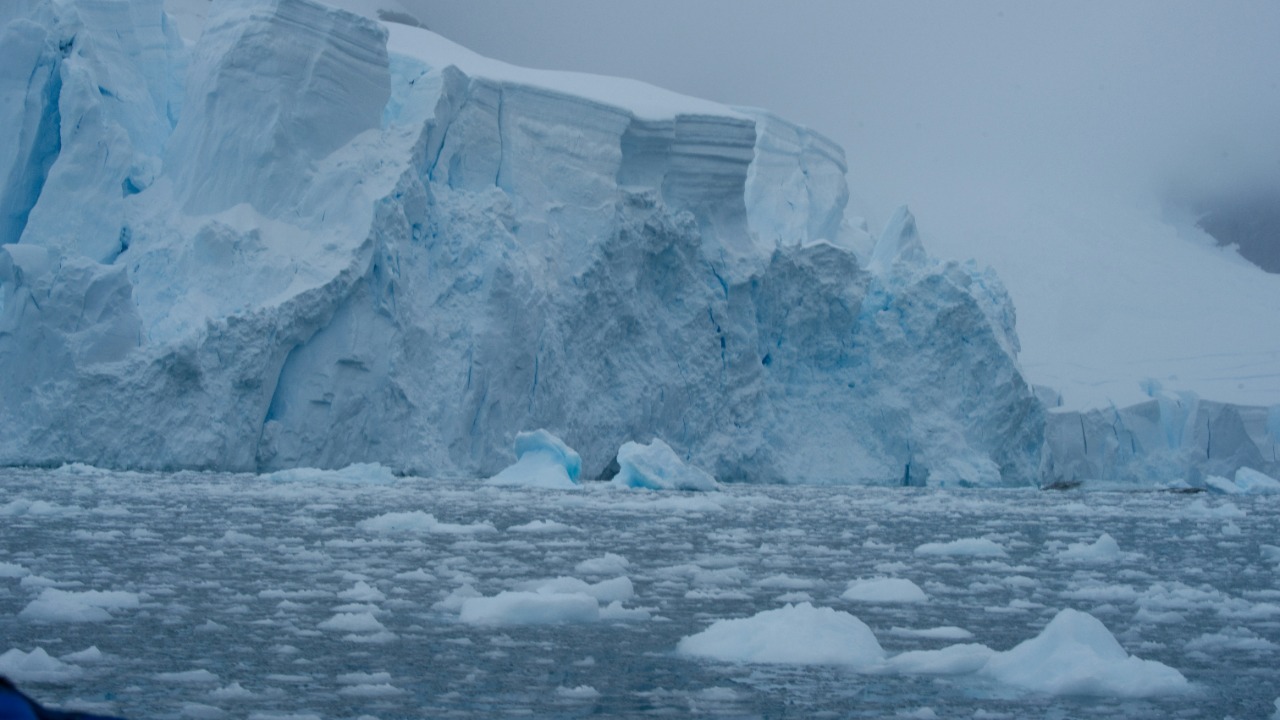

Antarctica’s biggest and oldest free‑floating iceberg is undergoing a startling transformation, with its once white surface now streaked by vivid pools of blue. The color shift is more than a visual curiosity, signaling that the giant slab of ice is weakening fast and could be on the verge of breaking apart. As the Antarctic summer intensifies, the fate of this single iceberg has become a striking snapshot of how quickly a warming world can reshape even the most ancient ice.
Scientists tracking the berg say the emerging blue tones are tied to rapid surface melt and structural change, not a harmless trick of the light. The same processes that are turning the ice into a mosaic of turquoise and teal are also carving channels, deepening cracks, and priming the berg for disintegration, with potential ripple effects for ocean circulation and sea ice around the frozen continent.
Antarctica’s veteran iceberg steps into the spotlight
The iceberg at the center of this drama is Iceberg A‑23A, a colossal slab that calved from Antarctica decades ago and has since become one of the largest and longest‑lived icebergs ever monitored. After years of drifting relatively quietly, it has recently moved into warmer waters where its sheer size and age now collide with a more hostile environment. That combination is why scientists describe it as both the Oldest, Largest Iceberg Is Turning and one that is now in a precarious state.
Researchers have followed A‑23A’s slow journey away from Antarctica using a constellation of satellites and ocean observations, watching as currents and winds gradually nudged it into a more exposed position. As it has drifted farther from the continent, the iceberg has encountered warmer air and water, conditions that accelerate melting along its edges and across its surface. That shift in setting is a key reason the berg’s appearance has changed so dramatically in recent weeks, and why its future is now measured in days or weeks rather than decades.
Why a white iceberg is turning an ominous blue
The new blue color is not paint or pollution, but the signature of intense surface melt that is reshaping the top of Iceberg A‑23A. When bright snow and rough, fractured ice cover an iceberg, they scatter sunlight and make it look white from space and at sea level. As that snow melts and drains away, it exposes older, denser ice and allows meltwater to pool in depressions, creating the striking blue ponds and channels that satellites have now captured on the berg’s surface. Those pools are what led scientists to say that Iceberg A‑23A is “looking a little blue” after it was spotted by Iceberg experts using high‑resolution imagery.
In physical terms, the color shift reflects how light interacts with water and compacted ice. Liquid water absorbs red wavelengths more efficiently than blue, so deep melt ponds appear turquoise or cobalt when viewed from above. Similarly, very dense ice that has been compressed over long periods contains fewer air bubbles, which means it scatters less light and can also appear blue. On A‑23A, both effects are at work: surface snow is vanishing, meltwater is pooling, and older ice is being laid bare, turning the iceberg into a patchwork of white ridges and blue basins that reveal just how much its surface has changed in a short span of time.
Satellites show a giant on the verge of breaking apart
What makes the blue pools so concerning is not just their color, but the mechanical stress they impose on the ice beneath. When meltwater collects in surface depressions, it can seep into existing cracks and crevasses, adding weight and pressure that pry the ice open. This process, known as hydrofracturing, can turn small surface features into deep fractures that slice through the iceberg’s interior. That is why scientists who examined recent satellite passes warned that the berg is now only “days or weeks” from disintegrating, describing it as One of the most fragile giants currently afloat.
NASA and NOAA have been central to documenting this shift, using the Terra satellite to capture detailed images of the iceberg’s evolving surface. In late December, Terra’s instruments recorded a network of bright blue melt ponds and channels that had not been present in earlier views, a clear sign that the Antarctic summer had triggered a new phase of rapid change. Those images, combined with thermal and radar data, show that the iceberg is thinning, its edges are calving more frequently, and its interior is riddled with weaknesses that could cause it to shatter into a flotilla of smaller bergs with little additional warning.
Antarctica’s changing climate, written in blue and white
Although a single iceberg cannot stand in for the entire Antarctic climate system, the story of A‑23A is unfolding against a backdrop of record warmth and shifting sea ice around the continent. As air and ocean temperatures rise, the seasonal window for surface melt on Antarctic ice shelves and icebergs is widening, giving features like A‑23A more time each year to develop melt ponds and structural damage. The fact that Antarctica’s biggest and oldest free‑floating berg is now covered in blue pools is consistent with a broader pattern of increased surface melting that scientists have documented across the region’s coastal ice. In that sense, the iceberg is both a unique case and a vivid example of processes that are becoming more common.
Those processes matter because they can accelerate the loss of ice from Antarctica into the ocean, which in turn contributes to sea level rise and can alter local ecosystems. When large icebergs break apart, they release freshwater and nutrients that can temporarily boost biological productivity, but they also change how sea ice forms and how ocean currents flow around the continent. The transformation of A‑23A into a fractured, blue‑streaked remnant is therefore not just a spectacle for satellite cameras, but a small piece of a much larger climate puzzle that links Antarctic ice to coastlines and weather patterns far beyond the Southern Ocean.
What the blue giant’s fate tells us about the future
For scientists, Iceberg A‑23A has become an unplanned experiment in how a massive, long‑lived berg responds when it drifts into warmer waters under today’s climate conditions. The rapid appearance of blue melt ponds, the acceleration of calving along its edges, and the expectation that it could disintegrate within weeks all provide real‑world data to test models of iceberg stability and melt. Those models are used to estimate how quickly ice from Antarctica might enter the ocean in the coming decades, and how that influx could influence sea level and ocean circulation. The more precisely researchers can track events like A‑23A’s breakup, the better they can refine those projections and identify thresholds that might trigger faster change.
At the same time, the visual drama of a glowing blue iceberg helps translate abstract climate trends into something tangible. It is one thing to talk about fractions of a degree of warming or millimeters of sea level rise, and another to see Antarctica’s largest and oldest iceberg visibly unravel in a single summer. That contrast is part of why images of A‑23A, captured by Antarctica focused satellites, have resonated so widely. The berg’s new color is beautiful, but it is also a warning signal, a reminder that even the most ancient ice is vulnerable when the planet’s thermostat keeps inching upward.
More from Morning Overview