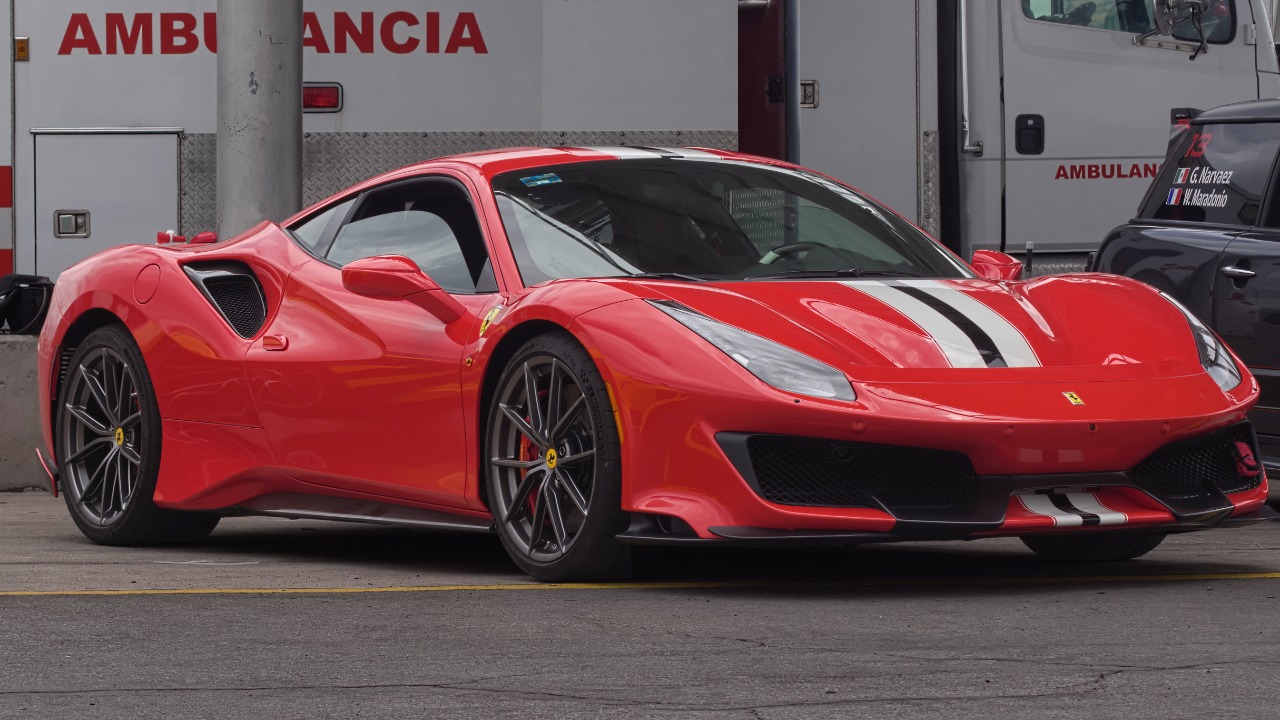

Ferrari’s appetite for ultra-rare specials shows no sign of slowing, and the next one already appears to be taking shape behind the scenes. Trademarks, recent one-off projects and the company’s own product roadmap all point to another bespoke machine emerging from Maranello’s most secretive skunkworks.
From the outside, it looks like a familiar pattern: a wealthy client, a tailored body and a chassis borrowed from a current flagship. Yet the context around this potential car is changing fast, as Ferrari juggles electrification, a packed launch schedule and a growing queue of collectors who want something built just for them.
HC25: the name that has everyone talking
The clearest hint that a fresh special is coming is the appearance of the HC25 name in enthusiast reporting and intellectual property chatter. The suggestion is that Ferrari is preparing a new one-off supercar called HC25, a designation that fits neatly alongside earlier bespoke codes like SP38 and SP48 and signals another entry in the brand’s most exclusive club. Early descriptions frame the HC25 as a unique commission rather than a numbered series, which would keep it aligned with the company’s most personal projects.
Reports indicate that the HC25 label surfaced in connection with filings at the World Intellectual Property Office, a typical first breadcrumb when Maranello locks in a new model name. One analysis notes that the Ferrari HC25 could be a one-off creation paying homage to the F40, with the alphanumeric tag hinting at a modern reinterpretation of that era’s hardcore ethos rather than a direct retro pastiche, and it ties this speculation to the broader idea that Another Special Ferrari Might Be On the Way. A separate report underlines that it seems that Ferrari is preparing to produce a new one-off supercar called HC25, while also warning that the early clues may be difficult to decipher, a reminder that until the car is shown, every detail remains provisional and Ferrari may be working on a new one-off supercar called HC25 is still an informed reading of the tea leaves rather than an official confirmation.
How Ferrari’s Special Projects division sets the template
To understand what HC25 might be, I have to start with how Ferrari’s Special Projects division operates. This is the in-house atelier that takes an existing platform and wraps it in a completely bespoke body, often with unique aero, interior details and historical references chosen by a single client. The cars that emerge are not just optioned-up versions of series models, they are effectively coachbuilt Ferraris for the modern era, each with its own story and visual identity.
The division itself grew out of a recognition that there was a market for completely bespoke-bodied supercars, a demand that was first highlighted by Pininfarina and then taken in-house so that Ferrari could give its most dedicated customers the chance to create something all to themselves. A video feature on the program explains that After a market for completely bespoke-bodied supercars was pointed out by pininfarina, Ferrari took it upon itself to formalize this offering, turning one-off commissions into a structured, if still extremely limited, part of the business. That context makes HC25 look less like an outlier and more like the next logical expression of a strategy that blends heritage, design theater and high-margin exclusivity.
SC40 and the F40 legacy HC25 is expected to tap
Ferrari has already shown how it can reinterpret one of its icons for a single client, and the SC40 is the clearest recent example. Presented as a one-off from the Special Projects Programme, the SC40 was explicitly inspired by the F40, yet it sits on a modern architecture with contemporary proportions and technology. The car’s styling cues, from its rear wing treatment to its venting and graphic signatures, were carefully chosen to evoke the late eighties hero without copying it panel for panel.
Official material describes the SC40 as a One-Off from the Special Projects Programme that was unveiled in Maranello and built around a V6 turbo-hybrid powertrain, a combination that underlines how Ferrari now uses its latest hardware as the canvas for its most nostalgic designs. The company’s own magazine notes that the Ferrari SC40: A One-Off Inspired by F40 channels the spirit of that earlier car while embracing the hybrid era, which is exactly the kind of balancing act HC25 is expected to perform if it really is conceived as a modern nod to the F40. In that light, HC25 would not be a standalone tribute but part of a growing lineage of F40-influenced specials that reinterpret the legend for different clients and powertrain eras.
Where HC25 could sit in Ferrari’s crowded product roadmap
Any new one-off has to be understood against the backdrop of Ferrari’s broader model strategy, which is unusually busy. The company has already signaled that it will launch 20 cars between now and 2030, a cadence that works out to roughly four new models a year on average and reflects an aggressive plan to cover everything from traditional mid-engined supercars to SUVs and electrified flagships. That volume leaves room for both core series cars and the occasional halo project that keeps the brand’s most devoted followers engaged.
One report on the company’s future range notes that Ferrari will launch 20 cars between now and 2030, and it links that expansion to the appearance of new names with the World Intellectual Property Office, the same ecosystem in which HC25 has been spotted. Earlier, Ferrari also announced that it would reveal six new vehicles in 2025 and confirmed that it would show its first EV, while also explaining that its VS moniker stands for Versione Speciale, a label reserved for more extreme derivatives of existing models, and that Ferrari announced yesterday that it will reveal six new vehicles in 2025. In that context, HC25 would not be counted among the mainstream launches but would instead sit above them, a bespoke layer that leverages the same platforms while reinforcing the brand’s aura of scarcity.
The SF90 replacement and the performance bar HC25 must clear
Ferrari’s latest hybrid flagship sets a daunting benchmark for any special that might share its underpinnings. The company has already unveiled the replacement for the SF90 Stradale, introducing the 2027 849 Testarossa as the new standard-bearer for its plug-in hybrid performance. Like its predecessor, the new car combines a powerful combustion engine with electric assistance, but it does so with even more focus on outright speed and track capability.
In official footage, Ferrari has just unveiled the replacement for the SF90 Stradale, the 2027 849 Testarossa, and highlighted that Like its predecessor, the new model uses a sophisticated hybrid system to deliver a total output of 1,036 horsepower, with the figure 849 used prominently in its name to signal its combustion component. The clip underlines that Ferrari has just unveiled the replacement for the SF90 Stradale: the 2027 849 Testarossa, which means any HC25 derived from this architecture would inherit a powertrain capable of four-figure outputs and blistering acceleration. That would give the one-off a performance envelope at least on par with the brand’s current hybrid hero, ensuring that its exclusivity is matched by genuine speed.
Lessons from the 296 Speciale and the new definition of “hardcore”
Ferrari’s approach to turning a series-production hybrid into a more extreme variant is already visible in the 296 Speciale, which sharpens the 296 GTB’s formula. In-depth reviews of the car emphasize how much quicker and more focused it feels compared with the standard model, with chassis tuning, aero and power upgrades that push it into territory once reserved for limited-run track specials. The result is a template for how Ferrari can dial up intensity without sacrificing the usability that modern buyers expect.
One tester notes that the 296 Speciale now delivers 868 bhp and remarks that you have to remember this car is so fast that it is quicker than LaFerrari in certain benchmarks, even mentioning that it does a 119 at a circuit referred to as van Ferrano and that this makes it feel like a new reference point for mid-engined Ferraris. The same review, captured in a video titled Ferrari 296 Speciale review. Now with 868bhp, is the latest …, underscores how far the company has come in extracting performance from hybrid architectures. For HC25, that evolution matters because it shows that Ferrari is comfortable using electrified platforms as the basis for its most aggressive interpretations, which in turn makes a hybrid-based F40 homage not just plausible but likely.
Why only a select few can commission cars like HC25
The idea of a one-off Ferrari naturally prompts a question: could any sufficiently wealthy enthusiast order something similar? The reality is more restrictive. Ferrari’s bespoke programs are reserved for a tiny circle of long-standing clients who have already demonstrated deep loyalty to the brand, often through extensive collections and participation in factory-backed events. Money is a prerequisite, but it is far from the only filter.
Enthusiast discussions about the process make this clear. In one widely shared exchange, a user asks whether, if they had the financial wherewithal, they could custom-order a pick-up or similarly radical Ferrari, and the consensus response is blunt: Probably not. Even the SP cars that ridiculously wealthy people can have made for them have to be based on an existing model, and if you are not already part of that inner circle, you almost certainly could not secure such a commission. That sentiment is captured in a thread where one commenter explains that Probably not. Even the SP cars are off-limits to newcomers, which means HC25 is almost certainly the product of a long-standing relationship rather than a one-off splurge by a new buyer.
How Ferrari balances exclusivity with shareholder expectations
Behind the romance of one-off commissions sits a very modern corporate reality. Ferrari N.V. is a publicly traded company that designs, engineers, produces and sells luxury performance sports cars through its subsidiaries, and it has to balance the desires of collectors with the expectations of investors who watch margins and growth closely. The brand’s strategy has been to maintain tight control over volumes while expanding its range into new segments, such as SUVs and future EVs, in order to broaden its revenue base without diluting its image.
Company profiles emphasize that Ferrari N.V., through with its subsidiaries, designs, engineers, produces and sells a range of luxury performance sports cars that includes special series, limited editions, open air roadsters and two-seater mid-rear-engined roadsters. Within that mix, one-off projects like HC25 serve a dual purpose: they generate significant revenue from a single build while also reinforcing the perception that Ferrari still operates at the intersection of art and engineering. For shareholders, the existence of such cars is a signal that the company can command extraordinary prices for its most exclusive products, which supports the premium valuation of the stock.
Why the wider market for bespoke performance cars matters
Ferrari is not alone in exploring ultra-tailored performance machines, and the broader market helps explain why HC25 fits a larger trend. Across the industry, specialist firms and tuners are offering increasingly personalized builds that blend classic aesthetics with modern technology, giving buyers a way to stand out even in a world saturated with supercars. These projects may not carry Ferrari’s prancing horse, but they tap into the same desire for individuality and craftsmanship.
One example comes from Switzerland, where a company has created the SPORTEC FERDINAND S as a backdate for tech-savvy individualists, reimagining older Porsche 911s with contemporary engineering. Reporting on the project notes that Four vehicles from the new FERDINAND series have already been sold before the presentation and are currently in production, a sign that demand for such bespoke reinterpretations is strong even at high price points. The feature explains that Four vehicles from the new FERDINAND series were spoken for before the public even saw them, mirroring the way Ferrari’s one-offs are effectively sold before they are announced. That parallel underscores how HC25 is part of a broader shift toward ultra-personalized performance, with Ferrari operating at the very top of that pyramid.
The cultural pull of Testarossa nostalgia and modern reinterpretations
Ferrari’s recent moves show that it is not only the F40 that is being reimagined for a new era. The company has also leaned into Testarossa nostalgia, both in its mainstream range and in the world of independent design studies. The 2027 849 Testarossa revives one of the brand’s most evocative names for a cutting-edge hybrid flagship, while outside Maranello, designers have proposed modern Testarossa concepts that imagine what a contemporary flat-12 wedge might look like if it were built today.
One enthusiast-focused feature highlights a Modern Testarossa Concept and frames it as what Ferrari should have built, pairing it with coverage of other specials and noting that This Modern Testarossa Concept Is What Ferrari Should’ve Built, alongside references to other projects such as This Ra that capture the same retro-futurist energy. That piece sits alongside the HC25 speculation and reinforces the idea that This Modern Testarossa Concept Is What Ferrari Should’ve Built in the eyes of some fans, even as the factory pursues its own path with the 849 Testarossa. For HC25, that cultural backdrop matters because it shows that Ferrari’s audience is hungry for designs that blend eighties drama with twenty-twenties technology, a combination that a one-off F40-inspired special is perfectly placed to deliver.
Why the next special Ferrari will be watched so closely
All of these threads converge on a simple reality: whatever form HC25 ultimately takes, it will be scrutinized as a bellwether for how Ferrari handles its heritage in an era of hybrids and looming EVs. The company’s Special Projects division has already shown with the SC40 that it can honor the F40 while embracing a V6 turbo-hybrid powertrain, and the 296 Speciale proves that hybrid platforms can deliver performance that eclipses even the LaFerrari benchmark, with lap times like 119 at van Ferrano cited as evidence of that leap. Against that backdrop, HC25 will be expected to combine visual drama, historical resonance and cutting-edge speed in a way that feels both authentic and forward-looking.
At the same time, Ferrari’s broader commitments, from the pledge to launch 20 cars between now and 2030 to the promise of its first EV, mean that every one-off now sits within a much more complex product ecosystem than the specials of a decade ago. Video coverage of the brand’s evolving range, including pieces like Untitled that showcase new models and design directions, keeps fans attuned to even subtle shifts in philosophy. In that environment, another special Ferrari on the way is not just a treat for one client, it is a public statement about how Maranello intends to carry its most storied nameplates into a future defined as much by software and batteries as by screaming combustion engines.
More from MorningOverview