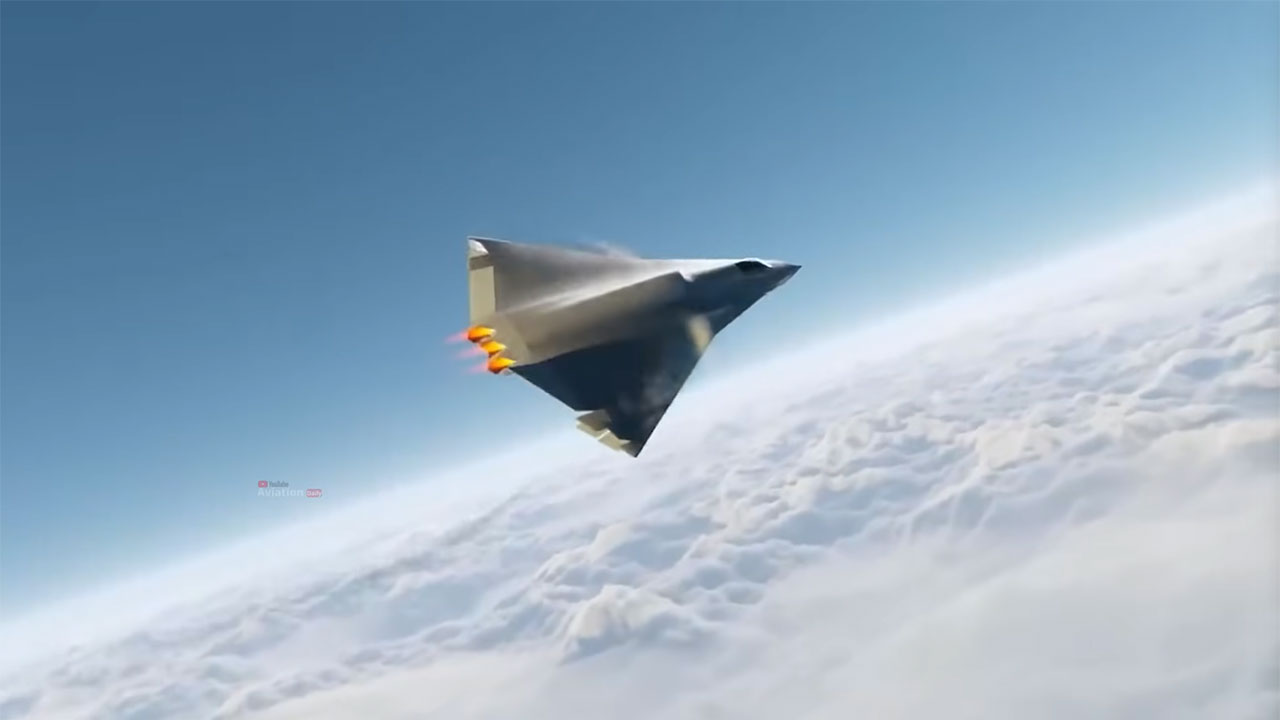

China’s next-generation combat aircraft program has taken another visible step, with new imagery and reports pointing to what observers describe as a third flying prototype of the J-36. The sighting suggests that the project is moving from isolated test articles toward a more sustained development rhythm, raising fresh questions about how quickly Beijing intends to field a sixth-generation platform.
As more details emerge about this latest airframe, the pattern of incremental design changes and increasingly complex test activity is starting to clarify what role the J-36 might play alongside the existing J-20 fleet. I see the reported third prototype not as an isolated curiosity, but as a marker of how China is trying to compress timelines, refine a tailless stealth design, and position itself for air superiority contests in the western and mid-Pacific through the 2030s.
From rumor to recognizable program
For several years, the aircraft now widely labeled J-36 sat in a gray zone between rumor and reality, tracked mostly by enthusiasts and analysts parsing grainy photos from Chengdu’s test facilities. That changed as the People’s Liberation Army watching community coalesced around the working designation “J-36,” a label chosen in reference to the aircraft’s expected role as a long-range air dominance platform and to the significance of the number 36 in Chinese fighter nomenclature. The PLA focus on this CAC project signaled that what began as a speculative shape on satellite imagery had matured into a recognizable program track within China’s broader modernization push.
The manufacturer at the center of this effort, CAC under Chengdu, already has deep experience with stealth design through the J-20, and that lineage is visible in how the J-36 has been framed as a complementary, not replacement, capability. Reporting on the new aircraft describes it as a stand-in for a future ultra-long-range interceptor and sensor node, with The PLA community treating it as a distinct line that will sit alongside the J-20 rather than simply superseding it. By the time the first airframes were spotted in flight, the conversation had shifted from whether the J-36 existed to how quickly CAC and Chengdu could move multiple prototype aircraft through testing and into something resembling an operational roadmap.
What the earlier prototypes already revealed
The first two J-36 airframes gave outside observers a baseline for the design, and they also showed how rapidly China was willing to iterate. In October, the second prototype of the J-36 entered flight testing, and analysts immediately noted structural changes compared with the initial article, including refinements to the tailless planform and adjustments that appeared aimed at saving internal space for fuel or systems. The fact that these modifications appeared so early in the test campaign suggested that Chengdu was using each prototype as a fast-turn platform to validate different aerodynamic and systems configurations rather than freezing the design too soon.
Those early flights also highlighted how seriously the program was being treated within China’s test community. The J-36 was observed flying in company with a Chengdu J-20S twin-seater stealth fighter acting as a chase plane, a pairing that underscored both the continuity between the two programs and the importance of gathering high-quality telemetry and visual data. Some images showed the new aircraft in coatings and markings consistent with advanced low-observable testing, reinforcing the impression that Chengdu and The PLA were not simply experimenting with exotic shapes but were already working through the practicalities of signature management, systems integration, and long-range mission profiles for a sixth-generation platform.
The “third prototype” sighting and what is actually new
The latest reports of a third J-36 in the air mark a notable inflection point, because they indicate that China is now running a small fleet of test articles rather than relying on a single demonstrator. Imagery and video of the new airframe, while not crystal clear, show enough detail for observers to conclude that this is not just a refurbished earlier jet but a distinct third prototype with its own configuration. The aircraft has been described as part of a sequence in which each airframe introduces new structural tweaks, and the third example appears to continue that pattern with changes in the rear fuselage and control surfaces that trade some rear-aspect stealth optimization for improved maneuverability and control authority.
In Dec, analysis of the latest footage highlighted how Chengdu seems to be deliberately walking a line between pure stealth shaping and the need for agility in a future air combat environment that will likely involve both long-range missile exchanges and closer-in engagements. The third prototype, observed flying in formation with support aircraft, was cited as evidence that the program is entering a more mature flight-test phase, with multiple airframes sharing the workload of envelope expansion, systems trials, and mission-representative profiles. That shift from isolated sorties to a more orchestrated test campaign is what makes this “third prototype” sighting more consequential than just another blurry image on social media, and it aligns with the broader pattern of China compressing development cycles on advanced fighters.
Design evolution: tailless stealth with tradeoffs
From the beginning, the J-36 has stood out for its tailless configuration, a choice that reflects a broader trend toward reduced radar signature and improved efficiency at high altitude and long range. The planform seen on the first and second airframes emphasized clean lines and blended surfaces, but the latest reports on the third prototype suggest that Chengdu is willing to accept some compromises in rear-aspect stealth to gain better handling and control. These changes, particularly around the aft fuselage and control surfaces, indicate a design team that is actively tuning the balance between low observability and maneuver performance rather than treating stealth as the only metric that matters.
That approach fits with the way Western sixth-generation concepts have evolved, where designers talk about “mission survivability” as a mix of stealth, electronic warfare, sensor reach, and kinematics instead of a single-minded focus on radar cross-section. In the J-36’s case, the tailless layout still anchors the aircraft in the category of advanced stealth platforms, but the incremental modifications seen across the three prototypes show a willingness to iterate quickly in search of a sweet spot. Analysts who have compared the J-36’s silhouette to other tailless concepts note that the Chinese design appears optimized for long-range cruise and sensor carriage, with the third prototype’s tweaks hinting at a growing emphasis on controllability in the demanding regimes where a sixth-generation fighter is expected to operate.
Ultra-long-range ambitions and the Pacific theater
Beyond its shape, what most distinguishes the J-36 in open-source assessments is its projected reach. Reporting on China’s ultra-long-range sixth-generation fighter program describes the J-36 as a platform intended to project power deep into the western and mid-Pacific, with the ability to threaten high-value assets and support aircraft far from China’s coastline. Although images of the third flight prototype are not perfectly clear, analysts have pointed to consistent design cues that support this interpretation, including a large internal volume for fuel and systems and an emphasis on efficient high-altitude cruise that would allow the aircraft to patrol or surge across vast distances.
Those ambitions are reinforced by commentary that frames the J-36 as a key tool for contesting airspace and sea lanes that have traditionally been dominated by Western forces. One detailed assessment of China’s new super J-36 “NGAD” style fighters notes that Chengdu’s J-20 fifth-generation fighter already has a range exceeding almost all Western fighters, but the J-36 is expected to push that envelope even further, pairing reach with a more advanced sensor and networking suite. In that view, the J-36 is not just another stealth jet but a cornerstone of a strategy to hold targets at risk across the western and mid-Pacific, complicating planning for carrier strike groups, tanker tracks, and forward bases that have long underpinned Western airpower in the region.
How the J-36 fits alongside the J-20
One of the more intriguing aspects of the J-36 story is how it appears to be integrating with, rather than displacing, the existing J-20 force. Footage from late October showed the J-36 operating in proximity to J-20 aircraft, and What emerges from the 31 October 2025 footage is that the J-36 is no longer an isolated prototype occasionally captured on satellite imagery but part of a more routine pattern of activity at major test and operational hubs. That visual pairing underscores the idea that China is building a layered stealth fleet in which the J-20 handles a mix of air superiority and strike tasks while the J-36 takes on ultra-long-range interception, sensor coverage, and command-and-control roles.
Analysts who have tracked both programs argue that this division of labor mirrors how some Western air forces are thinking about their own fifth and sixth-generation mixes, with legacy stealth fighters remaining in service even as newer platforms arrive. In China’s case, the J-20’s proven range and maturing weapons suite provide a solid foundation, while the J-36’s more ambitious design aims to extend that reach and add capabilities like cooperative engagement and distributed sensing. The fact that the J-36 has been seen flying with a J-20S chase plane and appearing alongside operational J-20 units suggests that The PLA and Chengdu are already experimenting with tactics and data links that will allow the two types to operate as a cohesive system rather than as separate, siloed fleets.
Signals from U.S. assessments and the global race
Outside China, the J-36 has become a focal point in discussions about the global race to field sixth-generation fighters, particularly in U.S. defense circles. A 2025 assessment highlighted two primary Chinese aircraft programs tentatively designated as tailless sixth-generation fighters, and it placed them in direct comparison with emerging U.S. concepts such as the F-47 and other Next Generation Air Dominance efforts. Under the heading The Rise of the Tailless Stealth, that assessment treated the J-36 and its sibling projects as evidence that China is not content to trail Western programs but is instead pushing to have multiple advanced prototypes airborne at roughly the same time as its competitors.
From my perspective, the fact that U.S. analyses now routinely reference the J-36 alongside American and allied sixth-generation projects is itself a measure of how far the Chinese program has come. It suggests that Washington no longer sees Chinese stealth development as a one-off surprise, as it did when the J-20 first appeared, but as a sustained effort that will shape the balance of airpower in the 2030s and beyond. The J-36’s tailless configuration, ultra-long-range aspirations, and rapid progression to a third prototype all feed into that narrative, reinforcing the sense that the competition is no longer about who fielded the first stealth fighter but about who can integrate networks of advanced aircraft, sensors, and weapons into a coherent, resilient force.
What multiple prototypes say about China’s industrial base
The emergence of a third J-36 prototype also offers a window into China’s aerospace industrial capacity and its willingness to fund parallel lines of effort. In November 2025, an investigation into China’s advanced fighter programs highlighted how Chengdu and other major players were running several cutting-edge projects in parallel, rather than serially, as had often been the case in earlier decades. That finding aligns with what we now see in the J-36 program, where multiple airframes are being built, modified, and flown in relatively quick succession, each incorporating lessons from the last while also testing new ideas.
From an industrial perspective, that pattern suggests a high degree of confidence in both design tools and manufacturing processes, including the ability to produce complex composite structures and stealth coatings at scale. It also points to a political and budgetary environment in which The PLA and national leadership are prepared to absorb the costs and risks of running several advanced fighter programs at once, betting that the payoff in terms of technological edge and strategic leverage will justify the investment. The J-36’s progression from a single demonstrator to a trio of distinct prototypes is therefore not just a technical story but a reflection of how China’s defense industry, anchored by Chengdu and CAC, has evolved into a system capable of sustaining multiple high-end projects simultaneously.
Why this “third prototype” matters for the next decade
Looking ahead, I see the reported third J-36 prototype as a signpost for where air combat is headed rather than as an endpoint in itself. Each new airframe, with its subtle design shifts and expanding test envelope, brings China closer to fielding a sixth-generation capability that can operate across the vast distances of the western and mid-Pacific, integrate with existing stealth fleets, and challenge long-standing Western assumptions about air superiority. The fact that Dec reporting now treats the J-36’s third prototype as a milestone in a broader ultra-long-range fighter program underscores how quickly the narrative has moved from speculation to concrete capability development.
For other actors, including the United States and its allies, the implications are clear. Programs like the U.S. NGAD, the British-led Tempest, and the Franco-German-Spanish FCAS will now be judged not only against each other but also against what China is doing with the J-36 and related projects. The appearance of a third prototype, backed by a growing body of analysis that ties the aircraft to specific missions and theaters, raises the stakes in that competition. It suggests that by the time the 2030s arrive, air forces in the western and mid-Pacific will be operating in an environment shaped as much by Chengdu’s tailless stealth designs as by any Western counterpart, with the number 36 likely to loom large in the strategic calculations of planners on all sides.
More from MorningOverview