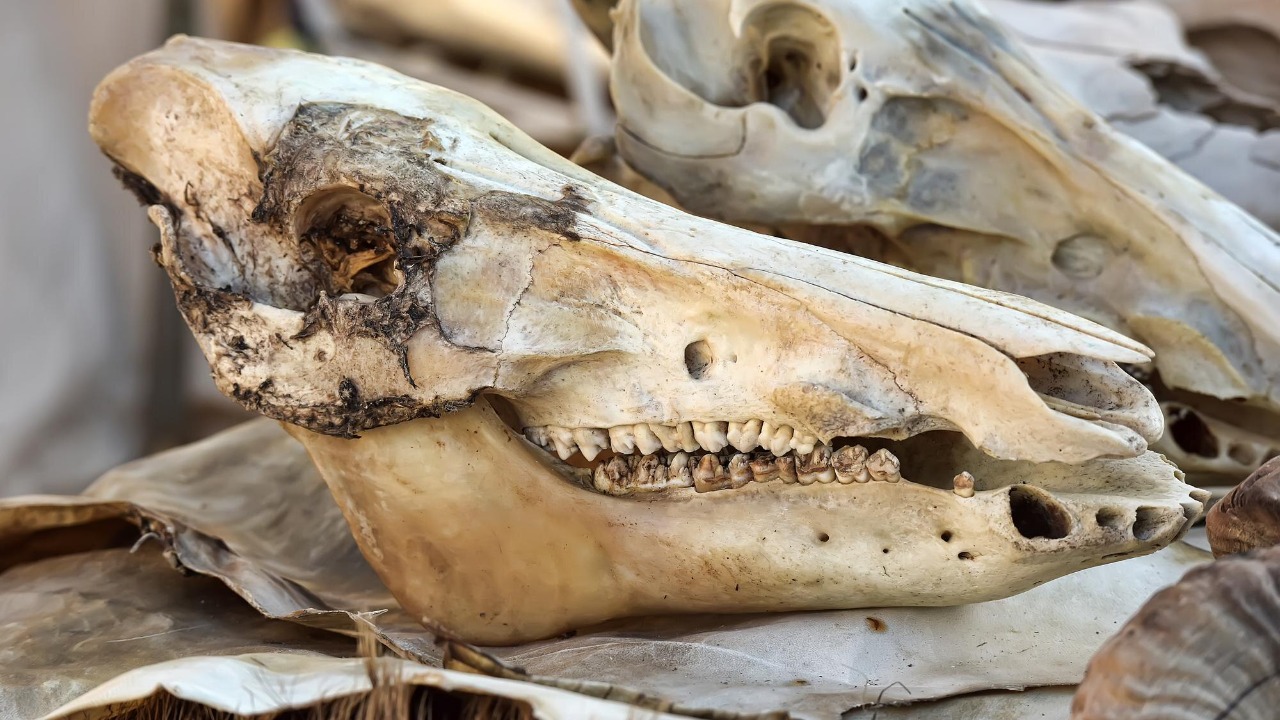

Deep inside a Caribbean cave, paleontologists have uncovered a scene that reads like gothic natural history: tiny bees once turned piles of animal bones into nurseries. Instead of burrowing into soil or wood, these insects packed their eggs and food into hollow skulls and jawbones, transforming the remains of rodents and other small creatures into shelter. The discovery pushes bee behavior into unexpectedly macabre territory and opens a new window on how life adapted to harsh Ice Age landscapes.
The work shows that, about 20,000 years ago, some bees treated skeletons as prime real estate, exploiting the ready-made cavities inside skulls and limb bones. By tracing those choices in the fossil record, researchers are now piecing together a story that links owls, rodents, insects and climate into a single, tightly wound ecological loop.
Inside a Caribbean cave, a bone-filled time capsule
The story begins on a Caribbean island, where paleontologists entered a cave expecting the usual Ice Age fare of small mammal and bird remains and instead found bones riddled with delicate tunnels. The cave floor was layered with skeletal fragments, many of them the compact skulls and jawbones of rodents and other prey that had accumulated over thousands of years. Those bones, it turned out, had once been part of a living recycling system, first processed by predators and then repurposed by insects that saw opportunity in every hollow space.
Researchers estimate that the nests were built sometime within the past 50,000 years, a span that covers repeated swings between cooler and warmer climates. Within that window, about 20,000 years ago, a population of bees on this Caribbean island began using animal bones as protected places to lay their eggs, a behavior that researchers describe as a striking adaptation to the cave’s unusual conditions. The setting preserved not only the skeletons of now extinct species but also the traces of the insects that later moved in, turning the cave into a layered archive of intertwined lives.
Owls, pellets and a ready-made housing market
The bones that became bee nurseries did not arrive in the cave by accident. They were mostly derived from owl pellets, the compact bundles of fur and bone that owls cough up after digesting their prey. The owls would go out and hunt and then come back to the cave and throw up pellets, leaving behind dense deposits of skulls, jawbones and limb fragments that gradually built up on the cave floor. Over time, this steady rain of remains created a kind of natural construction yard filled with small, hollow structures just waiting to be used.
When paleontologists examined fossils from these deposits, they found that some of the rodent skulls and other bones were not just scattered debris but had been carefully modified and filled. The fossils suggest that ancient burrowing bees made their homes in rodent skulls, carving out or enlarging passages and sealing brood cells inside the bone cavities. In effect, the owls unintentionally stocked the cave with prefabricated housing, and the bees moved in, turning regurgitated pellets into a network of protected nests.
How scientists recognized bees in the bones
At first glance, the tiny tunnels and chambers inside the bones could have been mistaken for simple weathering or damage from other animals. What convinced researchers that bees were responsible was the distinctive architecture of the cavities and the material preserved inside them. The internal walls showed the smooth, cylindrical burrows and partitioned cells that are hallmarks of solitary bee nests, rather than the irregular gnaw marks left by rodents or the chaotic galleries carved by beetle larvae. In some cases, the team could even see the remains of brood cells and other organic traces that matched what is known from modern bee nesting behavior.
In a paleontological first, scientists reported that bees had used the jawbones and other bones of now extinct species as nesting sites, filling them with brood cells and sealing them off with plugs of sediment and plant material. The bones of these animals, which they found in excess in the cave deposits, contained patterns that matched those of modern burrowing bees, leading the team to conclude that ancient bees burrowed inside bones rather than simply exploiting cracks in rock. When paleontologists examined fossils from the cave in more detail, they found that the bee-made structures were preserved alongside the fossils themselves, a rare case where insect behavior is frozen in place rather than inferred from indirect clues.
A behavior “never seen before” in the fossil record
What makes this discovery stand out is not just the oddity of bees in bones but the fact that such behavior has never been documented in the fossil record. Usually what you find in this cave are rodents, birds and other small fauna, so finding evidence of ancient bees in that context was a surprise even to seasoned researchers. The nests show that, under the right conditions, insects can radically shift their nesting strategies, abandoning soil or wood for a substrate that offers better protection from predators and environmental stress.
Scientists studying this Caribbean island have described the fossilized bee nests inside skeletons as unlike anything they had seen before, a view echoed in reports that call the structures a behavior never seen before in ancient bees. The work, which points to a new kind of ecological interaction preserved in the cave, shows how environmental constraints and resource availability can drive insects to innovate. As one researcher explained, the discovery of ancient bee nests in fossils points to a more complex Ice Age ecosystem than previously recognized, with discovery of ancient bee nests in fossils revealing how insects, predators and prey were linked through shared spaces.
Climate pressure and the search for safer nests
The timing of the nests, clustered within the last glacial period, suggests that climate played a role in pushing bees toward such unconventional housing. About 20,000 years ago, a cooler and drier climate would have made suitable nesting sites in soil or wood harder to find or more vulnerable to flooding and erosion. In that context, bones offered a stable, elevated and relatively dry refuge, especially inside a cave where temperature and humidity fluctuated less than on the surface. The bees appear to have seized on this microhabitat, turning a byproduct of predation into a buffer against environmental stress.
Reports on the find describe how 20,000-year-old fossils reveal ancient bees found a “perfect home” in owl prey bones, using the hollow interiors as protected nurseries for egg laying. The 20,000-year-old bones, mostly derived from owl pellets, show how the insects exploited a resource that was both abundant and underused. By nesting in bone, the bees may have reduced competition with other burrowing insects and avoided some of the pathogens and parasites that accumulate in soil, trading a more typical substrate for one that offered better odds of survival in a challenging climate.
What bone nests reveal about bee evolution
For evolutionary biologists, the bone nests are more than a curiosity; they are a rare, concrete record of behavior that usually vanishes without a trace. Modern solitary bees show a wide range of nesting strategies, from tunneling in sand banks to hollowing out stems, and the fossil nests suggest that this flexibility has deep roots. The Caribbean bees that once occupied skulls and jawbones were likely close relatives of today’s burrowing species, but their choice of substrate shows that even small shifts in environment can open up entirely new behavioral pathways. In that sense, the nests are snapshots of evolution in action, capturing a moment when insects experimented with a novel way of living.
Scientists who first described the find emphasize that these fossilized bee nests inside skeletons are unlike anything we have seen before in terms of preserved insect behavior. About 20,000 years ago, a population of bees on a Caribbean island began using animal bones as places to lay their eggs, a pattern detailed in reports that note how scientists discover ancient bees built nests inside animal bones. Other accounts describe how these fossilized bee nests inside skeletons are unlike anything we have seen before, underscoring that the behavior is not just unusual but also uniquely well preserved. Together, the studies show how environmental constraints and resource availability can drive insects to innovate, leaving behind traces that, with enough patience and luck, can still be read tens of thousands of years later.
A new kind of fossil story, written in miniature
What lingers from this discovery is the sense of an ecosystem written in miniature, with each bone and burrow hinting at a chain of events that began with a hunt and ended with a hatch. Owls hunted rodents and other small animals, then returned to the cave and deposited pellets that broke apart into piles of bones. Bees later arrived and turned those bones into nurseries, sealing their larvae inside and leaving behind a record of their choices in the architecture of the nests. Long after the owls, rodents and bees themselves vanished, the cave preserved their interactions as a single, layered story.
For me, the most striking detail is how much information is packed into such tiny structures. The clandestine nests, described as ancient bee nests hiding in regurgitated, fossilized bones, mark the first time scientists have been able to trace this kind of behavior directly in the fossil record. Accounts of ancient bee nests hiding in regurgitated bones, along with descriptions of fossilized bee nests inside skeletons that are unlike anything we have seen before, show how even the smallest traces can reshape our understanding of the past. In this case, the humble bee has expanded the fossil record from a catalog of bones into a record of behavior, revealing how life once found shelter in the most unlikely of places.
Supporting sources: Fossilized Bee Nests Inside Skeletons Are Unlike Anything We’ve ….
More from Morning Overview