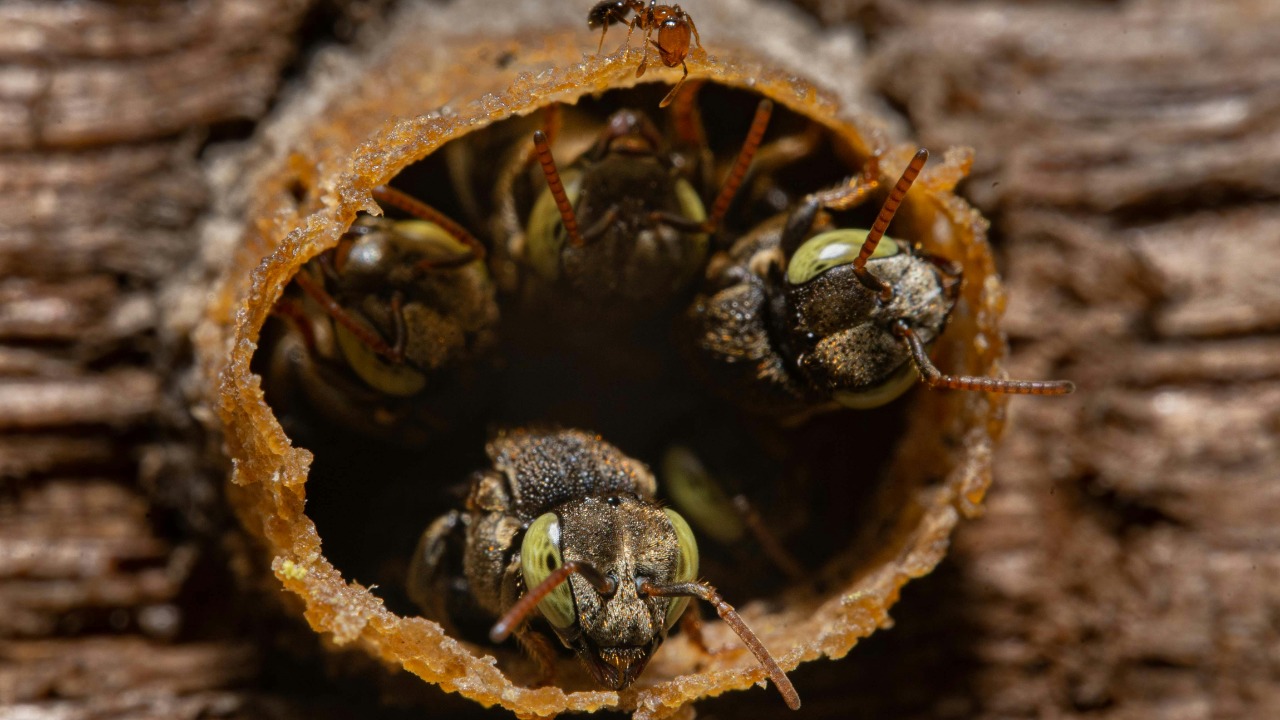

In a remote corner of Peru’s central Amazon, a small, ancient pollinator has quietly rewritten legal history. Native stingless bees, long overshadowed by their stinging cousins, have become the first insects on record to be recognized as rights-bearing entities, not just resources to be managed. The move signals a profound shift in how law can treat nonhuman life, with implications that reach far beyond the forest canopy.
By granting these Amazon stingless bees explicit legal rights, local authorities have elevated them to the same conceptual plane as rivers, forests, and other ecosystems that already enjoy legal personhood in some jurisdictions. I see this as a test case for whether rights of nature frameworks can stretch down to the smallest, often invisible workers that keep food systems and cultures alive.
How a provincial ordinance made legal history
The breakthrough began in Satipo, a largely rural province in Peru’s department of Junín, where local leaders moved to protect native pollinators that underpin both Indigenous livelihoods and regional agriculture. The local government of Satipo, described as the largest and easternmost province in Junín, approved a measure that explicitly recognizes the rights of Amazonian stingless bees, treating them in the same legal family as rivers, mountains, and forests that have already been granted personhood in other rights of nature experiments. Reporting on how, on Tuesday, the authorities in Satipo, Peru, Jun, took this step underscores that the decision was framed as part of a broader movement to treat ecosystems as subjects of law rather than objects.
The legal vehicle is a municipal ordinance that functions as a kind of local constitution for the bees, spelling out their status and the obligations humans have toward them. In official descriptions, the initiative is identified as the Satipo, Per, Municipal Ordinance, with its Location listed as Satipo Province, Peru, and its Status marked as approved in 2025, and it notes that the Declaration recognizes the inherent rights of the Amazonian stingless bees and sets out protections against habitat destruction, pollution, and other impacts. By embedding these protections in local law, Satipo has created a binding framework that residents, companies, and even state agencies must now navigate.
From overlooked pollinators to rights holders
For decades, stingless bees have been ecological workhorses with little public profile, even as they quietly pollinated crops, sustained forest plants, and supported Indigenous food systems. In Peru’s central Amazon, officials and advocates have emphasized that these bees are critical to local agriculture, traditional honey production, and broader food systems and global markets, which is why they pushed for formal recognition of their status as rights holders. Coverage that explains how, for the first time in history, the law is recognizing an insect as a rights holder in Dec, For the, In Peru, Amazon, notes that this shift is rooted in the bees’ role in sustaining both forest biodiversity and human economies.
The new legal framework does more than symbolically elevate the bees, it forces policymakers to treat them as central actors in environmental stewardship. Advocates describe this as a crucial legal shift that highlights these essential pollinators and moves them from being overlooked in environmental policy to being explicitly considered in the process of environmental stewardship, a change that has been documented in analysis of Stingless Bees in Peru and the effort to protect pollinators’ legal rights. By centering the bees in law, Satipo is effectively telling regulators that any decision about land use, pesticides, or development must now account for the bees’ own legally recognized interests.
Inside the ‘Declaration of Rights for Native Stingless Bees’
At the heart of the change is a detailed legal text known as the Declaration of Rights for Native Stingless Bees, which sets out what it actually means for an insect to have rights. The Declaration recognizes the inherent rights of these bees to exist, to maintain their natural cycles, and to have their habitats protected from activities that could cause harm, and it also outlines mechanisms for monitoring and enforcement when those rights are threatened. Reporting on how the Dec, Declaration, Declaration of Rights for Native Stingless Bees has become a landmark document explains that it is designed to be invoked in concrete cases, not just as a symbolic statement.
The Declaration goes further by specifying how communities and authorities should respond when the bees’ rights are violated, including the possibility of legal action to halt damaging activities. A more detailed account of the same text describes how the ‘Declaration’ is the Declaration of Rights for Native Stingless Bees, a landmark document which recognizes the inherent rights of these insects and sets out procedures for communities to bring cases of threat or harm to the bees before local authorities, as outlined in the Dec, Declaration of Rights for Native Stingless Bees account. In practice, that means residents can now argue in court that a particular project violates the bees’ right to exist and flourish, a radical departure from traditional environmental law that usually focuses on human interests alone.
‘Satipo Approves Historic Ordinance’ and a precedent with no equal
Local and international advocates have framed the Satipo decision as a watershed moment in the evolution of environmental law. In Nov, a detailed account titled Satipo Approves Historic Ordinance, In World First, An Insect Is Granted Legal Rights, described how the ordinance was adopted in a precedent with no equal, recognizing the rights of Amazonian stingless bees and the ecosystems they sustain, and situating the move within a broader rights of nature movement that has already extended legal personhood to rivers and forests in other parts of the world. The description of Nov, Satipo Approves Historic Ordinance, In World First, An Insect Is Granted Legal Rights underscores that this is the first time an insect has been explicitly named as a subject of rights in a binding legal instrument.
Advocates emphasize that the ordinance is not just about bees, but about reimagining the relationship between human communities and the ecosystems that support them. In a follow up description, the same Nov account stresses that, in a precedent with no equal, the ordinance recognizes the rights of the bees and the ecosystems they sustain, and it positions Satipo as a pioneer in applying rights of nature principles to smaller, often ignored species, as captured in the passage on In a precedent with no equal. For me, that framing matters because it signals that the bees are being treated as keystone actors whose well being is inseparable from the health of the forest and the people who live there.
Why Amazon stingless bees matter so much
Part of what makes this legal experiment compelling is the biology and cultural history of the bees themselves. These are stingless bees from the Amazon, a group that scientists describe as among the planet’s most ancient bee lineages, and they play a central role in pollinating native plants and crops across the rainforest. Detailed coverage of how Amazon stingless bees now hold legal rights notes that they are considered some of the oldest bee species on Earth and that their colonies are deeply intertwined with Indigenous practices of honey gathering and forest management, a point highlighted in reporting that describes how Dec, Stingless, Peru, Amazon pollinators have become the world’s first insect to be granted legal rights.
Scientists and advocates also stress that these bees are under pressure from deforestation, pesticide use, and the spread of industrial agriculture, which threaten both their habitats and the traditional knowledge systems built around them. A separate account describes how rare stingless bees in the Amazon become some of the first insects to receive legal rights, noting that these Rare Stingless Bees, Amazon Become Some of the First Insects, Receive Legal Rights, and that reporter Angel Saunders has been documenting how their decline could ripple through local food webs and economies, as seen in the coverage anchored to Dec, Rare Stingless Bees, Amazon Become Some of the First Insects, Receive Legal Rights, Angel Saunders. By foregrounding these ecological and cultural stakes, the legal rights framework is not just an abstract gesture, it is a response to concrete threats facing a species that holds together multiple strands of Amazonian life.
From Satipo to Nauta: a growing legal experiment
What began in Satipo is already spreading to other parts of the Peruvian Amazon, suggesting that the idea of insect rights is gaining traction beyond a single municipality. Reports note that Satipo and Nauta municipalities are now both involved in recognizing the rights of these bees, with local ordinances that affirm their right to exist and to flourish and that commit authorities to protecting their habitats from destructive activities. An account of how stingless bees from the Amazon were granted legal rights in a world first explains that Dec, Stingless, Amazon, Bees, The Guardian describes Satipo and Nauta municipalities as recognizing the bees’ right to exist and to flourish, effectively creating a small but growing legal corridor for pollinator protection.
As more municipalities adopt similar measures, the legal status of the bees could become a test case for how rights of nature frameworks scale across different jurisdictions. Advocates involved in the Satipo process have already been working with communities and local governments to replicate the model, using research methods that include community engagement and poll based consultations to understand how residents view the bees and what protections they support. Analysis of the broader campaign to protect these pollinators notes that this crucial legal shift serves to highlight these essential pollinators and that the process of environmental stewardship has been informed by local perspectives gathered through a poll and other participatory methods, as described in the account of poll based stewardship. If Nauta and other municipalities continue to follow Satipo’s lead, the bees’ rights could eventually be recognized across a much larger swath of the Amazon.
What ‘rights’ actually mean for an insect
Granting rights to an insect raises immediate questions about what those rights look like in practice and who speaks for the bees. In Satipo’s case, the ordinance and the Declaration of Rights for Native Stingless Bees specify that the bees have rights to exist, to maintain their natural cycles, and to have their habitats protected, and they empower designated guardians, including community members and local authorities, to represent the bees in legal and administrative processes. A detailed legal summary of the Satipo Province, Peru initiative explains that the Declaration recognizes the inherent rights of the Amazonian stingless bees and outlines protections against habitat destruction, pollution, and other impacts, as captured in the description of the Declaration recognizes the inherent rights of the bees.
In practical terms, that means that if a proposed development, such as a road or plantation, threatens to destroy nesting sites or foraging areas, guardians can argue that the project violates the bees’ rights and seek to halt or modify it. Advocates involved in the process emphasize that this flips the usual burden of proof, requiring proponents of potentially harmful activities to show that they will not infringe on the bees’ rights, rather than asking communities to prove harm after the fact. The broader analysis of how stingless bees in the Amazon became the first insects with legal rights notes that officials in Peru’s central Amazon have framed the bees as rights holders whose interests must be considered alongside human economic goals, and that this recognition is part of a wider shift in how law treats nonhuman entities in the region, as described in the account of In Peru, Amazon recognition. For me, that is the core innovation: the bees are no longer just indicators of environmental health, they are legal subjects whose well being can be defended in court.
Oldest bee species, newest legal frontier
There is a striking irony in the fact that some of the planet’s oldest bee species are now at the cutting edge of legal innovation. Scientific accounts describe these Amazonian stingless bees as part of an ancient lineage that predates many other bee groups, and they have evolved complex social structures and relationships with tropical plants over millions of years. A widely cited report notes that the Planet’s Oldest Bee Species Has Become The World, First Insect To Be Granted Legal Rights, and it emphasizes that the new legal framework is intended to shield the bees from activities that threaten these rights, including land use changes and chemical exposure, as detailed in the analysis of Dec, The Planet, Oldest Bee Species Has Become The World, First Insect To Be Granted Legal Rights, OFF, OFFER. The reference to a 40% OFF OFFER in that context is incidental marketing, but the core point about the bees’ evolutionary status is central to the story.
By pairing this deep evolutionary history with cutting edge legal tools, Satipo and its partners are effectively arguing that ancient species deserve modern protections that match their ecological importance. Other analyses of the bees’ new status describe how Amazonian stingless bees are now recognized as the first insects to get legal rights in the world, and they stress that the Declaration of Rights for Native Stingless Bees is designed to be a model that can be adapted for other species and regions, as seen in the coverage of Amazonian stingless bees first insects to get legal rights in the world. I see this as a signal that rights of nature frameworks are moving beyond charismatic megafauna and iconic rivers to encompass the less visible, but no less vital, species that keep ecosystems functioning.
What this means for the future of environmental law
The recognition of legal rights for Amazon stingless bees is already being cited as a precedent that could influence how courts and lawmakers think about other species, from pollinators in industrial agriculture to soil microbes in regenerative farming systems. Advocates involved in the Satipo process argue that if an insect can be a rights holder, then there is no principled reason why other ecologically important organisms cannot also be granted similar status, especially when their decline threatens human food security and cultural survival. The Nov account of Satipo Approves Historic Ordinance, In World First, An Insect Is Granted Legal Rights, frames the decision as a precedent with no equal that could inspire similar measures elsewhere, and it highlights how the ordinance recognizes the rights of the bees and the ecosystems they sustain, as described in the detailed passage on Satipo Approves Historic Ordinance.
At the same time, the bees’ new status raises hard questions about enforcement, economic trade offs, and the limits of local authority in the face of national and global market pressures. Legal scholars and environmental advocates are watching closely to see how courts interpret the bees’ rights when they collide with infrastructure projects or agribusiness interests, and whether higher levels of government will respect or override municipal ordinances that prioritize pollinators over short term economic gains. A broader analysis of the stingless bees’ legal recognition notes that, for the first time in history, the law is recognizing an insect as a rights holder in Peru’s central Amazon, and that this experiment is unfolding in a region where food systems and global markets are tightly intertwined, as detailed in the account of how stingless bees became the first insects with legal rights. For now, the Amazon stingless bees stand as a small but potent symbol of how far environmental law can stretch when communities decide that even the tiniest creatures deserve a place in the legal order.
More from MorningOverview