
Public fascination with alien visitors has surged again after a cryptic response from the Central Intelligence Agency about the interstellar object 3I/ATLAS. While NASA scientists have publicly described the visitor as a natural comet, the CIA’s refusal to clarify whether it holds records on the object has reopened old anxieties about secrecy, unidentified threats and what governments choose to share with the public.
At the center of the uproar is a familiar tension: astronomers like Avi Loeb are pressing for transparency, intelligence officials are leaning on cautious language, and online audiences are filling the gaps with speculation. The result is a new wave of “alien panic” that says as much about our distrust of institutions as it does about the strange rock that briefly swept past Earth.
From obscure comet to cultural flashpoint
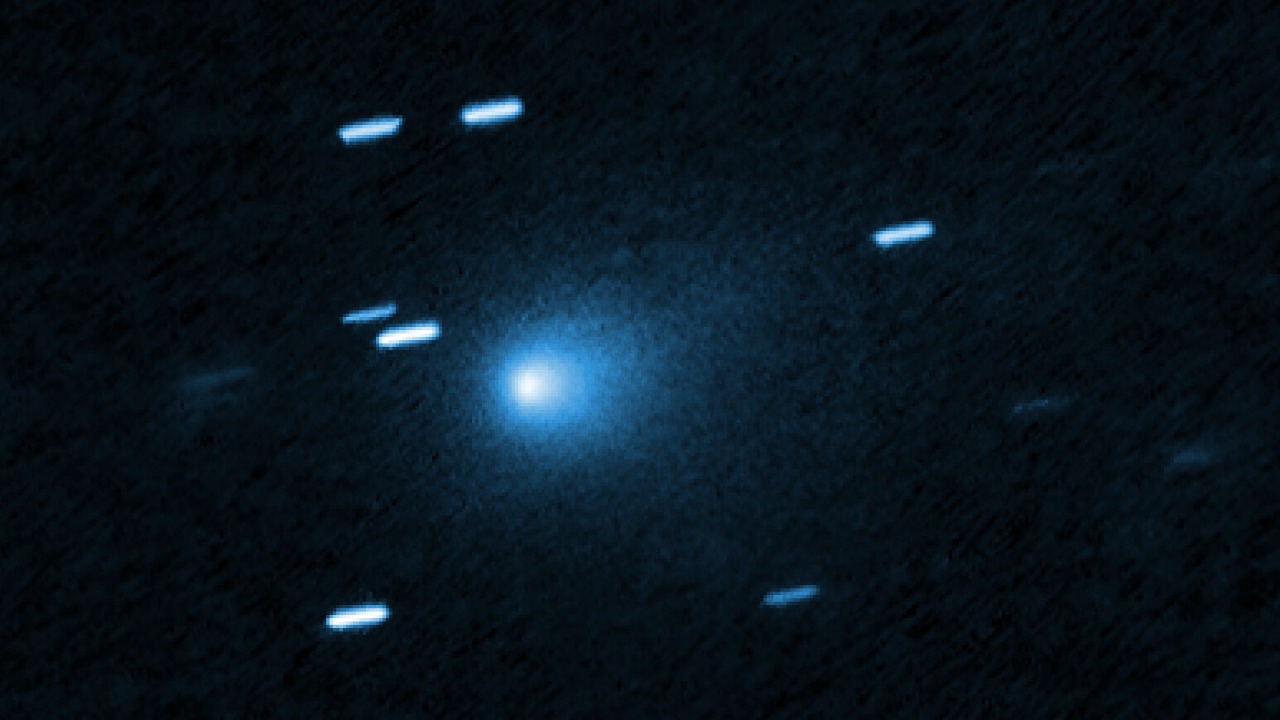
3I/ATLAS began as a technical curiosity, catalogued as the third known interstellar object to pass through our solar system and also known as C/2023 A3, discovered by the Asteroid Terrestrial-impact Last Alert System, or ATLAS, which also lends its name to Comet ATLAS. Astronomers quickly established that its trajectory would take it no closer than about 1.8 astronomical units from Earth, posing no threat, and early analyses slotted it into the growing but still tiny category of interstellar visitors that include ‘Oumuamua and 2I/Borisov. On paper, it was a scientific prize, not a security concern.
The public mood shifted after 3I/ATLAS made its close flyby of Earth on December 19, 2025, a moment that turned an obscure object into a trending topic. Reporting notes that 3I/ATLAS made this close approach to Earth, and nearly two weeks later the conversation had already drifted from orbital mechanics to existential questions about whether the object might be artificial, or even hostile. That timing primed audiences to interpret any hint of official ambiguity as evidence that something was being hidden.
The CIA’s “neither confirm nor deny” answer
The spark for the latest wave of alien panic was not a telescope image but a bureaucratic phrase. In response to a query about whether it held records on 3I/ATLAS, the CIA replied that it would “Neither Confirms Nor Denies” the existence of such Files, a formulation long associated with sensitive intelligence programs. Coverage of the exchange highlighted that this language came despite NASA’s public position that the object is a comet of natural origin, setting up a sharp contrast between the scientific and intelligence communities and raising the question of why the CIA looked into ATLAS at all.
That contrast has been amplified by commentary pointing out that NASA is not the government institution Avi Loeb is most concerned about. In a new blog post, the Harvard astronomer argued that the key issue is the CIA’s refusal to say whether it monitored 3I/ATLAS, even as NASA has described it as a comet of natural origin, a stance that Loeb sees as potentially incomplete without access to classified tracking data from agencies beyond NASA. The agency’s stock phrase, in other words, has become a Rorschach test, read by some as routine caution and by others as a sign that something extraordinary is being kept under wraps.
Avi Loeb, FOIA pressure and the “panic” argument
Into this vacuum has stepped Avi Loeb, who has spent years arguing that interstellar objects deserve to be treated as potential technological artifacts until proven otherwise. Writing in Medium, Loeb suggests that the CIA’s silence is a calculated move to manage potential risk, framing the “Neither Confirms Nor Denies” response as a way to keep options open if 3I/ATLAS were later judged to be a probe rather than a comet. He argues that the simplest interpretation of the agency’s posture is that officials want to avoid triggering global panic, a claim that has been widely shared and debated since he published his Writing on the subject.
The pressure on the agency has also come through formal channels, including a Freedom of Information request that sought details of any monitoring of the object. Nearly two weeks after 3I/ATLAS passed Earth, coverage described how a suspicious response by the CIA to a November 2025 Freedom of Information request, or FOIA, about the supposed comet fed speculation that the agency was withholding data about an object that will not return to our solar system by 2030, a narrative that has been amplified by social media posts summarizing how the Now familiar FOIA tools are being used. For those already inclined to distrust secretive agencies, the combination of legal stonewalling and Loeb’s warnings has been enough to revive the language of “cover up” and “panic management” that has long surrounded UFO debates.
What we actually know about 3I/ATLAS
Stripped of the intrigue, the scientific picture of 3I/ATLAS is still grounded in data rather than rumor. NASA briefings have emphasized that, whether you need an introduction to or a refresher about 3I/ATLAS, the interstellar object follows a hyperbolic path that will carry it out of the solar system after its brief visit, and that follow up observations are aimed at pinning down its origins rather than tracking any threat to Earth, a framing laid out in public explainers on what Whether 3I/ATLAS is a comet or something stranger. Earlier television interviews with Loeb, including a segment on john Hook’s Newsmaker that described the object as roughly the size of Manhattan and “fast moving,” helped cement its image as a dramatic visitor, but they also underscored that its path did not intersect our planet in a dangerous way, even as the Newsmaker framing leaned into its cinematic qualities.
Scientific analyses have flagged anomalies, but they remain within the realm of debate rather than proof of alien engineering. One technical review described 3I/ATLAS as the third interstellar object and noted that it exhibits unusual traits in its spectrum and emissions, challenging conventional cometary explanations and prompting discussion of whether it might be an engineered probe, a question explored in detail in a set of Key Takeaways. Loeb has highlighted that because the object was on a hyperbolic path, it would never come back, and that it was traveling at a record breaking 137,000 miles per hour relative to the Sun, details that feed his argument that such one time visitors should be monitored with extreme prejudice rather than dismissed as routine, a point he has reiterated in interviews that stress that “Because the” object will not return, any missed data is lost forever.
Why secrecy keeps fueling alien panic
For all the technical nuance, the public reaction to 3I/ATLAS is being shaped as much by institutional behavior as by orbital dynamics. Commentators have noted that The CIA have refused to deny they have records monitoring the object, a stance that was highlighted in coverage quoting Joshua Whorms and pointing readers to View 4 Images of the agency’s carefully worded reply, which leaned on the familiar “neither confirm nor deny” formula associated with past secrecy battles over UFO files and surveillance programs, a pattern that has been documented in detail by researchers like John Greenewald Jr., whose work was cited in the Joshua Whorms coverage. When the same language is applied to an object already framed as a potential “hostile alien threat,” it is hardly surprising that audiences leap to the most dramatic interpretation.
Loeb himself has tried to walk a line between caution and alarm. He acknowledged that government officials would have likely wanted to verify that 3I/ATLAS was not an alien threat, however he has also stressed that the additional anomalies of 3I/ATLAS raise other questions about its nature, to which we do not have answers yet, a position quoted in coverage that framed his comments as a call for more data rather than a declaration of invasion, and which noted that he compared the object’s behavior to the orbits of Saturn, Uranus and Neptune when arguing that its path through the outer solar system deserved close scrutiny, a point captured in reporting on the ATLAS debate and in follow up pieces quoting his line that “The additional anomalies of 3I/ATLAS raise other questions” about its nature as it moved past the orbits of Saturn, Uranus and Neptune, a formulation repeated in coverage that highlighted how those anomalies have become a rallying point for those who see the object as more than a comet and cited his remarks on the ATLAS anomalies.
In that sense, the 3I/ATLAS episode is less a story about a single object than about how modern societies process uncertainty. When a Harvard professor warns that secret CIA files may exist to prevent global panic, when a routine FOIA reply becomes a viral talking point, and when a comet discovered by the Asteroid Terrestrial-impact Last Alert System is recast as a possible probe, the line between scientific mystery and cultural anxiety blurs. As long as agencies default to silence and astronomers like Loeb argue that silence is simply not an option, each new interstellar visitor will arrive not just as a point of light in the sky, but as a fresh test of how much trust the public is willing to extend to those watching it on our behalf.
More from Morning Overview