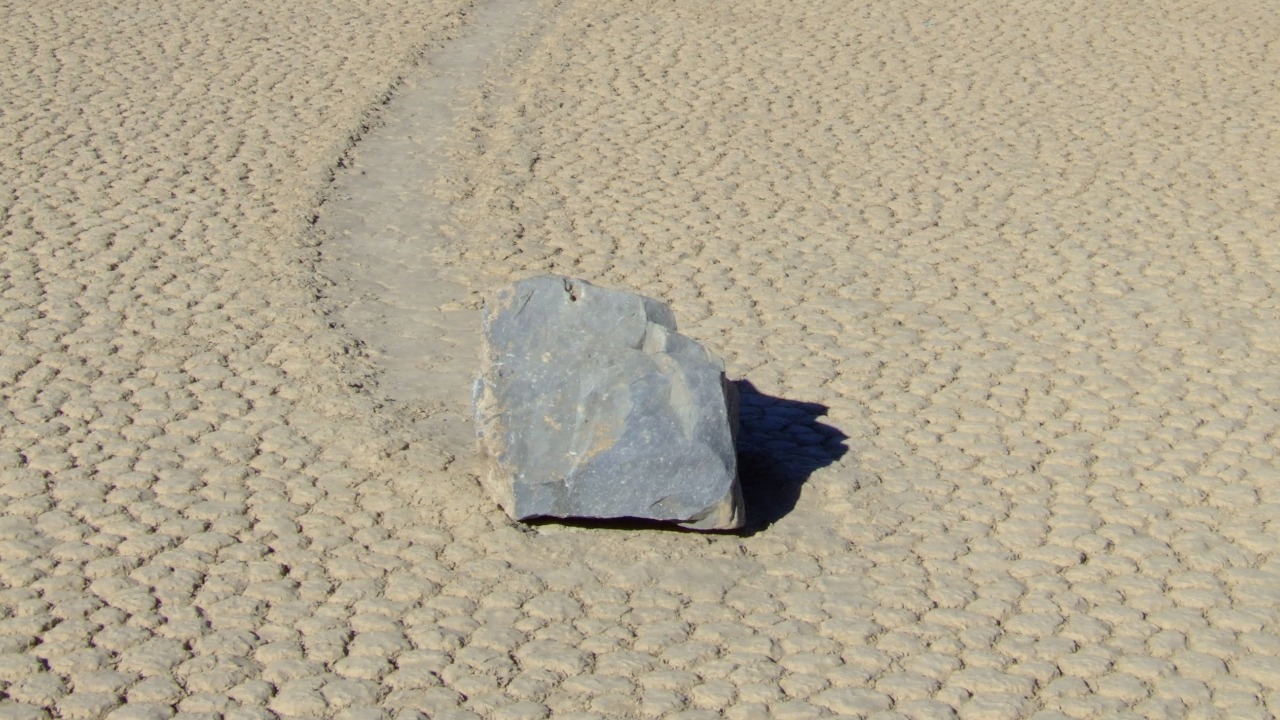

For more than a century, visitors to a remote California lakebed have stared at long, ruler-straight tracks etched into the mud and wondered how heavy boulders could apparently glide on their own. The mystery of these “moving rocks” became one of geology’s most persistent puzzles, spawning theories that ranged from magnetic fields to pranksters. After years of patient fieldwork and a rare stroke of luck with the weather, researchers have now shown in detail how a delicate mix of ice, water and wind finally explains what is happening on that desert floor.
The answer turns out to be less supernatural than it looks, but far more intricate than early explanations suggested. The rocks move only when a shallow pond forms, a thin sheet of ice locks around them, and a light breeze nudges the whole frozen raft across slick mud. It is a textbook example of how a seemingly simple landscape can hide a finely tuned natural machine that only switches on under just the right conditions.
From campfire legend to scientific obsession
The story of the moving rocks begins on Racetrack Playa, a dry lakebed in Death Valley National Park where isolated stones sit on a flat, cracked surface, each one trailed by a sinuous groove that can stretch for hundreds of meters. Early visitors saw the tracks but almost never the motion itself, so the phenomenon quickly slipped into desert lore as a kind of geological ghost story. Over time, the rocks picked up a formal name, Sailing stones, and the playa became a pilgrimage site for anyone fascinated by strange patterns in nature.
As more people arrived with cameras and notebooks, the puzzle hardened into a serious scientific problem. The tracks were too long and too sharply defined to dismiss as a trick of erosion, and the stones themselves, some weighing tens of kilograms, were clearly not being nudged by casual human interference. The result was a kind of observational stalemate: the evidence of motion was everywhere, yet the act of motion remained stubbornly out of sight, turning Racetrack Playa into a natural laboratory that taunted generations of geologists.
Wild theories in a harsh landscape
In the absence of direct observation, speculation flourished. Some early ideas leaned on magnetism, suggesting that subtle forces in the Earth’s field might tug the rocks along, while others invoked powerful gusts that could somehow shove even the heaviest boulders across the playa. There were also more exotic proposals, including the notion that microbial films or unusual clay minerals might act like lubricants, letting the stones slide with minimal friction, a cluster of hypotheses that reflected how little was known about the playa’s seasonal cycles.
As field measurements improved, researchers began to rule out the most extreme suggestions and focus on a partnership between wind and water. Careful surveys showed that the tracks tended to form after rare wet periods, when shallow ponds briefly covered parts of the lakebed before evaporating in the desert heat. Later work, including analysis highlighted by Jun, emphasized that the evaporation rate on Racetrack Playa can exceed the supply of water feeding these ponds, which means the window for any water-driven motion is short and easily missed by casual observers.
The Goldilocks conditions that finally revealed the motion
The breakthrough came when a small research team decided to stop waiting for luck and instead camp the playa with instruments until the rocks finally moved. They installed high resolution GPS units on selected stones, set up time lapse cameras, and monitored the shallow basin through a winter season. Their patience paid off when a thin layer of water pooled on the surface, froze overnight, and then began to fracture under the morning sun, creating floating ice panels that could interact with the rocks in ways no one had directly seen before.
Lead researcher Richard Norris described what they saw as a “Goldilocks” phenomenon, a system that only works when conditions are not too wet or too dry, not too warm or too cold. Thin “Ponds” of water must be deep enough to float ice but shallow enough that the rocks still touch the mud, and the ice itself has to be fragile, so it can break into plates that push gently on the stones instead of locking them in place. When a light wind arrives at just the right moment, those plates drift and drag the rocks along, leaving crisp trails in the soft sediment beneath.
How ice, wind and mud turn boulders into slow-motion boats
Once the mechanism was captured on camera and GPS, the physics of the moving rocks became easier to describe. Overnight, a thin sheet of ice forms across the ponded water, bonding to the exposed surfaces of the stones. As the sun rises, the ice warms and fractures into panels that remain attached to the rocks, which now sit in a slick film of water over saturated mud. Even a modest breeze can then push the ice panels, and with them the stones, at speeds of only a few centimeters per second, slow enough that a person standing nearby might not notice the motion without careful reference points.
Because the mud is soft and cohesive, each stone carves a distinct furrow that records its path long after the water has vanished. Observers have documented tracks that curve, intersect and even reverse direction, patterns that once seemed to demand complex explanations but now fit naturally with shifting wind directions and changing ice geometry. Later syntheses of the fieldwork, including a detailed overview of How the stones slide, emphasize that the rocks do not need hurricane force winds or thick ice, only a rare alignment of thin ice, shallow water and gentle airflow.
Confirming the mystery in the scientific record
Capturing the motion on instruments was only part of the story; the team also had to convince other scientists that this delicate process really was the main driver of the tracks. They analyzed GPS logs that showed coordinated movement of multiple rocks, sometimes over distances of tens of meters in a single event, and matched those data to weather records and camera footage. The result was a coherent timeline in which specific wind speeds, ice thicknesses and water depths lined up with bursts of motion, a pattern that could be tested and critiqued rather than simply admired.
The researchers then published their findings in the journal PLOS ONE, where the work could be scrutinized in detail. Perhaps the most striking aspect of the study was how modest the forces involved turned out to be, a point that “Perhaps the” most skeptical observers had not anticipated. Instead of dramatic gusts or exotic materials, the rocks were moved by conditions that would feel almost calm to a human standing on the playa, a reminder that slow, persistent processes can leave some of the most dramatic marks on a landscape.
Why the rocks fooled us for so long
Knowing the mechanism, it is tempting to ask why it took so many decades to reach a consensus on what was happening. The answer lies in how rarely all the necessary ingredients come together. Racetrack Playa sits in one of the driest parts of North America, so standing water is infrequent, and when it does appear it can vanish quickly as the desert air pulls moisture from the surface. The thin ice required for motion forms only during cold, clear nights that follow just the right kind of storm, and even then the window for movement can be measured in minutes or hours.
Those constraints meant that generations of visitors were essentially walking into a theater long after the show had ended, seeing only the tracks left behind. Later analyses of the playa’s hydrology, including work summarized by water and evaporation studies, underline how quickly the ponds can disappear once the wind picks up and the sun returns. By the time most people arrived with cameras, the ice had melted, the water had drained or evaporated, and the rocks sat motionless on a surface that gave no hint of the fleeting conditions that had just set them in motion.
What the sailing stones reveal about rocks in motion
Although the moving rocks of Death Valley are a local curiosity, they also fit into a broader story about how solid Earth materials are constantly being shifted, reshaped and recycled. Geologists describe this long term transformation as the Rock cycle, a framework that tracks how igneous, metamorphic and sedimentary rocks form, move and break down under the influence of tectonics, climate and even biological activity. In that context, the Racetrack stones are a tiny, surface level expression of a much larger pattern in which gravity, water and temperature gradients are constantly rearranging the crust.
What makes the sailing stones stand out is not that they move, but how they move. Most rock transport is abrupt, like a landslide, or slow and steady, like a river carrying pebbles downstream. On Racetrack Playa, the motion is intermittent and highly sensitive to narrow environmental thresholds, which is why it took such careful monitoring to document. That sensitivity makes the playa a useful natural experiment for understanding how small changes in climate, such as shifts in winter temperature or storm timing, could alter the frequency or character of the tracks, providing a visible record of subtle environmental change.
Beyond Death Valley: similar mysteries and public fascination
The Death Valley stones are the most famous example of this phenomenon, but they are not the only ones. Similar tracks have been reported on other dry lakebeds, and the general term “Sailing Stones” has been applied to rocks that appear to slide across flat, fine grained surfaces in a variety of arid settings. In each case, the same basic ingredients seem to be present: a smooth, low friction substrate, occasional shallow flooding, and a climate that can swing quickly between freezing nights and sunny, breezy days, a combination that sets the stage for ice assisted motion.
Public fascination with these sites has only grown as the scientific explanation has solidified, in part because the real story is more intricate than the myths it replaced. Travel accounts now describe how the Sailing Stones rely on a combination of natural forces working in harmony, a phrase that captures both the fragility and the elegance of the process. That narrative, grounded in careful measurement but still tinged with wonder, has helped turn Racetrack Playa from a niche geological puzzle into a widely recognized symbol of how patient observation can decode even the strangest looking patterns in nature.
How the mystery changed the way we study extreme places
Solving the moving rock puzzle also shifted how researchers approach other hard to catch phenomena in extreme environments. The Racetrack team showed that relatively simple tools, such as consumer grade GPS units and time lapse cameras, can yield high value data when deployed thoughtfully and left in place long enough. Their work encouraged similar instrument heavy campaigns in other remote settings, from high altitude glaciers to polar sea ice, where rare events leave outsized marks on the landscape but are difficult to witness directly.
At the same time, the story has become a case study in how to communicate complex, counterintuitive science to a broad audience. Early reports focused on the visual drama of rocks “sailing” across the desert, but later coverage, including explanations that note how But two researchers traced the motion to thin, clear sheets of ice, helped anchor the narrative in specific, testable mechanisms. For me, that blend of spectacle and rigor is the real legacy of the moving rocks: a reminder that even in a hyper connected era, some of the most satisfying discoveries still come from quietly watching a lonely landscape until it finally decides to move.
More from MorningOverview