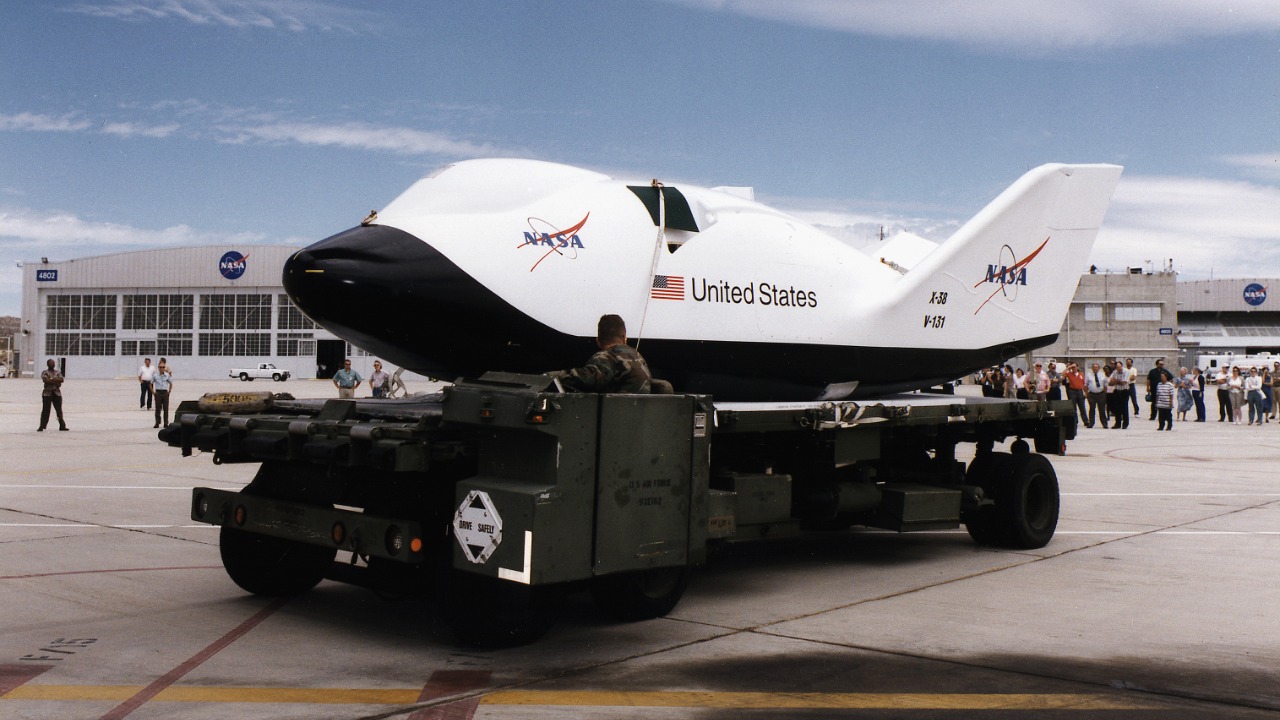

NASA’s long-promised space plane is finally on the cusp of leaving the runway behind and heading for orbit, a decade after the agency first backed the concept. The lifting-body vehicle known as Dream Chaser has cleared a gauntlet of pre-flight tests, secured a revised mission plan, and now has a launch slot on the manifest, turning a once-speculative shuttle successor into a concrete flight program. After years of redesigns and contract reshuffles, the space plane is no longer a paper project but a flight article being readied for a late 2026 debut.
The decade-long wait for a reusable space plane
When NASA first embraced a small, winged cargo vehicle to complement capsules, the idea was to recapture some of the flexibility of the Space Shuttle without its complexity. Over the past ten years, that vision has been repeatedly delayed by funding shifts, technical hurdles, and changing station logistics, leaving Dream Chaser as a kind of perennial “next year” spacecraft. I see the current moment as a pivot point: the hardware is now built, the test campaign is largely complete, and the program has finally crossed the line from aspiration into operational planning.
The long wait has also reshaped expectations for what a NASA-backed space plane should do. Instead of rushing into routine International Space Station cargo runs, the agency and its industry partner have opted for a more incremental path that starts with a free-flying demonstration and then branches into commercial and potentially military roles. That evolution reflects a broader shift in low Earth orbit, where NASA is increasingly a customer rather than the sole operator, and where a reusable vehicle has to prove it can serve multiple masters to justify its cost and complexity.
From ISS workhorse to free-flying demonstrator
The original pitch for Dream Chaser was straightforward: a “mini shuttle” that could ferry cargo to and from the International Space Station, land on a runway, and return sensitive experiments to researchers within hours. That plan has now been significantly reworked. Under a revised agreement, the Sierra Space Dream Chaser will first Perform a Free Flight Demo Under Revised NASA Contract, flying as an independent spacecraft rather than docking with the station. NASA and Sierra Space mutually agreed to this change, trading near-term ISS cargo work for a more flexible demonstration that can validate the vehicle’s systems in orbit.
That shift has already rippled through the schedule. NASA’s Dream Chaser “mini shuttle” has had a flight schedule change, with the first mission pushed back and re-scoped away from immediate station resupply. Instead of lining up alongside other ISS cargo vehicles, the space plane will prove itself as a free flyer, demonstrating guidance, navigation, life support for payloads, and runway landing before taking on the more complex choreography of station approaches. In my view, that is a pragmatic compromise: it delays the original promise but gives the program a cleaner technical path to orbit.
Critical pre-flight milestones finally in the bag
For any new spacecraft, the difference between a glossy rendering and a launch-ready vehicle is measured in test reports, not press releases. Over the past year, Dream Chaser has quietly ticked off a series of critical pre-flight milestones that give NASA and Sierra Space the confidence to move toward the pad. The company has reported that the Dream Chaser spaceplane successfully completed key structural, thermal, and systems checks, culminating in a post-landing recovery rehearsal that demonstrated the safing of vehicle systems and ground handling after touchdown. That rehearsal, part of a broader campaign in which Dream Chaser is on track for its first mission, effectively treated the space plane as if it had already flown, validating procedures at Vandenberg Space Force Base.
Those rehearsals sit on top of a stack of earlier checks. Sierra Space has said that Dream Chaser completed critical pre-flight milestones and is now moving into its final round of acoustic testing, a punishing trial that simulates the intense sound and vibration environment of launch. With these critical milestones achieved, the company argues that Dream Chaser is positioned to support some of the nation’s most pressing space priorities, a claim anchored in the vehicle’s ability to land on conventional runways and rapidly return cargo. The latest update framed Sierra Space’s Dream Chaser as a spaceplane that has Successfully Completes Critical Pre-flight Milestones, a necessary precondition for NASA to clear it for flight.
Inside the test campaign that unlocked NASA’s green light
Behind those milestone headlines sits a dense test campaign that has probed Dream Chaser’s design in ways that go far beyond simple engine firings. Engineers have run the space plane through environmental chambers, structural load tests, and integrated avionics trials to ensure that its lifting-body shape and composite airframe can survive both ascent on a rocket and the stresses of atmospheric reentry. One key phase involved simulating the acoustic environment of launch, where the roar of engines and the buffeting of air can shake loose any weakness in the structure or wiring. According to program updates, the vehicle is now moving into its final round of acoustic testing, a sign that the team believes the major design risks have been retired.
The test campaign has also extended to ground operations, which are crucial for a reusable vehicle that is meant to be turned around quickly. The post-landing recovery rehearsal at Vandenberg Space Force Base, described in detail in the report that noted Dream Chaser is on track for its first mission, walked teams through safing the vehicle, venting propellants, and towing it from the runway. In parallel, another update on Dream Chaser emphasized that these rehearsals are not just box-checking, but part of a strategy to prove the spaceplane can be integrated into existing spaceports without bespoke infrastructure. From my perspective, that is central to the business case: a reusable vehicle that requires a custom ground ecosystem is far less attractive than one that can roll into a standard hangar.
A launch date, a rocket, and a crowded manifest
For years, Dream Chaser’s biggest problem was not just technical risk but calendar drift. That is now changing. The latest public launch schedules list a mission labeled Vulcan Centaur • Dream Chaser 1, with a launch time marked as TBD and a launch site at SLC-41, Cape Canaveral Space Force Station. The entry notes that the schedule was Updated and that the mission is NET Q4 2026, explicitly flagged as delayed from 2025. In other words, the space plane finally has a home on a real rocket, with Updated NET Vulcan Centaur Dream Chaser Launch TBD at Space Launch Complex 41.
That slot sits within a broader surge of national security and civil missions that are also targeting the mid 2020s. A separate space calendar notes that NET 2026, Northrup Grumman will launch the EWS OD-1 payload for the United States Space Force and that NET 2026, United Launch Alliance will send The Ele mission to the International Space Station from Vandenberg Space Force Base in California. By the time Dream Chaser 1 rides its Vulcan Centaur, it will be sharing the manifest with missions like NET Northrup Grumman EWS for the United States Space Force and The Ele, underscoring how crowded and competitive the launch landscape has become. In that context, securing a specific rocket and pad is itself a sign of program maturity.
Contract upheaval and a late 2026 debut
The path to that launch slot has not been smooth. Earlier contract arrangements envisioned Dream Chaser flying ISS cargo missions on a more aggressive timeline, but those plans were upended as NASA reassessed its needs and Sierra Space recalibrated its readiness. One detailed account described how the Sierra Space Dream Chaser’s NASA deal was upended and its first flight pushed to late 2026, framing the shift as a major reset for the program. The same report, filed under a Science section, stressed that the Sierra Space Dream Chaser’s NASA deal upended its original schedule, with the first flight now targeted for late 2026, a delay that forced both sides to rethink how the vehicle would be used. The story of Sierra Space Dream Chaser NASA Orlando Sentinel Science is, in many ways, the story of a program that had to trade speed for survivability.
That reset dovetails with NASA’s broader shift toward commercial free flyers and future private stations. Instead of locking Dream Chaser into a narrow ISS cargo role, the revised contract and delayed debut give Sierra Space room to position the vehicle as a multi-mission platform. The late 2026 target aligns with the expected ramp-up of other commercial destinations in low Earth orbit, where a reusable space plane could shuttle cargo, host experiments, or even support national security payloads. From my vantage point, the delay is painful but strategically coherent: it aligns the vehicle’s readiness with the emerging market it is meant to serve.
What kind of spacecraft Dream Chaser actually is
Beyond schedules and contracts, it is worth asking what kind of machine NASA is about to send into orbit. The Dream Chaser is a lifting-body spaceplane with a design lineage that traces back to HL-20 concepts, scaled for modern materials and launchers. It is small enough to ride atop a Vulcan Centaur yet large enough to carry significant cargo and experiments, and it is designed to land on standard runways, offering a gentler return for delicate payloads than a splashdown. One detailed profile notes that The Dream Chaser is on track for its first orbital flight in late 2026, but that it will not be heading to the Internationa Space Station on that debut, instead operating as a free-flying spacecraft focused on missions in low Earth orbit. That same report emphasizes that The Dream Chaser Internationa plan has shifted toward a broader portfolio of missions in low Earth orbit.
Technically, Dream Chaser sits somewhere between a capsule like SpaceX’s Dragon and the retired Space Shuttle. It lacks the shuttle’s cavernous payload bay and crew capacity, but it inherits the runway landing and cross-range capability that made the shuttle so versatile. Compared with capsules, it offers a more benign reentry profile and the ability to land at multiple airports, which could be crucial for time-sensitive biological samples or defense payloads. In my assessment, that hybrid identity is both a strength and a challenge: it gives NASA and Sierra Space a unique tool, but it also means the vehicle must carve out roles that neither capsules nor large cargo planes can easily fill.
Uncertain future, expanding mission set
Even as Dream Chaser inches toward its first flight, questions linger about its long-term role. One analysis framed the program as continuing despite an uncertain future, noting that tests for a first mission in late 2026 are underway but that the original ISS cargo vision will not unfold as once imagined. Nevertheless, the Dream Chaser is described as an asset that could be repurposed for alternative missions, including military use, if the commercial and civil markets evolve in its favor. That report underscores that The Dream Chaser development continues despite uncertain future demand, precisely because its design lends itself to alternative missions, including military use.
From a policy perspective, that flexibility is both a hedge and a selling point. If NASA’s needs change or private stations are slower to materialize than expected, Dream Chaser could pivot toward national security work, on-orbit servicing, or specialized research flights. The same runway landing that appeals to microgravity scientists could be attractive to defense planners who want rapid, controlled return of reconnaissance hardware. I see this as a bet on versatility: by building a space plane that can serve NASA, commercial customers, and potentially the Pentagon, Sierra Space is trying to ensure that a decade of investment does not hinge on a single contract.
Why NASA is still betting on wings in a capsule era
In an era dominated by capsules like Crew Dragon and Orion, NASA’s continued support for a winged vehicle might seem like a nostalgic indulgence. The reality is more pragmatic. A reusable space plane offers operational advantages that capsules cannot easily match, especially for missions that demand rapid turnaround and gentle landings. NASA’s decision to keep Dream Chaser in its portfolio, even after upending the original ISS cargo deal and accepting a late 2026 first flight, suggests that the agency sees value in maintaining a diverse fleet. The revised contract that has the Sierra Space Dream Chaser perform a free flight demo under a new arrangement with NASA and Sierra Space is a sign that the agency is willing to adapt the program rather than abandon it.
At the same time, NASA is not carrying Dream Chaser alone. The program is embedded in a broader ecosystem of commercial launch providers, national security customers, and international partners who are all looking for new ways to access and use low Earth orbit. The detailed coverage of how Dream Chaser completed key tests ahead of its first flight, including references to Discounted Access and Learn as part of the program’s outreach and stakeholder engagement, underscores that this is not a niche side project but a vehicle with multiple constituencies. The report that Dream Chaser completes key tests ahead of first flight with Discounted Access and Learn highlights how the program is being framed as a platform for exploration, education, and new kinds of missions. In that light, NASA’s bet on wings looks less like nostalgia and more like a calculated move to keep its options open in a rapidly changing orbital economy.
More from MorningOverview