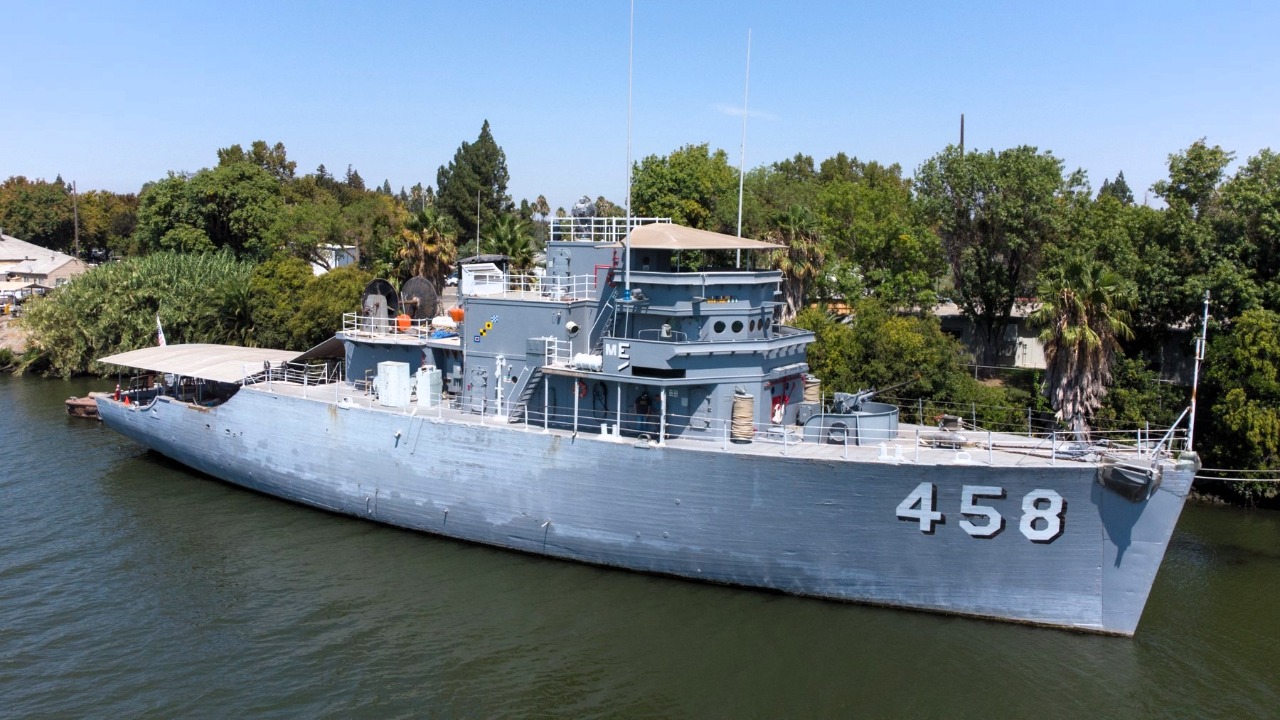

A “very rare” Navy ship that once hunted mines in the Pacific is being rebuilt in an unlikely place: the Port of Stockton in California’s Central Valley. The USS Lucid, a Cold War era minesweeper, is undergoing a major restoration that aims to turn the wooden-hulled vessel into a fully interpreted museum ship in time for the Navy’s 250th birthday and America’s semiquincentennial in 2026. The project is more than a cosmetic facelift, it is a bid to anchor national maritime history in a city that many visitors do not even realize has a deepwater port.
The effort to bring the USS Lucid back to life is unfolding just as the Navy and civic partners across the country prepare tall ships, historic vessels and modern warships for a sweeping slate of anniversary events. If it stays on track, the Stockton project will give the public a rare chance to walk the decks of a surviving minesweeper at the very moment the country is being asked to think harder about sea power, shipbuilding and the cost of keeping oceans open.
The USS Lucid’s unlikely second life in Stockton
The USS Lucid is one of the last remaining examples of a Navy minesweeper built with a wooden hull, a design choice meant to reduce the magnetic signature that could trigger underwater explosives. After years in the reserve fleet and time laid up in Suisun Bay, the ship was acquired by local advocates who are now working to restore the vessel at the Stockton Maritime Museum, where it is described as a “very rare” survivor of its class and era. The plan is to stabilize the hull, rebuild key interior spaces and open the ship as a permanent exhibit that explains how minesweeping protected carriers, cargo ships and amphibious forces in conflicts that stretched from the Korean War through Vietnam, a story that is often overshadowed by more glamorous combat roles.
Stockton might sound like an odd setting for such an ambitious naval restoration, but the city is connected to the Pacific through the San Joaquin River and the Port of Stockton, which means the USS Lucid can sit in the water rather than on blocks in a parking lot. Reporting on the project notes that Stockton is not truly landlocked and that the long term goal is to turn the ship into a floating museum that can host school groups, veterans and tourists who might never make it to San Diego or Norfolk. The vessel’s “bright future” is framed as a chance to bring a hidden piece of Stockton history into public view, with the Stockton Maritime Museum using the Lucid as a centerpiece for a broader maritime campus that also interprets the city’s role in West Coast logistics and ship repair.
Why a “very rare” minesweeper matters to veterans and visitors
For veterans who served on similar ships, the USS Lucid is not just a curiosity, it is a physical reminder of a dangerous mission that rarely makes it into Hollywood scripts. Organizers say the ship carries particular significance for visitors and veterans because it preserves “the very unique stuff” that defined minesweeping, from the wooden planking underfoot to the specialized gear used to cut mooring cables and neutralize explosives. One local leader, identified in coverage as Rajkovich, has emphasized that many residents have no idea this kind of Navy history is tied to their city, and that walking through the restored compartments can spark conversations that a textbook never will. By keeping the restoration faithful to the original layout, the team hopes to give former sailors a space where they can explain to their families what their work actually looked and felt like.
The project also fits into a broader push to use historic ships as living classrooms rather than static monuments. In a separate report on the restoration, advocates describe how the USS Lucid will be turned into a maritime museum with exhibits that trace the ship’s journey from active duty to the Suisun Bay reserve fleet and finally to its berth near downtown Stockton. That narrative arc mirrors the experience of many Cold War vessels that were mothballed and then scrapped without much public notice, which is why preserving even one minesweeper in working order is a big deal for naval historians. When the museum opens fully, visitors will be able to see how a relatively small ship played an outsized role in keeping sea lanes open, a lesson that resonates in an era when naval mines and improvised explosive devices still threaten commercial shipping.
A restoration timed to Navy 250 and America’s 250th
The timing of the USS Lucid’s overhaul is not accidental. In 2026, the Navy will join America’s 250th birthday celebration with a series of high profile events that highlight its role in defending the Nation and securing trade routes from the age of sail to the present. Official planning documents describe an International Naval Review that will bring together U.S. ships and foreign partners, along with other federal maritime agencies such as the Coast Guard, the Army Corps of Engineers and NOAA, to showcase both heritage and modern capability. Against that backdrop, having a restored minesweeper ready for visitors gives Stockton a way to plug into a national conversation about sea power that will otherwise be concentrated in traditional fleet hubs.
Those national plans are not limited to warships. As the United States prepares for the 250th anniversary, organizers are lining up tall ships and naval vessels to highlight the Nation’s maritime story in multiple locations along major harbors. One program envisions historic sailing ships and modern gray hulls sharing the waterfront, creating a visual timeline from wooden frigates to steel destroyers. The USS Lucid, with its wooden hull and Cold War pedigree, sits right in the middle of that arc, bridging the gap between the age of sail and the era of guided missiles. By 2026, visitors who have just watched a parade of tall ships in a place like Boston or Philadelphia may find themselves in Stockton, walking through a very different kind of wooden ship that tells a more recent chapter of the same story.
How Boston’s icons and Stockton’s minesweeper fit together
On the opposite side of the country, Boston is preparing its own slate of 2026 events that will put historic ships at the center of civic celebrations. The USS Constitution Museum has already been “Sailing into the New Year” with posts that look ahead to Sail Boston and America250, signaling that the world’s oldest commissioned warship still afloat will be a star attraction. In a separate update, USS Constitution Sailors have been sharing New Year resolutions tied to the question of whether the ship will sail under her own power for the great event, a reminder that even a vessel launched in the 1790s can still move under canvas when conditions and safety rules allow. Those preparations underscore how powerful it can be to see history not just preserved but activated, with crews in period uniforms working alongside modern sailors.
That same impulse is visible in other corners of the naval community. The Scholarship Foundation behind a major Marine Corps education charity recently highlighted how its staff and supporters were thrilled to board the USS Constitution for a D-Day tribute in Boston, using the ship as a backdrop to connect past sacrifice with present service. When I look at the USS Lucid project through that lens, the Stockton restoration reads as part of a broader pattern in which communities are using historic hulls to anchor living traditions. Boston has a frigate that fought in the War of 1812, Stockton will have a minesweeper that represents the Cold War and Vietnam, and together they give the public a more complete sense of how naval technology and missions have evolved over 250 years.
From wooden hulls to LNG and the future of sea power
Restoring a wooden minesweeper in 2026 also invites a comparison with the ships now being built for commercial and military use. Shipping company Yang Ming, for example, has ordered new vessels scheduled for delivery in 2026 that will be equipped with high pressure LNG dual fuel main engines, advanced monitoring and a broadband maritime satellite system. These LNG capable ships reflect a push to cut emissions and improve efficiency on long haul routes, a far cry from the diesel powered engines and analog gauges that once drove the USS Lucid through minefields. Yet both generations of vessels share a common thread, they exist to keep global trade moving safely, whether by clearing explosives from harbor approaches or by carrying containers across contested seas.
The Navy’s own anniversary planning hints at how those technological shifts will be framed for the public. Official materials for the Navy 250 campaign describe Military and public events being planned nationwide through October and 2026, with a concentration of activities in Philadelphia unless otherwise listed. That calendar will sit alongside broader America250 programming that features tall ships, modern warships and community events in multiple ports. In that environment, a restored minesweeper in Stockton is more than a local curiosity, it is a tangible link between the wooden hulls of the past and the LNG fueled giants of the future, a reminder that sea power is built not just on aircraft carriers but on the quieter workhorses that clear the way.
There is also a civic dimension to the Lucid project that mirrors what is happening in larger coastal cities. One report on the Stockton restoration notes that Josie Heart, who has covered the effort, framed the ship’s transformation as a way to turn a hidden artifact into a maritime museum that belongs to the community. Another account emphasizes how Rajkovich and other advocates see the vessel as a tool to teach local students about the Navy, Stockton’s port and the broader history of conflict at sea. When I put those threads together with the national push around America250, the picture that emerges is of a country using its anniversary not just to stage parades, but to invest in the physical spaces where history can be touched, smelled and heard underfoot.
Even the language around the Stockton project hints at a shift in how inland cities think about their relationship to the ocean. Coverage that describes how You would be forgiven for assuming you need to go to San Diego to see unusual Navy ships, only to reveal that Stockton is quietly rebuilding one of the rarest, challenges the coastal monopoly on maritime storytelling. By 2026, visitors who follow that trail to the Port of Stockton will find the USS Lucid moored near the Stockton Maritime Museum, a wooden hull that has survived scrapyards and neglect to become a centerpiece of a new kind of inland maritime heritage. If the restoration succeeds, it will stand as proof that even a single “very rare” ship can change how a city sees itself and how the Nation remembers its Navy.
More from Morning Overview