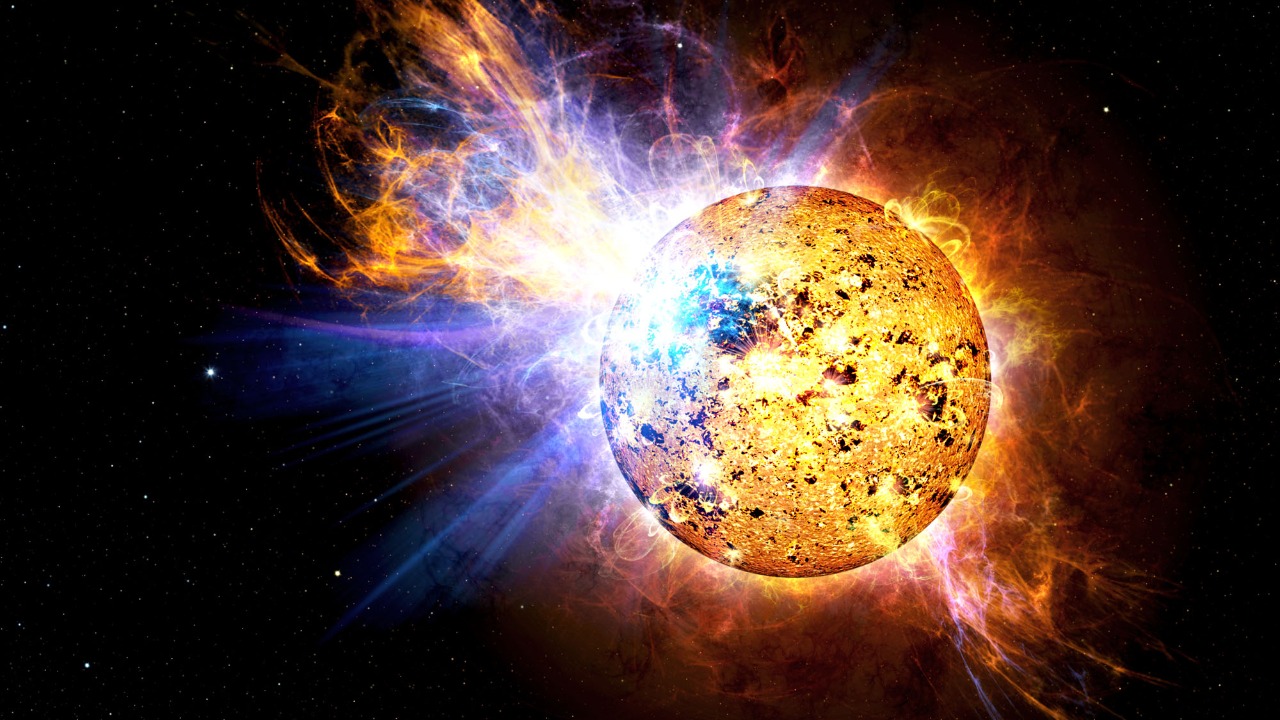

A violent outburst from a nearby star has given astronomers a rare, close-up look at how stellar tempers can threaten the habitability of surrounding planets. The event, a powerful solar storm bursting from a neighboring sun, did not just light up telescopes, it raised hard questions about whether rocky worlds in such systems can keep their atmospheres intact long enough for life to gain a foothold. I want to unpack what this storm tells us about extreme stellar activity, how it compares with the most intense flares from our own Sun, and why the line between a survivable blast and a planetary catastrophe can be razor thin.
Researchers are still working through the data, but the early picture is stark: when a star unleashes a storm of this scale, nearby planets are suddenly on the front line of high-energy radiation and charged particles. The same physics that drives the Sun’s X-class flares appears to be at work, only in a more concentrated environment where habitable zones sit closer to the stellar surface. That proximity turns what might look like a routine outburst on paper into a potentially atmosphere-stripping event for any world unlucky enough to orbit in the blast zone.
What astronomers actually saw from the nearby star
The new event centers on a solar storm erupting from a nearby star, a burst of energy and particles that swept through its planetary system with little warning. Astronomers tracked the outflow as it left the stellar surface and expanded into space, watching in real time as the storm’s structure evolved and its potential impact on any close-in planets became clear. The reporting describes Scientists detect solar storm bursting from a nearby star and emphasizes that this was not a gentle breeze of plasma but a full-scale space weather event with the power to reshape local conditions.
Crucially, the observations link this storm to questions about whether nearby worlds could support life, not because the event is labeled as a superflare, but because its intensity and proximity to any habitable-zone planets could be enough to erode atmospheres and bathe surfaces in damaging radiation. The star’s outburst is framed as a solar storm rather than a formally defined superflare, which matters for interpreting its energy scale and long-term consequences. By focusing on the storm’s measured effects and the vulnerability of close-orbiting planets, rather than inflating its classification, astronomers can more accurately assess how often such systems might cross the line from marginally habitable to outright hostile.
Why “superflare” is a loaded term
In popular language, it is tempting to call any dramatic stellar outburst a superflare, but in astrophysics that word carries a specific weight. Superflares are typically reserved for events that release orders of magnitude more energy than the Sun’s strongest X-class flares, often tied to stars with extreme magnetic fields or rapid rotation. The nearby star’s solar storm, as described in the observations, is clearly powerful and consequential for its planets, yet the reporting does not provide the detailed energy measurements that would justify placing it in that superflare category. Without those numbers, labeling it a superflare would be an assumption, not a conclusion.
That distinction is more than academic, because the term shapes how readers imagine the risk. If I describe the event as a solar storm from a nearby star, I am grounding the story in what is actually reported: a burst that could threaten atmospheres and habitability in its system. If I escalate it to a stellar superflare without evidence, I imply an energy scale that might rival or exceed the most extreme events we know from our own Sun, which the sources do not support. Keeping the language precise allows the real stakes to stand on their own, which are already high for any planet caught in the path of such a storm.
How the storm could strip or sterilize nearby worlds
For planets orbiting close to their star, a solar storm of this magnitude can be a direct assault on the atmosphere. High-energy photons can ionize upper layers of gas, while charged particles can punch through magnetic shields and drive atmospheric escape, especially on worlds with weaker fields or thinner air. The report on the nearby star explicitly ties the storm to concerns about whether nearby worlds could support life, underscoring that repeated events of this kind might gradually erode the very conditions that make a planet habitable.
Even if an atmosphere survives, the surface environment can be transformed. Intense radiation can damage organic molecules, disrupt potential biosignatures, and complicate the chemistry that leads to complex life. For planets with oceans or subsurface habitats, some life might endure beneath shielding layers of water or rock, but surface ecosystems would face a harsh test each time the star flares. Over geological timescales, the cumulative effect of frequent storms could mean that only the most resilient biospheres, or those with strong magnetic fields and thick atmospheres, have any chance of persisting.
Our own Sun’s recent flares as a benchmark
To understand how extreme the nearby star’s storm might be, it helps to compare it with the most powerful events from our own Sun. Earlier this year, The Sun released the most powerful solar flare in 2025, an X5.1-class eruption that highlighted just how much energy our star can unleash in a single burst. That flare, which followed an X2 flare the previous day, was strong enough to raise concerns about radio communication, satellite safety, and power grid stability on Earth, even with our relatively thick atmosphere and magnetic field.
Not long after, the Sun fired off the second-strongest flare of the year, another intense event that triggered radio blackouts across Africa and reminded forecasters how quickly conditions can change. The report notes that the sun fired off another powerful flare that disrupted high-frequency communications, with imagery from the NOAA Space Weather Prediction Center captured in an Image composed from multiple Images and presented in a graphic created in Canva Pro. These benchmarks show that even without invoking superflares, ordinary solar activity at the high end of the scale can have tangible, planet-wide effects.
December’s flare barrage and what it reveals
The closing weeks of the year have been a vivid demonstration of how active our star can become when its magnetic cycle peaks. On a Monday at the start of December, an X1.9-class flare erupted from the Sun, a blast that space weather trackers quickly flagged as one of the more significant events of the season. A video clip captured how the sun erupted with an X1.9-class solar flare to kick off December, with the word “Wow” attached to the spectacle for good reason.
Space weather logs show that this was not an isolated outburst. The Latest entries for solar flares highlight how, on Sunday, an M8.1 solar flare with an earth-directed CME was recorded, followed by that Monday X1.9 solar flare and additional Coro data that helped characterize the associated coronal mass ejections. The running list at solar flares illustrates how quickly conditions can escalate from moderate to severe, and how a sequence of events can compound the stress on satellites, power infrastructure, and communication systems.
From solar storms to space weather forecasting
Events like the nearby star’s solar storm and the Sun’s recent X-class flares are not just dramatic light shows, they are test cases for the models that predict space weather. Forecasters rely on real-time data from solar observatories to estimate when a CME will reach Earth, how strong its magnetic field will be, and which regions of the planet will feel the brunt of radio blackouts or geomagnetic disturbances. The detailed record of an M8.1 flare with an earth-directed CME on a Sunday, followed by an X1.9 flare on a Monday, gives modelers a chance to refine how they handle sequences of eruptions and overlapping shock fronts.
For exoplanet systems, the challenge is even greater, because we cannot yet monitor distant stars with the same cadence and resolution we apply to the Sun. Instead, astronomers must infer storm frequencies and intensities from occasional flares and indirect signatures, then fold those estimates into climate and atmospheric escape models for planets in the habitable zone. The nearby star’s solar storm, observed in enough detail to connect it to questions about planetary habitability, becomes a rare anchor point for those models, a concrete example of how a single event might reshape the prospects for life in a compact planetary system.
NASA’s interest in extreme solar activity
Recognizing how central these questions are, space agencies are investing in missions that can probe the Sun’s behavior and its influence on space weather in far more detail. Reporting notes that The Sun emitted the strongest solar flare of 2025 and that NASA selects two missions to study sun, its effects on space weather, a pairing that underscores how scientific curiosity and practical concern are now tightly linked. By tracing how magnetic fields twist and snap on the Sun, these missions aim to improve forecasts of when the next major flare or CME will erupt and how severe its impact might be.
Those same insights feed directly into our understanding of other stars. If we can decode the magnetic dynamics that produced the Sun’s X5.1 flare and its accompanying disturbances, we can apply similar frameworks to interpret the solar storm from the nearby star. NASA’s focus on the Sun’s strongest events is not just about protecting satellites and astronauts in Earth orbit, it is also about building a comparative toolkit that can be used to judge whether exoplanet systems are likely to be battered by frequent storms or blessed with relatively calm stellar weather.
Reframing the risk without exaggeration
When a nearby star unleashes a solar storm that might threaten the habitability of its planets, the temptation is to reach for the most dramatic language available. Yet the reporting makes clear that what we have is a powerful solar storm bursting from a nearby star, not a formally quantified stellar superflare. By keeping that distinction front and center, I can describe the real dangers, from atmospheric erosion to surface sterilization, without overstating the energy scale or implying that the event sits in a different physical regime than the Sun’s strongest flares.
In practice, the line between survivable and catastrophic for a planet may not depend on whether an event crosses an arbitrary superflare threshold, but on how often storms of this kind occur, how close the habitable zone sits to the star, and how robust each world’s magnetic and atmospheric shields are. The nearby star’s storm, the Sun’s X5.1 and X1.9 flares, the M8.1 event with an earth-directed CME, and the broader pattern captured in the Latest solar flare logs all point to the same conclusion. Space weather is not a background detail for planetary habitability, it is a central character, and understanding it starts with describing each event as precisely as the data allow, without inflating the label just to match a headline.
More from MorningOverview