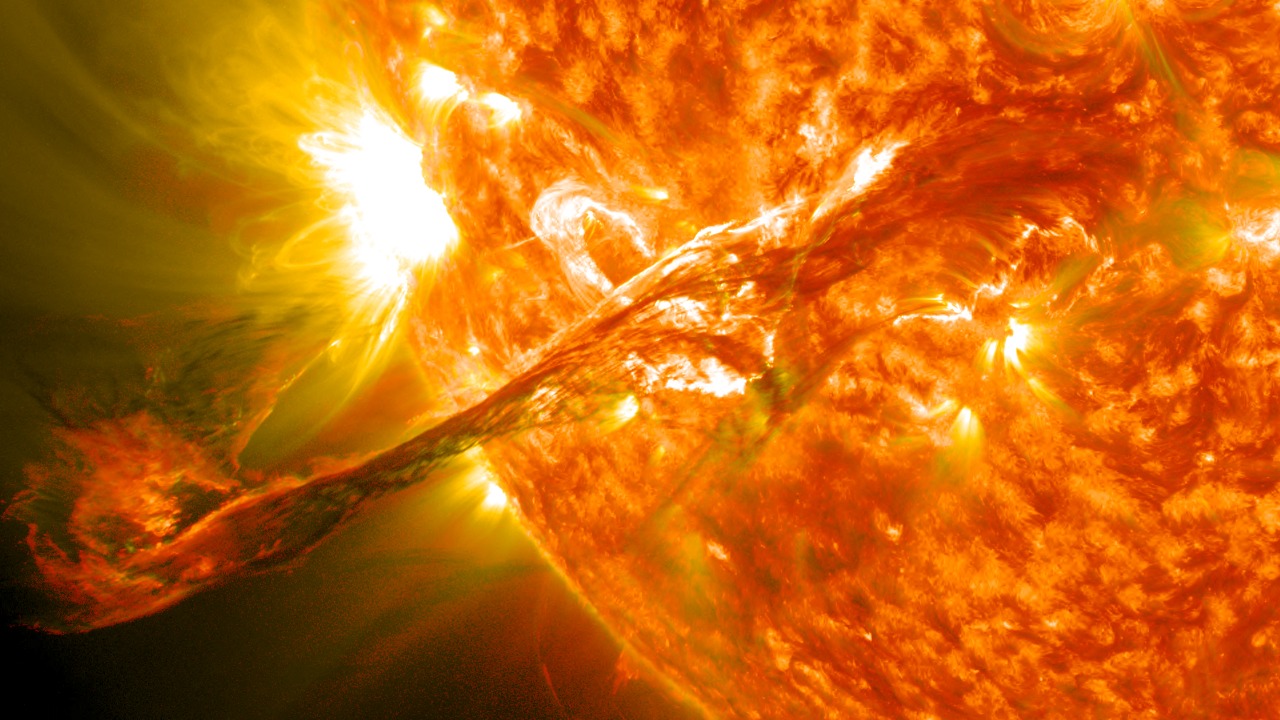

A single patch on the Sun recently stayed hyperactive for 94 straight days, hurling flare after flare into space and setting a new record for continuous monitoring of such a volatile region. The spectacle has thrilled solar physicists and unsettled people who depend on satellites, power grids, and GPS, which is to say almost everyone. I want to unpack what this marathon outburst really means, how it fits into the broader solar cycle, and whether it should change how worried we feel about the next big solar storm.
What actually happened in that 94‑day solar marathon
The basic story is simple but staggering: Scientists locked their instruments onto a single active region on the Sun and watched it erupt for 94 days without a real break. Over that span, the region spat out nearly 1,000 flares of varying strength, turning into a kind of slow‑motion fireworks show in extreme ultraviolet and X‑ray light. The feat was not just about the Sun’s fury, it was about human persistence, with teams coordinating multiple spacecraft and ground observatories to keep the region in view as it rotated in and out of direct line with Earth.
Researchers described this effort as a kind of Marathon Solar Surveillance, tracking the same patch of the solar surface on the Sun for a record 94 days and cataloging almost 1,000 individual bursts. That level of detail lets them see how magnetic fields twist, reconnect, and recharge in one place instead of stitching together snapshots from different regions. It also turns a single active zone into a natural laboratory for testing models of how flares start, how they evolve, and which ones are likely to launch the more dangerous coronal mass ejections that can affect Earth.
How Solar Orbiter followed the sunspot that lit up our skies
To pull off this continuous watch, scientists leaned heavily on spacecraft that can see parts of the Sun that are hidden from Earth. One of the workhorses was Solar Orbiter, a probe looping around the inner solar system on a tilted, elongated path that gives it unusual vantage points on the solar disk. As the active region rotated away from Earth, Solar Orbiter kept it in view, then handed off to other instruments as the Sun turned again, creating a relay of coverage that had never been achieved for a single sunspot group.
That same region was not just a curiosity for researchers. It was the source of eruptions that sparked vivid auroras far from the usual polar zones, lighting up skies over places that rarely see them. The spacecraft’s long stare, described in reports on how Solar Orbiter Sets Record Watching a sunspot region that triggered global auroras, turned a pretty light show into hard data. By tying specific flares and eruptions to the geomagnetic storms that followed, scientists can better calibrate how a given solar blast translates into disturbances in Earth’s magnetic field and atmosphere.
Inside NOAA 13664, the super‑active region behind the record
The star of this story even has a name: NOAA 13664, the designation given by the National Oceanic and Atmospheric Administration to the sprawling sunspot complex that became the focus of the campaign. Scientists first picked it up on the far side of the Sun, using helioseismic techniques and off‑axis spacecraft views to spot its birth before it rotated into direct view. From there, they followed its entire life cycle, from early growth through peak activity and eventual decay, something that had never been done in such detail for a single region.
According to a detailed account of the longest observation of an active solar region, the team watched NOAA 13664 from its emergence on the far side until its decay after mid‑July 2024, capturing every twist in its magnetic structure. That cradle‑to‑grave record is crucial because it shows how a region can stay productive for months, repeatedly recharging its magnetic fields instead of simply flaring once and fading. It also reveals patterns in how the most violent outbursts cluster in time, which could eventually help forecasters flag when a long‑lived region is entering a particularly dangerous phase.
Why this outburst matters for the 11‑year solar cycle
On its own, one hyperactive region might sound like a freak event, but it fits neatly into a larger pattern. The Sun’s magnetic activity rises and falls in an approximately 11‑year cycle, with sunspots, flares, and eruptions ramping up toward what scientists call solar maximum. We are now heading into one of the most energetic peaks in two decades, which means more regions like NOAA 13664 are likely to appear and more flares will be aimed in our direction.
Researchers have been warning that the Sun is entering a particularly busy phase, with one analysis noting that a suddenly bustling sun is expected to be the most active in roughly twenty years. That does not mean every day will bring a crisis, but it does mean the odds of strong flares and geomagnetic storms are higher than they were during the last solar minimum. The 94‑day marathon region is a vivid example of what a magnetically charged Sun looks like when it is near the top of its cycle, and a reminder that this is normal behavior for our star, even if it feels dramatic from our vantage point.
Solar maximum 2026 and what it means for Earth
Looking ahead, many forecasts point to 2026 as a likely window for the current cycle’s peak, or at least for a sustained plateau of high activity. For people on the ground, solar maximum translates into more frequent and sometimes more intense space weather events, from minor radio blackouts to major geomagnetic storms that can disturb power systems. The key is not that the Sun suddenly becomes dangerous, but that the background level of risk rises, so rare events become somewhat less rare.
Analyses of Space Weather Risks During Solar Maximum emphasize that at Earth, the practical consequences include more frequent disruptions to radio communications, satellite operations, and navigation systems. For airlines flying polar routes, that can mean rerouting flights to avoid radiation spikes and communication gaps. For satellite operators, it can mean dealing with increased drag on low‑Earth‑orbit spacecraft and a higher chance of single‑event upsets in electronics. The 94‑day active region is a preview of the kind of sustained stress the near‑Earth environment may experience as the cycle crests.
From pretty auroras to power‑grid headaches
When solar storms hit Earth, the most visible effect for many people is the aurora, shimmering curtains of light that can dip into mid‑latitudes during strong events. The same eruptions that made NOAA 13664 famous for global auroras also carried the potential to disturb radio and satellite signals. In most cases, the impacts were modest, but they highlighted how even moderate storms can ripple through modern infrastructure that depends on precise timing and uninterrupted connectivity.
Reports on the longest ever observation of a super active solar region underline that when eruptions are directed toward Earth, they can disrupt power grids, interfere with radio and GPS, and increase radiation exposure for astronauts and high‑altitude flights. In the case of the 94‑day region, some flares and associated storms briefly affected communications, but they stopped short of causing major blackouts or satellite failures. That outcome is a reminder that not every big solar outburst is a catastrophe, but also that the same physical processes that paint the sky with color can, under the right conditions, stress the systems we rely on.
How close did this region come to causing real damage?
For all its fireworks, the marathon active region did not produce a worst‑case scenario event. Many of its flares were moderate, and even the stronger ones did not always launch coronal mass ejections directly toward Earth. When disturbances did arrive, they caused temporary radio blackouts and navigation glitches rather than cascading failures. That is partly luck, in the sense that the geometry of the eruptions spared us, and partly a reflection of how power companies and satellite operators have quietly improved their resilience since earlier solar storms exposed vulnerabilities.
Coverage of how scientists observed a solar active region for a record 94 days notes that radio and communications were briefly affected during some of the strongest bursts. That is consistent with the kind of short‑lived high‑frequency radio blackouts that pilots and mariners have learned to work around. It also shows that even without a headline‑grabbing disaster, the cumulative effect of repeated storms can be a steady drumbeat of minor disruptions, which is why operators of critical systems track solar alerts as closely as they do weather forecasts.
The nightmare scenario: a global tech blackout
When people ask whether they should worry about a hyperactive Sun, they are often thinking about the extreme tail of the risk curve, the kind of storm that could knock out power and communications on a continental scale. Scientists sometimes point to historical events like the 1859 Carrington Event or the 2003 Halloween storms as benchmarks for what the Sun can do. In a world that now depends on real‑time data flows, from stock markets to hospital networks, the stakes of a similar storm are far higher than they were in the telegraph era.
Warnings from NASA Warns Solar Storm Could Trigger Global Tech Blackout sketch out a scenario in which a powerful geomagnetic storm could disrupt power grids and communications globally, disconnecting people and businesses. In that kind of event, transformers could be damaged by induced currents, satellites could be knocked offline, and GPS‑dependent systems from container shipping to ride‑hailing apps could be thrown into chaos. The 94‑day active region did not produce such a storm, but its sheer productivity shows that the Sun is capable of sustaining the kind of magnetic tension that, under the right alignment, could unleash one.
Why scientists are excited, not just alarmed
From a research perspective, the long‑lived active region is a gift. It offers a continuous dataset that can be used to refine models of how solar magnetic fields evolve and how energy builds up before a flare. That, in turn, feeds into better forecasting tools, which can give grid operators, airlines, and satellite controllers more lead time to take protective measures. Rather than treating the Sun as an unpredictable menace, scientists are slowly turning it into a system that can be monitored and, to some extent, anticipated.
The record‑setting campaign, described in summaries that highlight how Scientists watched a single region blast out nearly 1,000 flares, is already feeding into improved space weather prediction. By comparing the timing, intensity, and magnetic signatures of flares from the same region, researchers can test which indicators are most reliable for forecasting whether a flare will be accompanied by a damaging coronal mass ejection. That kind of nuance is essential if alerts are to be taken seriously, since constant false alarms would quickly erode trust among the people who need to act on them.
What history tells us about the years around solar maximum
One of the more sobering lessons from past cycles is that the risk of strong storms does not vanish the moment solar maximum passes. Big flares and geomagnetic disturbances can and do occur in the years after the peak, when the Sun is still magnetically active even as the overall sunspot count begins to decline. That means the window of elevated risk around the coming maximum is measured in years, not months, and the 94‑day region may be just one of several major players in this cycle.
Analyses of whether 2026 will bring strong auroras note that strong flares remain likely even years after solar maximum, with examples drawn from the powerful storms that followed the 2001 peak. That historical perspective suggests that the current burst of activity is not a one‑off scare but part of a longer arc in which elevated vigilance will be needed for several years. For planners, that argues for sustained investment in monitoring and hardening, rather than a short‑term surge of attention that fades as soon as the current sunspot numbers start to dip.
So, should we worry?
Faced with a Sun that can keep a single region firing for 94 days, the honest answer is that some concern is justified, but panic is not. The same physics that produced the marathon of flares is a normal part of the solar cycle, and Earth has lived with it for billions of years. What has changed is our dependence on technologies that are sensitive to space weather, from GPS‑guided tractors in Iowa to undersea cables linking stock exchanges. That makes it rational to take solar risk seriously, especially as we head toward a busy solar maximum.
At the same time, the detailed tracking of regions like NOAA 13664, the vantage points provided by missions like Solar Orbiter Sets Record Watching a single active region, and the growing body of work on At Earth space weather risks all point in the same direction. We are getting better at seeing trouble coming and at designing systems that can ride out the storm. The 94‑day eruption is a warning shot, but it is also a sign that our ability to live with a restless star is improving, as long as we choose to pay attention.
More from Morning Overview