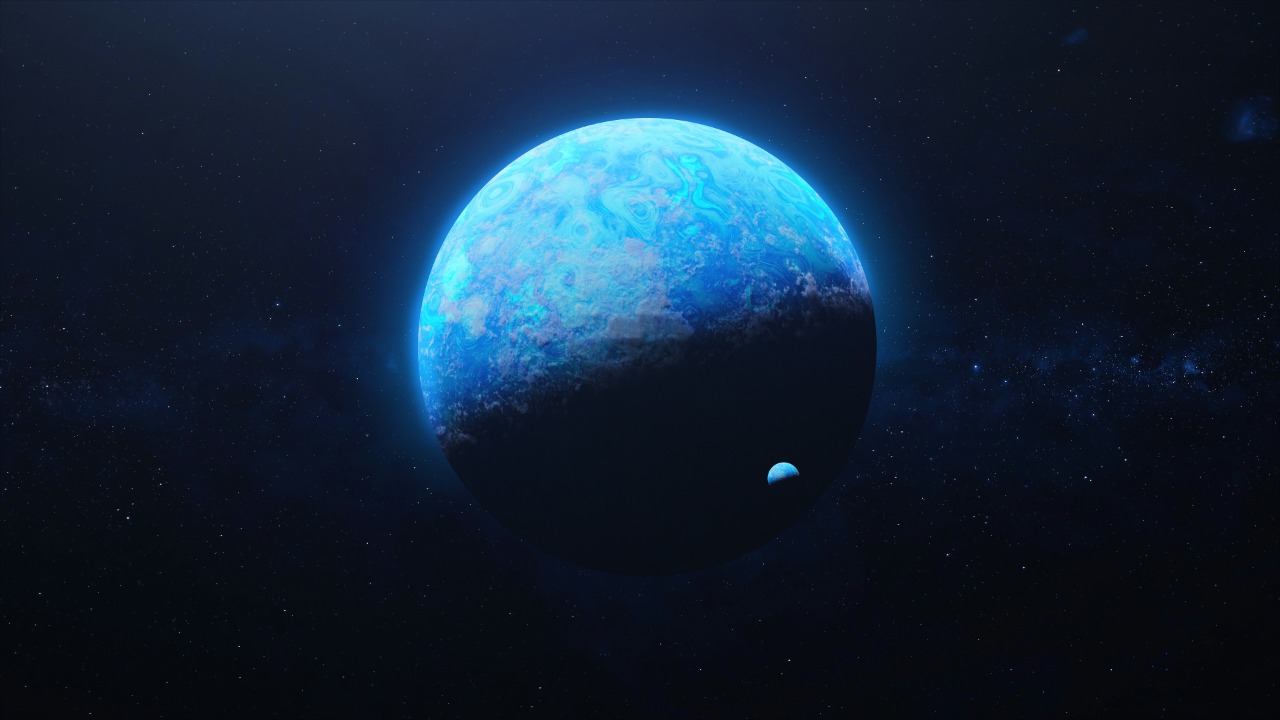

Astronomers have spotted a lonely world roughly the size and mass of Saturn, drifting through the Milky Way without a star to orbit. The discovery turns a once theoretical curiosity into a concrete object that scientists can weigh, locate and begin to place in the broader story of how planets form and sometimes get flung into the dark.
Instead of circling a sunlike star, this Saturn-scale globe is cruising through interstellar space, lit only by distant starlight and whatever residual heat it still carries from its birth. Its detection, and the unusually precise measurements that followed, give researchers a rare laboratory for testing ideas about “rogue” planets and the violent dynamics that can eject them from their home systems.
What astronomers actually found
The newly reported object is a free-floating planet, comparable in mass to Saturn, that appears to be traveling alone through the galaxy. It was picked up not because it glows on its own, but because its gravity briefly magnified the light of a background star, a fleeting brightening that signaled a compact, planet-scale lens passing in front of our line of sight. Follow-up analysis showed that this lensing body is not bound to any nearby star, marking it as a genuine rogue world rather than a distant member of a hidden planetary system.
Researchers describe this Saturn-scale wanderer as a rare catch, since most known exoplanets are found hugging close to their host stars, where they are easier to spot. In this case, the microlensing signal was short and sharp, consistent with a planet roughly the mass of Saturn and far lighter than a brown dwarf, and the team could rule out any luminous companion star within a wide radius. One report characterizes it as a Saturn-mass rogue planet wandering through the Milky Way, with the lensing event itself lasting only hours or days before the background star’s light returned to normal.
Why a Saturn-sized rogue is such a big deal
Free-floating planets have been suspected for decades, but most candidates have been either very massive, closer to failed stars, or too poorly measured to pin down. A world that is clearly in the Saturn class, with a mass tens of times that of Earth but far below the threshold for starlike fusion, fills in a crucial gap in the planetary census. It shows that not only Jupiter-scale giants but also somewhat smaller gas planets can be kicked out of their systems and survive in interstellar space.
One detailed account notes that this object is a rare Saturn-sized rogue planet that is the first of its kind to have its mass directly measured, rather than inferred from broad assumptions. That precision matters, because it lets scientists compare the planet’s properties to Saturn itself and to other gas giants, testing whether ejected planets tend to resemble the ones we see in stable orbits or whether they form a distinct population shaped by more extreme birth environments.
How microlensing revealed a planet with no star
To find a dark, cold planet that does not orbit a nearby star, astronomers rely on gravitational microlensing, a technique that uses gravity itself as a natural telescope. When a compact object passes in front of a more distant star, its gravity bends and focuses the starlight, causing a temporary brightening that can be measured from Earth. The shape and duration of that brightening encode the mass of the lensing object and its relative distance, even if the lens is otherwise invisible.
In this case, the team combined ground-based observations with space-based data to disentangle the geometry of the lensing event and extract both the mass and distance of the planet. One analysis explains that, according to a newly released study, astronomers were able for the first time to measure both the mass and distance of a free-floating planet, designated 2024-BLG-0792, using this approach. Another report notes that the authors had both ground-based observations and data from Gaia, and that this combination was “purely” what allowed them to nail down the distance and estimate the mass, a point highlighted in coverage that cites Gaia as a key ingredient.
Pinning down mass and distance in the dark
Measuring the mass of a planet that emits almost no light is notoriously difficult, which is why this detection stands out. By tracking how the microlensing event evolved from different vantage points, astronomers could infer how far away the lensing planet is and how strongly it bent the background light. That, in turn, yielded a mass estimate in the Saturn range and placed the planet roughly ten thousand light-years from Earth, in the direction of the crowded central regions of the Milky Way.
Reports describe this object as a rare free-floating exoplanet 10,000 light-years from Earth, with a mass roughly 70 times larger than Earth, squarely in the Saturn regime. Another account emphasizes that the team could, for the first time, directly weigh such a planet and confirm that it is not a low-mass star or brown dwarf, but a true planet-scale body whose gravity is strong enough to lens starlight yet far too weak to ignite nuclear fusion.
What makes a planet go rogue
Finding a Saturn-mass world adrift raises the obvious question of how it ended up alone. The leading scenario is dynamical ejection, in which gravitational interactions in a young planetary system fling one or more planets out into interstellar space. In crowded systems with multiple giant planets or unstable stellar companions, close encounters can pump up orbital energies until a planet is thrown clear of its star’s gravity, turning it into a wanderer that drifts through the galaxy indefinitely.
In the new research, the discovery team discusses how such a planet might have formed in a disk around a star before being expelled by interactions with other planets or unstable stellar companions. One summary notes that, in the new research, Subo Dong and colleagues describe the discovery of a free-floating planet spotted during a short-lived microlensing event, and they point to these kinds of gravitational scuffles as the most plausible origin story. That narrative fits with broader models of planetary system evolution, which predict that a significant fraction of giant planets may be lost to ejection over billions of years.
How this lonely world compares to Saturn
Although the rogue planet’s distance makes detailed characterization difficult, its mass and inferred size invite comparisons to Saturn. Like Saturn, it appears to be a gas giant with a mass tens of times that of Earth but smaller than Jupiter, suggesting a similar balance between a dense core and a thick envelope of hydrogen and helium. Its temperature is likely far lower than Saturn’s, however, since it lacks the steady heating from a nearby star and instead cools slowly as it radiates away the energy left over from its formation.
Coverage of the discovery repeatedly frames it as a planet the size of Saturn, underscoring that it sits in a familiar mass range even as it occupies a very unfamiliar environment. One report notes that when we imagine a planet, we think of one like ours, orbiting a star, but some have a far lonelier existence, drifting through space without a sun. That contrast between a Saturn twin and its starless journey is part of what makes this object so compelling: it is both recognizable and utterly alien.
The growing census of starless worlds
This Saturn-class wanderer does not exist in isolation. Over the past decade, astronomers have accumulated evidence that the galaxy may be teeming with rogue planets, perhaps rivaling or even outnumbering the planets that remain bound to stars. Most of these candidates are poorly characterized, but each new well-measured example helps to calibrate estimates of how common such worlds are and what kinds of masses they tend to have.
One overview notes that a Saturn-sized planet is drifting through space alone, and that this object is part of a broader population of free-floating planets that have been sent drifting through interstellar space. Another piece describes how astronomers have detected a massive, lonely world drifting through the darkness without a star to call home, and notes that this Saturn-scale body may be more common than previously thought, even if such planets are harder to find than Jupiter-sized giants, a point highlighted in coverage that opens with the line that astronomers have detected a massive, lonely world hurtling through space.
Why catching one event is so hard
Despite their potential abundance, rogue planets are fiendishly difficult to detect. Microlensing events are rare, because they require a precise alignment between a foreground planet and a background star, and they are brief, often lasting only hours or days. To catch them, astronomers must monitor dense star fields continuously, looking for subtle, transient brightening that could signal a lensing event rather than ordinary stellar variability or instrumental noise.
Reports on the Saturn-mass planet emphasize that the microlensing signal was short-lived and that the team had to act quickly to gather enough data to model it. One account notes that now scientists have spotted one of these planets using a microlensing event, which happens when the gravity from an object magnifies the light from a more distant star, and that the findings were published in the journal Science. Another summary stresses that the event associated with this Saturn-mass rogue lasted only hours or days, underscoring how easy it would have been to miss without constant surveillance of the Milky Way’s crowded central regions.
The telescopes that will hunt many more
The successful detection and weighing of this planet is a preview of what upcoming observatories are expected to do at scale. The Nancy Grace Roman Space Telescope, a NASA mission slated to survey wide swaths of the sky with exquisite sensitivity, is explicitly designed to capture large numbers of microlensing events toward the galactic bulge. By watching millions of stars continuously, Roman should be able to build a statistical census of free-floating planets across a wide range of masses.
NASA describes how the Nancy Grace Roman Space Telescope will use its wide field of view and infrared detectors to monitor the galaxy for microlensing signals, including those produced by rogue planets that are impossible to see directly. One educational overview on rogue planets notes that that is where the Nancy Grace Roman Space Telescope comes in, highlighting its role in turning isolated discoveries like this Saturn-mass wanderer into a robust population study. With Roman and complementary ground-based surveys, astronomers expect to move from anecdotes to demographics, mapping how many such worlds exist and how their masses are distributed.
What this discovery reveals about planet formation
Beyond the novelty of a starless Saturn, the discovery feeds directly into debates about how planetary systems assemble and evolve. If ejected planets are common, then the early lives of planetary systems must be far more chaotic than the relatively stable architecture we see in our own solar system today. Each rogue planet is a fossil of that violent youth, preserving clues about the mass distribution and orbital configurations that prevailed before gravitational interactions reshuffled the deck.
One scientist quoted in coverage of the discovery suggests that the study offers a new way to probe the history of planets, using microlensing to access populations that are invisible to other methods. A related report on a separate Hubble observation notes that astronomers have found a planet in a stunning planet-forming disk, underscoring how telescopes now capture both the birthplaces of planets and the exiles that have been cast out. Together, these observations help close the loop between formation, migration and ejection, turning individual discoveries into a coherent narrative of planetary evolution.
More from MorningOverview