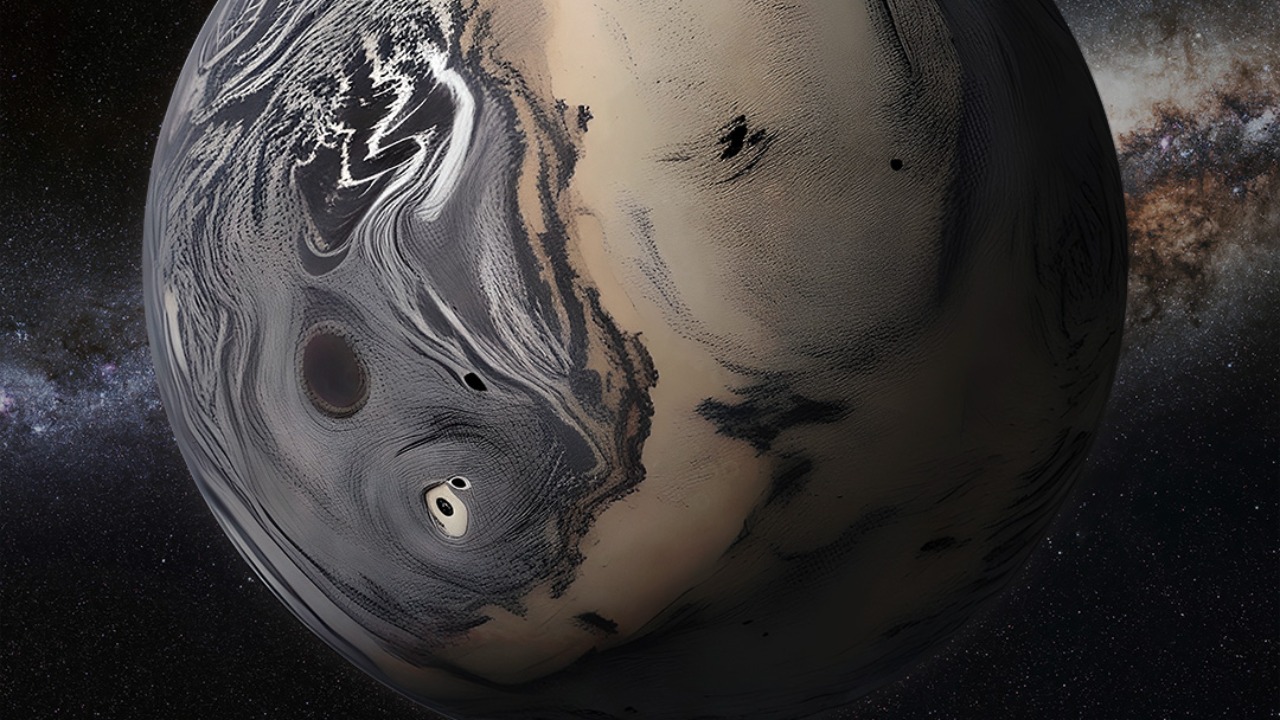

Astronomers have finally pinned down the mass and distance of a lonely world that drifts through the galaxy without a parent star, a feat that turns a once-theoretical class of objects into a precisely measured reality. Instead of circling a sun, this Saturn-sized body wanders in the dark, and the team behind the work has used a rare alignment of light and gravity to weigh it and map its place in the Milky Way. I see this result as a turning point, because it shows that even planets cut loose from their systems can now be studied with the same rigor as worlds bound to a star.
What makes a planet “rogue” in the first place
In planetary science, the word “rogue” is not a flourish, it is a technical description of a world that travels through space without orbiting a host star. Instead of tracing a predictable path around a sun, a rogue planet moves through interstellar space, lit only by distant starlight and its own fading heat. The newly characterized object fits this definition cleanly, a Saturn-mass body with no detectable stellar companion, a world that has slipped the gravitational grip that defines a conventional solar system.
Earlier work had already hinted that such free-floating planets might be common, but they were notoriously hard to confirm because they are so dim and so small compared with stars. The latest detection, described as a case of No Star, No Orbit, shows a Saturn-Sized Planet Is Drifting Through Space Alone, moving through space without a host star and confirming that such solitary planets are not just theoretical curiosities but observable members of the galactic population.
The microlensing trick that revealed a hidden world
To find a dark planet with no nearby sun, astronomers rely on gravity rather than light. When a compact object passes in front of a more distant star, its gravity bends and magnifies the background starlight, a phenomenon known as gravitational microlensing. The shape and timing of that brightening encode the mass of the lensing object, and if there is no sign of a star in the data, the culprit is likely a planet-sized body drifting on its own.
In this case, the team watched a brief, sharp microlensing event that pointed to a small, isolated lens, and they followed up from multiple observatories to capture the full light curve. That careful monitoring allowed Subo Dong’s team at Peking to show that the lensing body was a Saturn-mass planet, not a dim star, and that it was truly free-floating rather than simply hiding a faint companion. The same strategy underpins the event cataloged as astronomers measure mass and distance of free-floating planet, where the microlensing signal from 2024-BLG-0792 provided the raw data needed to weigh a solitary world.
How astronomers finally nailed the mass and distance
Weighing a planet that emits almost no light requires more than a single telescope watching a single brightening. To break the degeneracies that usually plague microlensing, the researchers combined observations from widely separated sites, turning Earth into a kind of improvised interferometer. By comparing how the event looked from different vantage points, they could measure the subtle parallax in the lensing signal, which in turn revealed both the mass of the planet and its distance from us.
This approach, described as Precision Through Distance, shows how Multi-site observations deliver what single-telescope microlensing never could, a direct estimate of the planet’s mass and its location relative to the Milky Way’s center. In parallel, the detailed modeling of the event labeled 2024-BLG-0792 shows how combining parallax with the duration of the lensing event lets astronomers measure mass and distance of free-floating planet candidates with unprecedented confidence.
A Saturn-mass planet adrift in the dark
The object at the center of this story is roughly comparable in heft to Saturn, a gas giant that in our own system orbits far from the Sun. That similarity in mass makes the discovery especially striking, because it suggests that planets like Saturn can be torn from their birth systems and sent wandering through the galaxy. The microlensing data indicate a compact, planetary-mass lens, and the absence of any stellar light in follow-up observations rules out a hidden star, leaving a Saturn-mass rogue as the only viable explanation.
Reports describe this world as a Rogue, Planet Floating Free, a Saturn-mass planet detected using a microlensing event that briefly amplified a background star. Another account frames it as A Saturn-Sized Planet Is Drifting Through Space Alone, a gas giant that may have formed in a planetary system before being sent drifting through interstellar space. When I compare these descriptions, I see a consistent picture of a Saturn-class world that has been dynamically ejected, a reminder that even planets of familiar scale can end up in very unfamiliar circumstances.
Why this measurement is a first for free-floating worlds
For years, astronomers could only infer the existence of rogue planets from brief microlensing blips that hinted at small, dark lenses. Those events were tantalizing but ambiguous, because without parallax or follow-up imaging, it was hard to know whether the lens was truly isolated or part of a wider system. The new work changes that, delivering a precise mass and distance for a planet that shows no sign of a host star, and doing so with the same level of rigor used for exoplanets that transit or tug on their suns.
One analysis notes that When we imagine a planet, we think of one like ours, orbiting a star, but this work shows that astronomers can now clock a rogue planet the size of Saturn, measure its distance and estimate its mass with confidence. Another report emphasizes that astronomers measure mass and distance of free-floating planets by exploiting microlensing parallax, turning a once speculative population into a set of objects with well defined physical properties. I see this as the moment when rogue planets move from the margins of exoplanet catalogs into the mainstream of precision planetary science.
What this lonely planet reveals about planetary violence
A planet of Saturn-like mass does not simply appear in interstellar space; it has to be thrown there. The most likely scenario is that the world formed in a young planetary system and then experienced a violent gravitational encounter, perhaps with a larger gas giant or a passing star, that ejected it into the galactic field. That kind of dynamical chaos is already suspected in the early history of our own solar system, and the existence of a Saturn-mass rogue adds weight to the idea that planetary systems routinely shed members during their formative years.
Other observations of solitary worlds reinforce this picture of a turbulent infancy. One study describes A huge, hungry rogue planet with a mass five to 10 times that of Jupiter, located about 62 units of distance from its environment, that appears to be accreting material at a record rate for a planetary-mass object. Another report on a Young rogue planet displays record-breaking ‘growth spurt’ notes that the findings provide insights into the tumultuous infancy of such celestial bodies, as described by Hannah Robbins of the Department of Physics and Astronomy. When I put these pieces together, I see a continuum from overfed, still-growing rogues to the cooler, Saturn-mass drifter, all shaped by the same violent processes that sculpt planetary systems.
Rogue planets as a hidden population in the Milky Way
If astronomers can now measure the mass and distance of a single free-floating planet, the next question is how many such worlds are out there. Microlensing surveys already suggest that the galaxy could host a vast population of unbound planets, perhaps rivaling or even exceeding the number of stars. Each new detection, especially one with a well constrained mass like this Saturn-class object, helps calibrate those estimates and refine models of how often planets are ejected from their systems.
The detailed characterization of events like 2024-BLG-0792 shows that astronomers measure mass and distance of free-floating planet candidates in a way that can be folded into population statistics, rather than treated as isolated curiosities. At the same time, the multi-site strategy highlighted in the description of Multi-site observations points toward a future in which networks of telescopes, on the ground and in space, routinely capture the parallax needed to turn fleeting microlensing blips into fully characterized rogue planets. I expect that as those networks mature, the lonely Saturn-mass world that has just been weighed will be joined by a catalog of hundreds, then thousands, of similarly well measured drifters.
How this changes the way I think about planets
For most of my life, the word “planet” has implied a world in orbit around a star, a member of a family bound together by gravity and bathed in shared light. The precise measurement of a Saturn-mass body with no star forces me to widen that mental picture, to include worlds that spend their entire existence in the deep night between stellar systems. These objects are not failed stars or minor debris; they are full-fledged planets, with masses and, likely, internal structures comparable to the giants we know, yet they live in a radically different context.
Accounts that describe a rogue planet the size of Saturn and a Saturn-Sized Planet Is Drifting Through Space Alone underline how far the field has come, from imagining such worlds to clocking their properties with precision. When I read that Subo Dong and colleagues can now pin down the distance of a free-floating planet from the Milky Way’s center, I see a quiet revolution in how we define and study planets. The lonely Saturn-mass drifter is no longer an outlier at the edge of our understanding; it is a data point in a growing map of planetary diversity that stretches far beyond the comforting glow of any star.
More from MorningOverview