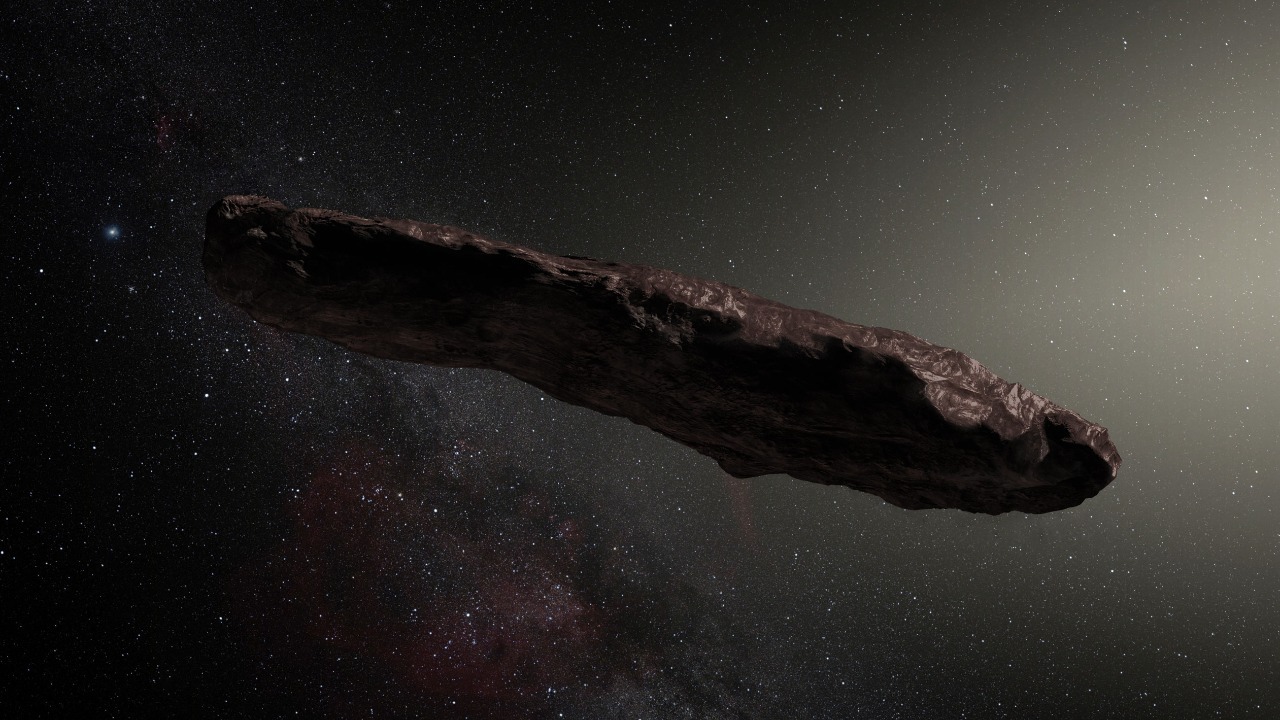

A comet from another star system is sweeping through our cosmic backyard and, for the first time, astronomers have picked up a clear radio signal coming from it. The object, known as Comet 3I/ATLAS, is only the third confirmed interstellar visitor ever seen in the Solar System, and its unexpected radio emission has triggered a global effort to understand what, exactly, is calling across the void.
Scientists now see 3I/ATLAS as a rare natural laboratory, a fragment of another planetary system that is briefly close enough to probe with the full arsenal of modern telescopes. The radio waves racing toward Earth are not a message from aliens, based on current evidence, but they are already reshaping how I think about comets, interstellar chemistry, and the search for life beyond the Sun.
How a third interstellar visitor crashed the party
Comet 3I/ATLAS did not arrive quietly. Astronomers first confirmed it as an interstellar object earlier this year, after tracking its path and realizing that its speed and trajectory could not be explained by an origin inside the Solar System. The designation “3I” marks it as only the third known object on a hyperbolic orbit from deep space, following 1I/ʻOumuamua and 2I/Borisov, and the “ATLAS” tag comes from the survey that spotted it. According to detailed Quick Facts, Comet 3I/ATLAS was discovered because of its high velocity and its trajectory, which immediately flagged it as a visitor from beyond the Sun’s gravitational family.
Once the orbit was nailed down, researchers could say with confidence that 3I/ATLAS is not gravitationally bound to the Sun and will never return after this flyby. It is a one-time guest, probably ejected long ago from another star’s protoplanetary disk and wandering the galaxy ever since. A broader overview of Comet 3I/ATLAS notes that it is only the third known object to pass through our Solar System from interstellar space, underscoring just how rare this opportunity is for planetary scientists who want to compare our own comets with those forged around other suns.
Why 3I/ATLAS is such a big deal for planetary science
Each interstellar object that sweeps through the Solar System carries a unique chemical and dynamical fingerprint of its home system, and 3I/ATLAS is no exception. Earlier interstellar visitors gave hints that other planetary nurseries produce bodies that look broadly comet-like, but with intriguing differences in composition and structure. With 3I/ATLAS, astronomers now have a third data point, which is enough to start asking whether there is a common pattern in how small icy bodies form around different stars. A detailed profile of Comet 3I/ATLAS emphasizes that its trajectory confirms its interstellar origin, turning it into a crucial test case for theories of planet formation.
Because 3I/ATLAS is active, shedding gas and dust as it approaches the Sun, it also lets researchers study how pristine interstellar ices behave when suddenly exposed to our star’s heat. That outgassing can reveal the mix of volatiles locked inside the nucleus, from water and carbon monoxide to more complex organics, and those measurements can be compared directly with comets that formed alongside Earth. A broader NASA overview of ATLAS stats frames the comet as a rare probe of material that condensed around another star, giving scientists a way to test whether our Solar System’s chemistry is typical or unusual in the galaxy.
The moment the radio signal appeared
The story shifted from “rare visitor” to “cosmic headline” when radio astronomers detected a sharp, unexpected signal apparently coming from the direction of 3I/ATLAS. Coverage of the event describes how a report titled Radio Signal From 3I/ATLAS quickly circulated online, highlighting that the detection stunned observers and sent social media into a familiar spiral of speculation about extraterrestrial contact. The signal itself was narrow in frequency and stood out clearly from the background, which is exactly the kind of feature that tends to grab the attention of both scientists and the public.
Another account of the same event notes that, on October 24th, 2025, the Mircat telescope in South Africa picked up a sharp radio signal from the interstellar comet, sparking what was described as a scientific scramble to understand its origin. That narrative, captured in a segment about how On October the Mircat telescope in South Africa detected the signal, underscores how quickly observatories around the world pivoted to point their dishes and antennas at 3I/ATLAS once the alert went out.
What astronomers say the signal really is
As soon as the detection was confirmed, researchers began the painstaking work of ruling out more mundane explanations before entertaining anything exotic. Detailed reporting on the first analysis of the data makes clear that astronomers detected the first “radio signal” from interstellar comet 3I/ATLAS, but that it was not aliens. The coverage of how Astronomers interpret the signal emphasizes that the emission is consistent with natural processes linked to the comet’s interaction with the solar wind and its own outgassing, rather than any kind of engineered transmission.
Other explainers have gone further, walking through how charged particles streaming from the Sun can generate radio waves when they encounter a cloud of gas and dust around a comet. One analysis of why Comet 3I/ATLAS is emitting a radio signal notes that what makes 3I/ATLAS so fascinating is that it originated somewhere beyond the Solar System, and that its radio emission likely arises from the same kind of plasma physics seen around local comets, just in a body that formed elsewhere. That perspective is laid out in a piece titled What, which stresses that the signal is a natural byproduct of the comet’s interaction with its environment, even if its interstellar origin makes it uniquely valuable.
Inside the Breakthrough Listen and technosignature campaigns
Even if the consensus points to a natural origin, the mere fact that a bright, narrow radio signal appeared from an interstellar object made it irresistible to the community that searches for technosignatures. The Breakthrough Listen project quickly added 3I/ATLAS to its observing queue, treating it as a rare chance to test whether an interstellar visitor might carry any artificial transmissions. A summary of Breakthrough Listen observations explains that the interstellar object 3I/ATLAS was targeted as part of a broader effort to scan nearby and unusual objects for signs of technology, using sensitive receivers to comb through a wide range of radio frequencies.
More technical details from the same campaign describe how observations were performed with large radio facilities and then processed to search for narrowband signals that could indicate an artificial source. One section of the report notes that The interstellar object 3I/ATLAS was observed in a way that allows researchers to place strict limits on any continuous transmissions, while another section explains that observations were performed with the data still being combed for weaker or intermittent signals once processing is completed. So far, no credible technosignature has emerged from these scans, but the work has already sharpened the tools that will be used on future interstellar visitors.
The Allen Telescope Array’s search for technosignatures
Alongside Breakthrough Listen, another major effort zeroed in on 3I/ATLAS using the Allen Telescope Array in California. Researchers framed the campaign explicitly as a search for radio technosignatures from the interstellar object, taking advantage of the comet’s relatively close pass to probe a wide swath of the radio spectrum. A detailed report titled Search For Radio Technosignatures From Interstellar Object explains that, in 2025 July, the third interstellar object was identified and then monitored across the frequency ranges covered by the survey, with the goal of detecting any narrowband or modulated signals that might hint at technology.
The Allen Telescope Array campaign is particularly important because it complements the work of other observatories, using different hardware and analysis pipelines to cross check any candidate signals. By scanning multiple frequency bands and time windows, the team can rule out many forms of terrestrial interference and place upper limits on the power of any hypothetical transmitter aboard or near the comet. The technosignature search also feeds into a broader narrative about how interstellar comets are becoming prime targets for SETI-style observations, with 3I/ATLAS serving as a benchmark for what can be achieved when the community mobilizes quickly around a new arrival.
What the signal reveals about comet physics
Beyond the technosignature angle, the radio emission from 3I/ATLAS is already teaching scientists about the physics of comets in a regime they have never seen before. Analyses of the signal show that it lines up with expectations for emission produced when the solar wind interacts with a cloud of ionized gas streaming off the nucleus, a process that can generate coherent radio waves at specific frequencies. A detailed explainer on Radio Signals Detected From Comet 3I/ATLAS notes that this establishes that, without a doubt, comets can produce detectable radio signals through natural processes, and that this realization may change some assumptions people hold about deep space radio noise.
Other observers have focused on how the comet’s interstellar origin makes its radio behavior especially revealing. Because 3I/ATLAS formed around another star, its ices may contain different ratios of key molecules, which in turn can affect how its coma and tail respond to the solar wind and ultraviolet radiation. A widely shared video titled 3I/ATLAS is the third interstellar object ever observed in our Solar System highlights how scientists are using the comet’s chemistry and radio signature together to turn this flyby into a cosmic event that illuminates conditions in distant planetary systems.
The flyby geometry and how close 3I/ATLAS really came
For all the drama around the radio signal, 3I/ATLAS never posed any danger to Earth. Orbital calculations show that the comet made its closest approach at a distance of approximately 1.8 astronomical units, which is farther than the distance between Earth and the Sun. A peer reviewed analysis of 3I/ATLAS notes in its Abstract that the interstellar object made its closest approach to Earth, at ∼1.8 au, on 2025 December 19, providing a clear geometric context for the radio observations and ruling out any close pass scenarios.
Public facing explainers have echoed that message, emphasizing that the comet’s path kept it at a safe distance while still close enough for powerful telescopes to study. One overview of how Comet 3I/ATLAS makes its way through the inner Solar System notes that its activity is driven by outgassing as it approaches the Sun, not by any unusual gravitational interaction with Earth. Live coverage of the encounter similarly framed the event as a close approach in astronomical terms, with one running update explaining that The interstellar comet 3I/ATLAS reached its closest to Earth flyby on December 19, an event that was streamed online in a free webcast for skywatchers.
How the signal fueled public fascination and speculation
Once the phrase “radio signal from an interstellar comet” hit headlines and video thumbnails, the story took on a life of its own far beyond the scientific community. One widely viewed segment framed the event as a strange voice from deep space, describing a mysterious object named Threeey Atlas that had just sent a signal aimed directly at Earth. That dramatic language, captured in a video titled Threeey Atlas, helped fuel a wave of speculation and conspiracy theories, even as researchers repeatedly stressed that the data fit neatly within known comet physics.
Other coverage tried to strike a balance between wonder and skepticism, presenting the signal as a historic first while carefully explaining why it did not qualify as evidence of extraterrestrial intelligence. A detailed explainer on ATLAS and its radio signal, for example, walked through the natural mechanisms behind the emission while still highlighting how extraordinary it is to hear a clear radio voice from a comet that formed around another star. Another video report titled ATLAS Solar System leaned into the sense of occasion, calling the detection a cosmic event that connects viewers emotionally to the broader story of interstellar exploration.
What the SETI limits tell us about alien technology
While no one has found a technosignature in the 3I/ATLAS data so far, the search itself has produced valuable constraints on what kinds of alien technology could be present and still remain undetected. A discussion thread summarizing the Breakthrough Listen work notes that 3I/ATLAS, an interstellar object, was observed in a way that allows researchers to rule out continuous narrowband transmitters down to the 100 mW level at certain frequencies, assuming an isotropic radiator. That is an extraordinarily low power threshold on astronomical scales, roughly comparable to a small household device, and it shows how sensitive modern SETI searches have become when a target is relatively nearby.
These limits matter because they help refine strategies for future searches. If an interstellar object can be scanned down to the 100 mW level without revealing any artificial signals, then either there is no technology present or any devices are operating in ways that are very different from our expectations. A more formal summary of Abstract ATLAS Earth notes that the observations were designed to test whether a hypothetical civilization could communicate via such signals, and the absence of detections helps shape the parameter space for what future surveys should prioritize when the next interstellar visitor appears.
What 3I/ATLAS means for the next interstellar encounter
In the end, the radio waves from 3I/ATLAS are a reminder that the galaxy is not a silent place, even when no one is deliberately trying to speak to us. Natural processes can produce striking, structured signals, and interstellar objects can carry those signatures across light years before briefly brushing past our world. A comprehensive overview of What Its Interstellar Origins Reveal argues that this realization should make us more cautious about interpreting unexplained radio bursts, but also more ambitious in using them to probe the physics and chemistry of distant planetary systems.
For me, the most striking legacy of 3I/ATLAS may be how quickly the global scientific community mobilized around it, from the first orbital calculations to the coordinated radio campaigns and public explainers. A live blog that invited readers to Jump Latest Comet updates captured that sense of shared curiosity in real time, as telescopes and laptops around the world tuned in to a comet from another star. The next time an interstellar object swings through the Solar System, the tools, playbooks, and public expectations shaped by 3I/ATLAS will be ready, listening for whatever the galaxy sends our way.
More from MorningOverview