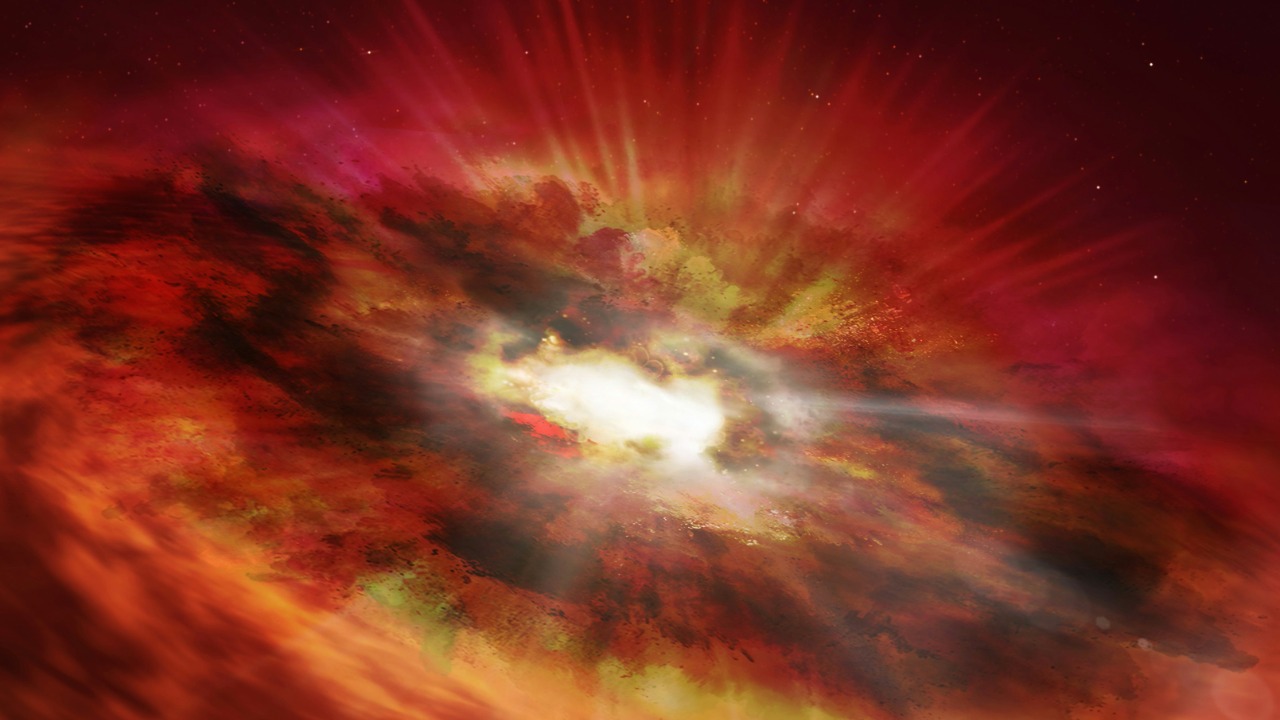

Astrophysicists are mapping a vast, hidden structure in the gas around the Sun that behaves like a tunnel carved through interstellar space, potentially linking our solar system to distant stars. Rather than a science fiction shortcut, this feature appears to be a real corridor in the hot, diffuse medium that surrounds us, shaped by ancient stellar explosions and the motion of gas in the Galactic disc. As researchers refine their models, they are beginning to see how this tunnel could connect the Local Hot Bubble to neighboring regions and even guide the paths of interstellar comets that wander into our skies.
What scientists actually mean by an “interstellar tunnel”
When astronomers talk about an interstellar tunnel, they are not describing a solid tube or a wormhole, but a channel of low density gas that threads through the surrounding medium and offers a relatively clear path between regions of space. In three dimensional models of the local environment, this corridor shows up as a kind of elongated cavity, a place where supernova blasts and stellar winds have swept material aside and left a connected route between the solar system and more distant star forming areas. The structure is subtle enough that it only emerges when researchers combine radio, X ray, and optical data into a single volumetric map.
Some early coverage of the idea leaned into dramatic language, prompting astronomers to clarify that what has been “discovered” is a pattern in the gas, not a new law of physics or a portal that spacecraft can jump through. In one explanatory clip, a researcher walks through a 3D model of the local region and stresses that the feature is part of the known Local Hot Bubble rather than a standalone object, a point that helps ground the excitement in established Galactic structure instead of hype from an interstellar tunnel video.
The Local Hot Bubble and its newly mapped corridor
The solar system sits inside a cavity of tenuous, million degree gas known as the LHB, short for Local Hot Bubble, which was likely carved out by multiple supernovae over tens of millions of years. Recent modeling work has sharpened the view of this region and revealed that the LHB is not an isolated pocket, but part of a network of overlapping cavities and channels that extend across hundreds of light years. Within that network, one feature in particular stands out as a tunnel like connection between our local environment and a neighboring superbubble in the Galactic disc.
By tracing how X ray emission and interstellar dust are distributed, a team of scientists has highlighted key structures inside the LHB, including a prominent corridor that lines up with the well known Canis Majoris tunnel in the Galactic plane. Their reconstruction shows how this channel links the Local Hot Bubble with a nearby superbubble, effectively turning what once looked like a closed cavity into a throughway that could allow gas, magnetic fields, and possibly even cosmic rays to flow between regions, a result that emerges clearly in their map of the LHB and Canis Majoris.
A mysterious link toward Centauri
One of the most intriguing aspects of the new mapping is a structure that appears to connect the Solar System with the constellation Centauri, forming what researchers describe as a mysterious interstellar tunnel. In visualizations, this feature looks like an elongated bridge of low density gas that stretches from the Local Hot Bubble into a larger cavity aligned with Centauri on the sky. The geometry suggests that the Sun sits near the edge of a broader network of bubbles, with this tunnel acting as a kind of on ramp toward more distant star fields.
Descriptions of the work emphasize that astronomers have identified an “interstellar tunnel” that links our local cavity with another, even larger bubble, and that this connection appears to point roughly in the direction of Centauri. An illustration of the structure shows the Solar System embedded in a smaller pocket that opens into the larger region through a narrow passage, a configuration that helps explain why certain lines of sight toward Centauri show unusually low absorption by intervening gas, consistent with a mysterious tunnel to Centauri.
A vast network of cosmic pathways
As models of the local interstellar medium improve, the emerging picture is not of a single tunnel but of a vast network of interconnected cavities and filaments that link our Solar System to far off constellations. In this view, the newly highlighted corridor is one branch of a larger system of invisible pathways, sculpted by past supernovae and stellar winds, that thread through the Galactic disc. The implication is that the Sun is traveling through a dynamic environment where the density and temperature of the surrounding gas can change significantly over tens or hundreds of light years.
Analyses of this environment describe a sweeping structure that effectively confirms a vast interstellar tunnel linking our Solar System to far off constellations, buried within the broader pattern of hot gas and magnetic fields. Researchers argue that this network of invisible cosmic pathways could influence how charged particles propagate and how future probes might navigate the interstellar medium, since some directions offer clearer routes than others, a conclusion drawn from work that explicitly frames the feature as a vast interstellar tunnel.
Hidden corridors between star systems
Beyond the immediate neighborhood of the Sun, astronomers are beginning to identify similar structures that seem to connect entire star systems through the hot interstellar medium. These features are not physical bridges, but regions where the gas is hotter and thinner, forming corridors that may allow material and radiation to travel more freely between clusters of stars. The newly observed tunnel near our Solar System appears to be one example of this broader phenomenon, hinting that such channels may be common in the Galaxy.
Reports on this work describe a newly observed feature, characterized as a possible interstellar tunnel, that may represent a rare corridor in the interstellar medium linking star systems through the hot interstellar medium. Scientists suggest that this structure could be part of a larger pattern of elongated cavities that align with Galactic magnetic fields, potentially guiding the flow of charged particles and influencing how we interpret observations of diffuse X ray emission, a perspective that frames the discovery as an interstellar tunnel linking star systems.
From hot bubbles to distant stars
Several teams now argue that these tunnels effectively connect our Solar System to distant stars by providing relatively unobstructed routes through the otherwise clumpy interstellar medium. In this interpretation, the Local Hot Bubble and its neighboring superbubbles form a kind of cosmic highway system, where the low density corridors act as lanes that stretch across large swaths of the Galactic disc. The Sun’s position near the junction of multiple bubbles may give us particularly good sightlines along these lanes, which is why astronomers can trace them using starlight and X rays.
Analyses of these structures describe extraordinary interstellar tunnels that link our local region to more distant stellar neighborhoods, framing them as part of a broader pattern of cosmic tunnels that connect our Solar System to distant stars. Scientists involved in this work emphasize that the tunnels are carved out of gas and debris, not exotic spacetime, and that they help explain how material and radiation move through space, a point underscored in discussions of cosmic tunnels connecting our Solar System.
How astronomers uncovered the hidden tunnel
The identification of a hidden tunnel linking our Solar System to distant stars depended on combining multiple data sets into a single, coherent model of the local interstellar medium. Researchers used measurements of starlight absorption, X ray backgrounds, and radio emission to reconstruct the three dimensional distribution of gas and dust around the Sun. When they visualized this distribution, they saw that the Local Hot Bubble was elongated in certain directions and that one of those elongations formed a continuous corridor toward more distant regions.
Reports on the work describe how astronomers discovered a hidden interstellar tunnel linking our Solar System to distant stars by analyzing the very space we inhabit, treating the local environment as a structure to be mapped rather than an empty backdrop. Scientists involved in the project argue that this approach reveals a previously unseen architecture in the interstellar medium, one that could influence everything from the paths of cosmic rays to the planning of future interstellar probes, a case made in detail in accounts of astronomers discovering a hidden tunnel.
Interstellar visitors as test particles
While these tunnels are mapped statistically, individual interstellar objects offer a way to test how material actually moves through the local medium. The newly discovered object 3I has been described as a candidate for the oldest comet ever seen, an ancient body that entered our Solar System after traveling for eons through interstellar space. Its trajectory and composition carry clues about the environment it passed through, including whether it followed one of the low density corridors that connect different regions of the Galaxy.
Researchers studying 3I note that its discovery suggests that prospects for the Rubin Observatory may now be more optimistic, with estimates that the facility could find about 50 objects of this type once it begins full operations between late 2025 and early 2026. Each of those interstellar comets would serve as a probe of the medium along its path, helping astronomers refine their models of the tunnels and bubbles that structure the Galaxy, a role highlighted in discussions of how the discovery of 3I and Rubin’s expected 50 objects could transform this field.
Scanning 3I/ATLAS for artificial signals
The arrival of 3I/ATLAS has also prompted a different kind of test of the interstellar environment, as scientists have scanned it for artificial radio signals that might hint at technological activity. Using facilities such as The Gemini South telescope in Chile, observers have captured detailed data on the object’s brightness and spectrum while simultaneously searching for narrow band emissions that would stand out from natural background noise. The effort reflects a growing interest in using interstellar visitors as potential carriers of information, whether natural or engineered.
Accounts of this campaign describe how researchers scanned 3I/ATLAS for alien signals and reported what they found, noting that the work was framed as a focused Reading of the object’s properties rather than a broad sky survey. The project has been summarized with the byline “By Ellyn Lapointe Published January,” and it underscores how targeted observations can probe both the physical nature of the comet and the possibility of artificial transmissions, a dual purpose that emerges clearly in reports on how scientists scanned 3I/ATLAS for artificial radio signals.
Why an interstellar comet has scientists excited
Beyond the technical details, the appearance of an interstellar comet inside a mapped tunnel of hot gas has captured the imagination of researchers who see it as a tangible link between the abstract structures in their models and the physical objects that travel through them. The Brief coverage of this event frames it as a Topline story, emphasizing that an ancient comet that entered our Solar System over the summer offers a rare opportunity to learn more about the conditions in deep space. By analyzing its composition and orbit, scientists hope to infer where it came from and whether its path aligns with any of the known low density corridors.
Reports stress that this interstellar comet has scientists excited precisely because it is not bound to the Sun and therefore carries a record of environments far beyond the Local Hot Bubble. The Brief notes that the Topline takeaway is the chance to study an object that has spent most of its existence in interstellar space, a perspective that dovetails with efforts to understand how tunnels and bubbles shape the Galaxy, as highlighted in summaries that present the event as The Brief Topline on an interstellar comet.
More from MorningOverview