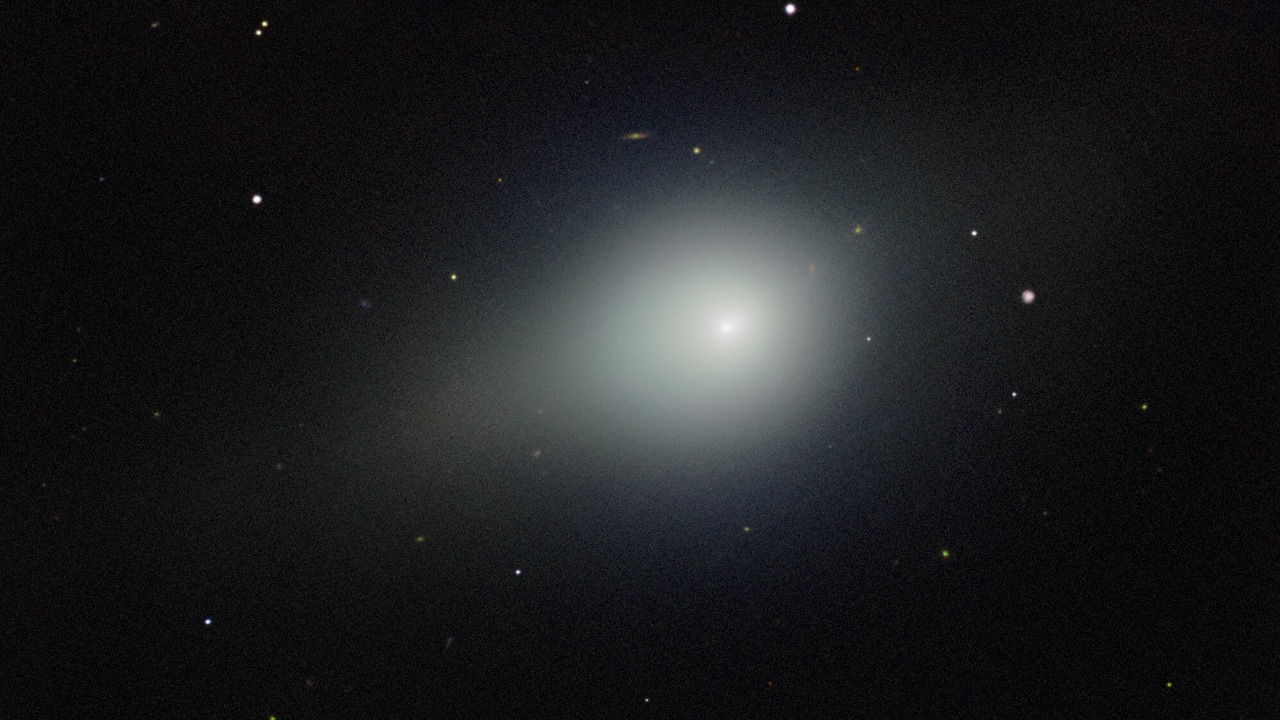

The long, quiet search for radio whispers from Comet 3I/ATLAS has finally paid off, and the result is as dramatic as the hype that preceded it. A deep observing campaign has captured a clear radio signal from this interstellar visitor, ending years of speculation about its nature and turning a once‑fringe debate into a sharp test of how we interpret strange objects from beyond our Sol system.
Instead of confirming a technological artifact, the new data reveal a natural comet behaving in ways that are exotic but still firmly within the laws of physics. The jaw‑dropping part is not that 3I/ATLAS is alien hardware, but that a single icy body can simultaneously fuel internet conspiracy theories, trigger serious SETI scrutiny, and still teach us more about how planetary systems form across the galaxy.
From obscure detection to interstellar celebrity
Comet 3I/ATLAS began as a faint blip in survey data, cataloged as an object discovered by the Asteroid Terrestrial, Last Alert System and quickly flagged as something unusual. Its highly elongated path and extreme speed marked it as an interstellar object, and it was soon listed as 3I/ATLAS, also known as C/202…, the third confirmed visitor from outside our Sol system after 1I/ʻOumuamua and 2I/Borisov, according to orbital data compiled for 3I/ATLAS. That dry designation masked a far more dramatic reality: for planetary scientists, each such object is a once‑in‑a‑generation chance to sample material forged around another star.
As astronomers refined the orbit, they realized that 3I/ATLAS would never come especially close to Earth, but it would still be bright enough for intensive study. The closest this interstellar object will come to Earth is 1.80 astronomical units, a distance of 269 m kilometers or 167 m miles, a geometry that keeps the planet safe while still allowing large telescopes to track its coma and tail, according to trajectory estimates summarized in a guide to what is comet 3I/ATLAS. That combination of safety and accessibility set the stage for a global observing campaign, including the deep radio hunt that has now delivered such a striking payoff.
Why 3I/ATLAS instantly became a SETI target
From the moment its interstellar origin was confirmed, 3I/ATLAS was destined to attract more than routine comet science. The memory of 1I/ʻOumuamua, whose odd shape and non‑gravitational acceleration sparked arguments about possible technology, loomed over every new data point. Some researchers, including Loeb, had already been vocal advocates of the idea that certain interstellar objects might be artificial, and Loeb in particular has been among the most vocal advocates of the hypothesis that 3I/Atlas has a technological origin, a view discussed in analyses of Loeb and Atlas. That framing guaranteed that any unusual behavior from this comet would be scrutinized through the lens of possible engineering.
SETI researchers moved quickly to fold 3I/ATLAS into their observing schedules. The Breakthrough Listen program, which has spent years scanning nearby stars for narrowband signals, pivoted some of its resources to this fast‑moving target. In a technical update on Breakthrough Listen observations, scientists emphasized that the interstellar object 3I/ATLAS was discovered on July 1, 2025, and that there is currently no evidence to suggest that it is transmitting artificial signals in any of their searches. Even so, the mere fact that such a program was pointed at a comet underscored how thoroughly 3I/ATLAS had become a test case for the boundary between natural astrophysics and potential technology.
The deep radio hunt and the MeerKAT breakthrough
The real turning point came when radio astronomers committed to a deep, sustained search rather than quick, opportunistic scans. The MeerKAT array in South Africa, a network of 64 interlinked dishes, was uniquely positioned to stare at 3I/ATLAS for long stretches and tease out faint emissions from the noise. The discovery, made by the MeerKAT array, 64 interlinked radio dishes in South Africa, initially shocked observers and was later tied to specific radicals (OH molecules) in the comet’s coma, according to a detailed account of how the discovery was made. That combination of sensitivity and spectral resolution allowed researchers to distinguish between engineered beacons and the messy chemistry of a sunlit coma.
The most recent confirmation of a genuine radio signal came from an observatory in South Africa that detected the first radio emission clearly associated with 3I/Atlas, a result that scientists say ends the debate about its basic nature by matching the profile of a natural comet rather than a transmitter, as described in a technical summary of The First Radio Signal From Comet. The signal itself is not a narrow, repeating beacon but a broad, line‑rich spectrum consistent with hydroxyl and other molecules fluorescing under solar radiation, exactly what one would expect from a large, active comet that formed around another star.
What the signal actually looks like
When astronomers talk about a radio signal from a comet, they are not describing a sci‑fi style ping but a complex pattern of emission lines and continuum noise. In the case of 3I/ATLAS, the MeerKAT data show features that line up with known molecular transitions, particularly from OH radicals produced when sunlight breaks apart water in the coma. The most recent confirmation of this pattern, described as a radio signal that finally pins down the comet’s nature, came from an observatory in South Africa that tied the emission to standard cometary chemistry rather than any engineered modulation, a conclusion highlighted in a follow‑up on South Africa and Atla. In other words, the jaw‑dropping outcome is that the signal is spectacularly ordinary by astrophysical standards, even if it is the first of its kind from an interstellar comet.
Independent analyses have reinforced that picture. Astronomers who examined the spectrum noted that the radio waves were detected as the comet’s activity ramped up near its closest point to the Sun, a timing that fits neatly with models of volatile ices sublimating and feeding a dense coma. Reports on why Atlas Is Important emphasize that since it formed outside of our solar system, its coma is emitting an unfamiliar mix of molecules, but the overall behavior still matches a natural object, and they stress that we are not in any danger from its passage. The signal, in short, is a chemical fingerprint, not a calling card.
Alien hopes, ruled out with data
For those who had pinned their hopes on 3I/ATLAS as a messenger from an alien civilization, the radio detection is a sobering reality check. Early speculation on social media and in some commentary pieces leaned heavily on the idea that a deliberately targeted signal might be hiding in the noise, especially given Loeb’s prior arguments about technological origins for interstellar objects. However, when astronomers at the MeerKAT telescope reported on the radio waves from 3I/ATLAS, it sparked curiosity that quickly turned into a careful effort to test whether any part of the spectrum showed the hallmarks of an engineered beacon, a process summarized in a review of how experts rule out alien origins. The verdict from those analyses is clear: the radio signals were detected, but they do not support the idea that the comet is an alien spacecraft.
That conclusion dovetails with the broader SETI campaign. The Breakthrough Listen team, which had already reported no evidence of artificial transmissions in their own scans, now has independent confirmation from a completely different instrument and technique. Their earlier statement that there is currently no evidence to suggest that 3I/ATLAS is transmitting in any of their searches, documented in the technical note on There is currently no evidence, looks even stronger in light of the MeerKAT spectrum. The deep radio hunt has not only failed to find aliens, it has provided a textbook example of how robust, multi‑wavelength data can deflate sensational claims without dampening scientific excitement.
Inside the comet’s chemistry and interstellar origins
Stripped of the alien narrative, 3I/ATLAS is still an extraordinary object, and the radio signal is a powerful probe of its chemistry. Astronomers have taken particular note of the comet’s composition, reporting that its coma is emitting an unusual mix of gases that reflect the conditions in the distant system where it formed. Analyses of why Astronomers care so much about this object stress that since it formed outside of our solar system, its ices preserve a chemical record of another protoplanetary disk, giving researchers a rare chance to compare that environment with the one that produced Earth. The radio lines from OH and related molecules are a key part of that comparison, because they trace how water and other volatiles are distributed in the coma.
Space agencies have also thrown their weight behind this compositional work. Comet 3I/ATLAS is an interstellar object, meaning that it comes from outside our Sol system, and that status has made it a target for multiple spacecraft and ground‑based campaigns, as explained in a technical FAQ on Comet 3I/ATLAS. Between November 2 and 25, ESA’s Jupiter Icy Moons Explorer, known as JUICE, has been observing the comet with various instruments, a window of time highlighted in a mission update that notes how Between November those dates, JUICE used its sensors to cross‑calibrate radio, optical, and ultraviolet measurements. The combined dataset will help scientists understand how interstellar comets differ from their homegrown cousins in both composition and activity.
Public fascination, media hype, and the “Threeey Atlas” moment
While scientists parsed spectra and orbital elements, the public conversation around 3I/ATLAS took on a life of its own. Social media feeds filled with clips speculating about alien messages, often stripped of the caveats that professional astronomers insisted on. One widely shared video described a strange voice from deep space and a mysterious object named Threeey Atlas that had just sent a signal aimed directly at Earth, framing the event as a potential first contact rather than a routine detection of cometary radio emission, as dramatized in a segment titled Radio Signal From 3I/ATLAS Stuns Astronomers | WORLD DNA. That framing, while compelling, glossed over the careful spectral analysis that quickly pointed to natural origins.
Other broadcasters leaned into the drama of the observation itself. Several news segments described how the radio signal arrived in the dead of night on October 24, with anchors emphasizing that the internet was abuzz and that astronomers were scrambling to make sense of the data, a narrative repeated in coverage labeled Radio Signal From 3I/ATLAS Stuns Astronomers | GRAVITAS and in a similar rundown under Top Stories. At the same time, more measured explainers appeared, including a detailed update from Anton, who opened a video by greeting viewers with “hello wonderful person this is Anton” before walking through the latest radio emissions from 3I Atlas and what they mean for our understanding of interstellar comets, in a piece titled Radio Emissions from 3I/ATLAS. Together, these narratives show how a single scientific result can be refracted into wildly different stories depending on the platform.
NASA images, Musk’s vow, and the politics of disclosure
As the radio story unfolded, new close‑up images from NASA added visual fuel to the fire. High‑resolution views of the nucleus and inner coma showed a massive, rugged object from outside the solar system, prompting fresh speculation that its shape or surface features might hint at artificial construction. For months, there has been speculation that the object could be of alien origin, a theory that took off on social media and was amplified by commentators who noted that some researchers had written extensively about 3I/ATLAS on his blog, according to a report on how NASA unveils new close-up images. The images themselves, however, showed a body that looked very much like a large comet, with jets, pits, and dust flows that match what missions like Rosetta saw at 67P.
Into this mix stepped high‑profile tech figures who promised radical transparency if anything truly anomalous emerged. One widely circulated story quoted Elon Musk vowing to reveal any alien evidence on Joe Rogan’s show and warning that the comet could flatten a continent if it ever struck Earth, a hypothetical that underscored the object’s size and kinetic energy rather than any real impact risk. That same account reiterated that the discovery was made by the MeerKAT array, 64 interlinked radio dishes in South Africa, and that the radio emission was tied to OH radicals in the coma, details laid out in coverage of 3I/ATLAS and Elon Musk. The juxtaposition of sober spectral chemistry with talk‑show‑ready hypotheticals illustrates how interstellar science now unfolds in a media ecosystem where politics, celebrity, and disclosure debates are never far from the surface.
What the jaw‑dropping outcome really means for future hunts
Stepping back from the noise, the deep radio hunt of 3I/ATLAS has delivered a quietly revolutionary result. By catching the first clear radio signal from an interstellar comet and showing that it matches natural expectations, astronomers have both expanded the toolkit for studying such visitors and set a benchmark for how to evaluate extraordinary claims. The MeerKAT findings have not only ruled out simple alien transmitter scenarios, they have also demonstrated that careful, multi‑instrument campaigns can turn even a distant pass, at 1.80 astronomical units from Earth, into a rich laboratory for comparative planetology, a point underscored in technical discussions of The MeerKAT findings. The jaw‑dropping part is not that we found aliens, but that we can now read the chemical and physical stories of other planetary systems from millions of kilometers away.
For future interstellar objects, this campaign offers a template. Survey systems like ATLAS will continue to flag fast movers with hyperbolic orbits, and each new discovery will trigger a cascade of follow‑up from optical, infrared, and radio facilities. Comet ATLAS itself, named for the Asteroid Terrestrial, Last Alert System that first spotted it, has shown how quickly a faint speck can become a global scientific priority, as reflected in the catalog entry for ATLAS. The deep radio hunt that culminated in this latest detection is likely to be repeated, refined, and extended, turning every future interstellar visitor into both a test of our technological imagination and a window into the diversity of worlds that orbit other stars.
More from MorningOverview