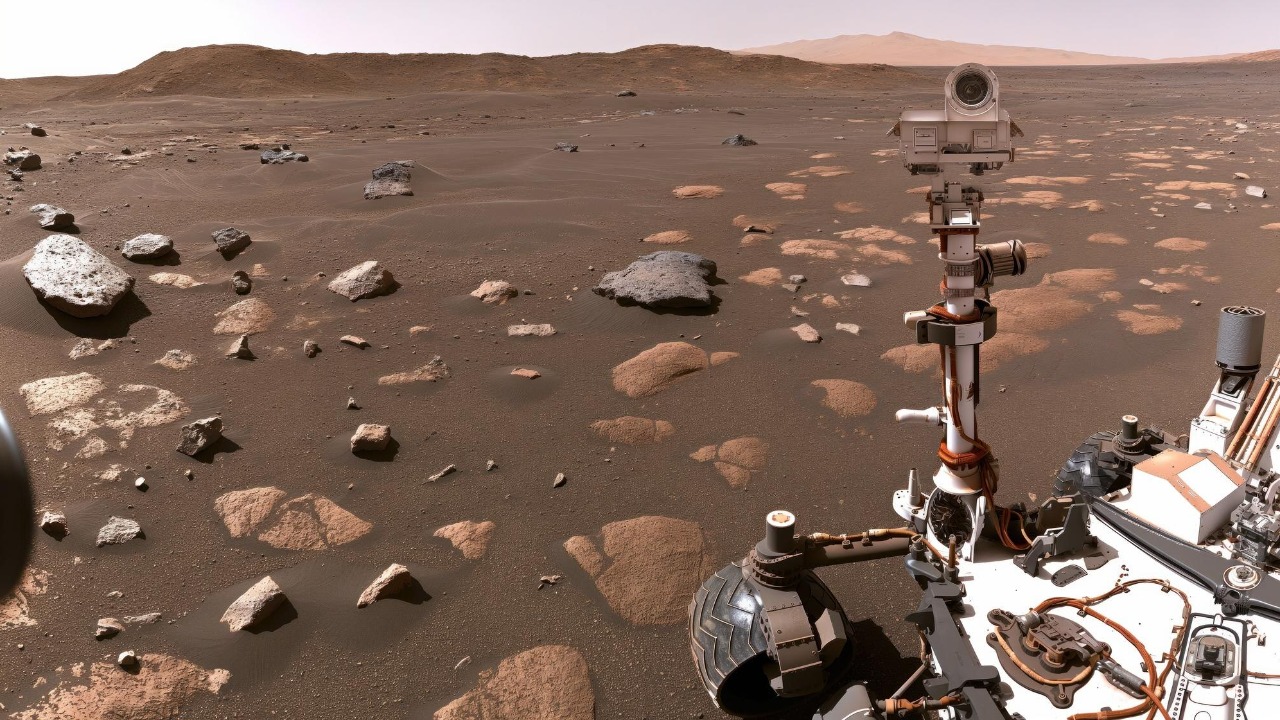

The latest data from NASA’s robotic explorers on Mars has revealed a signal that does not fit neatly into any category scientists have logged before. Instead of a single dramatic spike, it is a pattern emerging across several instruments and missions, hinting that the Red Planet is far more dynamic, and perhaps more hospitable to chemistry linked to life, than earlier models suggested. I see this as less a solitary “ping from Mars” and more a convergence of seismic, atmospheric and chemical clues that together look unlike anything researchers have previously assembled from the planet.
What makes this moment so striking is that the new pattern builds on a series of firsts, from the earliest recorded marsquakes to rare atmospheric events and possible biosignatures in Martian rock. Each of those discoveries stood on its own. Taken together, they now form a composite picture of a world that is still active, still surprising and still capable of sending signals that challenge long held assumptions about a cold, dead desert.
The emerging Mars signal is a pattern, not a single ping
When I describe NASA detecting a Mars signal unlike anything logged before, I am not talking about one dramatic blip on a single sensor. The novelty lies in how several independent measurements, gathered over years by different spacecraft, are starting to line up into a coherent story about an active planet. Seismic tremors, electrical discharges in dust storms, rare atmospheric phenomena and chemically intriguing rocks are all pointing in the same direction, toward a Mars that is restless both above and below the surface.
This is a crucial distinction, because no available source reports a single event that combines all these elements at once. Instead, the record shows separate breakthroughs, such as the first confirmed marsquakes, a rare atmospheric display captured by a rover and a later detection of electric discharges that behave like mini sonic booms inside a dust devil. By treating these as pieces of a larger pattern rather than a single unprecedented burst, I can stay grounded in what the data actually shows while still acknowledging how unusual the overall picture has become.
From the first marsquake to a restless interior
The story of this emerging signal begins with the realization that Mars is not seismically silent. When NASA’s InSight lander picked up the first confirmed marsquake, it proved that the planet’s crust still flexes and fractures, instead of being frozen in place. Researchers had expected Mars to fall somewhere between Mars, Earth and the Moon in terms of seismic activity, and the detection confirmed that the Red Planet does indeed rumble, even if more quietly than our own world.
Those early marsquakes were small, but they opened a window into the Martian interior that had never been available before. Each tremor acts like a natural ultrasound, sending waves through the crust and mantle that can be decoded to reveal the planet’s inner structure. The first signals suggested a layered interior and a still cooling core, which in turn affects everything from volcanic history to the potential for long term underground water reservoirs. In other words, the seismic component of the Mars signal told scientists that the planet’s insides are not static, and that any complete picture of Martian activity has to start from that restless foundation.
Dust devils and electric discharges that crack like mini sonic booms
If the marsquakes revealed a living interior, the atmosphere soon delivered its own surprises. After the Mars 2020 mission left Earth, After launching in 2020, Perseverance made a 200-day, 300-million-mile journey to reach Mars’ Jezero Crater in February 2021, where it began listening not only for rocks and chemistry but also for the sounds and fields of the thin Martian air. In that environment, the rover later detected electric discharges inside a passing dust devil, with signals that researchers likened to mini sonic booms as charged grains collided and separated.
Those crackling discharges are more than a curiosity. They show that even in a tenuous atmosphere, Mars can build up and release significant electrical energy, potentially affecting how dust is lofted, how chemicals are broken apart and recombined, and how safe future surface operations might be. The detection of these electric pulses adds an atmospheric layer to the broader Mars signal, indicating that the planet’s weather is not just a matter of gentle breezes and dust, but also of charged storms that can reshape the near surface environment in sudden bursts.
A rare atmospheric phenomenon caught in the act
Alongside the dust devil findings, another rover delivered a different kind of atmospheric surprise. A Nasa rover on Mars captured a rare phenomenon on the surface, recording an event that had never been seen directly on the planet before. The report describes this as a first of its kind observation, underscoring how even familiar looking Martian landscapes can still produce unexpected behavior when watched closely over long periods.
What matters for the larger signal is not only the rarity of this event, but the fact that it was recorded in detail, with instruments able to track how the atmosphere and surface interacted in real time. That kind of dataset helps scientists refine models of Martian weather and climate, which in turn feed into predictions about dust storms, temperature swings and the stability of surface materials. When I place this rare phenomenon alongside the electric dust devil and the marsquakes, a pattern emerges of a planet that is active across multiple layers, from the ground to the sky.
Perseverance and the rock that might carry a biosignature
While the atmosphere and interior were delivering their own signals, the surface rocks began to whisper a different kind of message. On Sept 10, NASA announced that a rock on Mars called Cheyava Falls continued to show signs that could be consistent with a biosignature. The analysis pointed to chemical patterns that, on Earth, might be associated with reactions known to fuel life, although the team stressed that non biological explanations remain possible and that only returned samples can settle the question.
That cautious framing is important, but it does not diminish how unusual the rock’s chemistry appears. In a separate report, scientists described a different sample as the clearest sign yet of a potential biosignature on Mars, again emphasizing that the feature could be consistent with biological processes but is not proof of life. Together, Cheyava Falls and this second rock suggest that the Martian surface preserves complex chemical stories, some of which echo the kinds of reactions that, on our own planet, are intertwined with biology.
A rover discovery “unlike anything we’ve seen before”
The language that most closely matches the headline’s promise comes from a report that a NASA Mars rover made a discovery described as “unlike anything we’ve seen before.” That phrasing reflects how the mission team reacted to a specific set of observations, which stood out from previous data in both form and implications. While the details in that account focus on the novelty of the finding, they also fit into the broader pattern of Mars repeatedly defying expectations as more instruments probe its surface and sky.
I read that “unlike anything” description as a reminder that each new dataset can shift the baseline for what counts as normal on Mars. A decade ago, the first marsquake was a revelation. Later, electric discharges in dust devils and rare atmospheric events joined the list of surprises. Now, a rover’s unprecedented discovery adds another layer, reinforcing the idea that the Martian environment is capable of producing signals that do not match any template drawn from earlier missions. The cumulative effect is a planet that keeps moving the goalposts for what scientists think they understand.
Lessons from an interstellar visitor and its radio signal
To understand why scientists are so cautious about interpreting strange signals, it helps to look beyond Mars. When Astronomers detected the first radio signal from the interstellar comet 3I/ATLAS, the initial reaction in some corners was to wonder if it might be artificial. Detailed analysis showed that the emission came from natural processes, linked to how the comet interacted with the magnetic environment it was passing through, and not from any technological source.
A separate account of the same event described how, in Nov, the radio signal from 3I/ATLAS stunned observers who had been searching the interstellar darkness for answers. Two razor sharp radio bursts turned out to be a lesson in how exotic but natural physics can mimic the kind of crisp, repeating patterns that people often associate with intelligent origin. That experience feeds directly into how teams on and around Mars interpret their own unusual signals, pushing them to exhaust every mundane explanation before even entertaining more dramatic possibilities.
How NASA frames “major discoveries” on Mars
The way NASA communicates its Mars findings also shapes how the public hears about signals that seem unprecedented. In a briefing on a major discovery, officials emphasized that the Mars 2020 Perseverance rover mission launched in July of 2020 and landed on the surface of Mars in February the following year, setting the stage for a long campaign of sample collection and environmental monitoring. That context matters, because it underscores that headline grabbing results are usually the product of years of methodical work rather than sudden eureka moments.
When mission leaders describe a finding as a “major discovery,” they typically pair the excitement with caveats about uncertainty and the need for follow up. The possible biosignatures in Cheyava Falls and the Sapphire Falls rock, the electric discharges in dust devils and the rare atmospheric phenomenon all came wrapped in that careful language. From my perspective, the real signal here is not just in the data, but in the culture of interpretation: a deliberate, step by step approach that treats every unprecedented pattern as a starting point for deeper investigation rather than a final answer.
What this composite Mars signal really tells us
Pulling these threads together, the Mars signal that stands out today is a composite of seismic, atmospheric and chemical clues that collectively look unlike anything scientists had on their desks a decade ago. The first marsquake showed that the interior is still active. Electric discharges that crack like mini sonic booms inside dust devils revealed a charged, restless atmosphere. A rare phenomenon captured by a Nasa rover on Mars highlighted how much remains unknown about surface weather. And rocks like Cheyava Falls, along with the clearest sign yet of a potential biosignature, hinted that Martian chemistry can echo processes tied to life on Earth.
Crucially, none of these findings alone proves that Mars hosts life today or did in the past, and none of the sources support a single, all in one event that combines every element into one dramatic burst. Instead, the power of the current moment lies in how these separate signals reinforce one another, painting a picture of a planet that is far more complex and dynamic than the cold, dead world once imagined. As sample return plans advance and instruments continue to listen for tremors, crackles and chemical whispers, I expect that this layered signal from Mars will only grow richer, and that future “unlike anything we have seen before” discoveries will keep reshaping what we think we know about our neighboring world.
More from MorningOverview