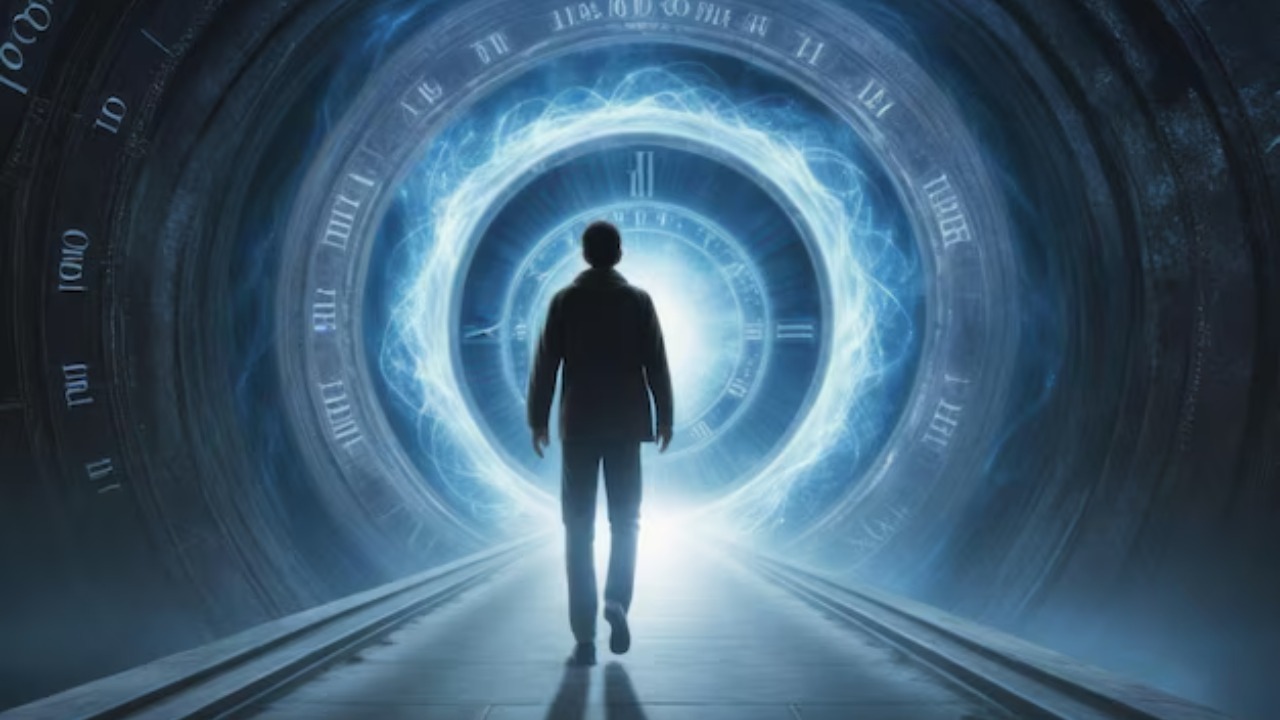

Time travel has long lived in the realm of fantasy, but a growing body of research is quietly shifting it into a serious scientific conversation. Instead of DeLorean-style leaps into the past, physicists are probing how time can be bent, looped, or processed in ways that already blur the line between science fiction and laboratory reality. At the center of that shift is one researcher who insists he has solved the core equations for a time machine, and a wider community whose work suggests the idea is no longer as distant as it once seemed.
From quantum experiments that appear to break time’s usual order to strange materials that behave as if they are constantly rearranging their own history, the latest findings hint that time is more flexible than everyday experience suggests. I see a pattern emerging: while no one is stepping into a chrome-plated time capsule, the tools and theories that could underpin future time travel are being built piece by piece right now.
The new science of bending time, not breaking it
Modern physics has already accepted that time is not absolute, and recent work is pushing that idea further by focusing on how information moves through time rather than how people might. Researchers are exploring how quantum systems can be manipulated so that cause and effect no longer follow a simple, one-way arrow, a shift that some describe as breaking time’s usual boundaries at the microscopic scale. In one set of results, scientists showed that quantum processes can be arranged so that events effectively influence each other in both directions, a finding that, while it does not let anyone relive their past, still marks what one report called a dramatic step in how we understand temporal order, with Aug highlighting how such effects could scale inside complex operations.
These experiments are often framed as “quantum time” research, where the focus is on how particles and information behave when time is treated as another resource that can be entangled, reversed, or superposed. In that context, scientists have described literally breaking time’s boundaries in the lab, not by sending people into the past, but by designing protocols where the usual sequence of before and after no longer applies. One overview of this work, titled Time Travel May Be Closer Than We Think, Scientists Say, points out that these ideas are already reshaping how we process time-dependent information in quantum devices, hinting that the first practical fruits of time research may arrive in computing and communications long before any physical time machine.
Glass, cameras and the strange hint that time travel may already be here
Alongside quantum theory, some of the most intriguing clues about time’s flexibility are emerging from surprisingly ordinary materials. One group of scientists turned to glass, a substance that looks static on a windowsill but, at the molecular level, behaves in a far stranger way. Using an ultra-sensitive video camera, they tracked how glass molecules move and found evidence that the material does not simply sit in a fixed arrangement, but instead constantly explores new configurations, a behavior that led them to suggest that a kind of time travel might already be present in the way this disordered solid evolves, as described in detail when Apr reported on their use of that ultra-sensitive video camera.
The key insight is that glass does not follow the neat, predictable patterns of more traditional molecular structures. Instead of settling into a single stable arrangement, its molecules constantly fall into new places, reshaping their relationship with neighboring atoms in a way that challenges simple, linear views of time. That behavior, captured in the same work where Instead of was used to emphasize how glass diverges from conventional solids, has been interpreted as a physical system that is always rewriting its own microscopic history. I see this less as proof that time travel is already happening and more as a reminder that our everyday materials can harbor dynamics that feel almost science fictional once we look closely enough.
Theoretical breakthroughs: loops, paradoxes and quantum shortcuts
On the theoretical side, physicists are building increasingly sophisticated models of time loops, closed timelike curves and other exotic structures that would allow information to circle back on itself. These models are not just intellectual games; they are being used to test whether the laws of physics can accommodate scenarios where an event is both cause and effect, and to see how paradoxes might be resolved if such loops exist. Some researchers have gone further, using these hypothetical time loops to design new approaches to quantum computing and cryptography, arguing that if information could traverse such paths, it might solve problems that are otherwise intractable, a line of thinking that Jan described as a way to turn some of the most perplexing paradoxes imaginable into practical tools.
General relativity also leaves room for more classical visions of time travel, particularly through structures known as wormholes. In these models, spacetime itself is curved so that two distant points are connected by a tunnel, which in principle could link not only different locations but also different moments. Other researchers have created detailed models in which such a wormhole acts as a shortcut through the universe, a configuration that, if stabilized and manipulated, could allow a traveler to emerge at a different time as well as a different place, a possibility that has been explored in depth by work that Other theorists have used to test the limits of Einstein’s equations. I read these models as signposts: they do not yet tell us how to build a machine, but they show that the underlying mathematics does not automatically forbid the idea.
“I solved Einstein”: the researcher who says time travel is ready
Amid these abstract models, one figure has stepped forward with a far more concrete claim. Dr. Ronald Mallett, a retired professor of physics, argues that he has already solved the core equations needed for a working time machine. In his account, he approached the problem through Einstein’s general theory of relativity and focused on how light, gravity and rotation might be combined to twist spacetime into a loop. He has described how he set out to solve Einstein’s gravitational field equations for a specific device, a configuration that would not just illustrate time travel on paper but, in his view, provide a blueprint for a real machine, a claim he summarized when he said, “I solved Einstein’s gravitational field equations for a device that’s called a ring laser,” in an interview where he explained that the purpose of that device is to create the conditions for time travel, a statement documented in detail in a report linked through Einstein.
Dr. Mallett’s conviction is not purely academic. His work is driven by a deeply personal story involving the loss of his father and a lifelong desire to go back and change that past, a motivation that has shaped his career and public persona. Now approaching 80, he remains steadfast in his belief that his equations will eventually translate into a functioning device, describing his research as a legacy that transcends time and portraying the future of time travel as a boundless frontier awaiting exploration. That sense of mission, and the specific figure of 80, underscores how he sees himself not just as a theorist but as a pioneer whose work will outlive him, even if the full-scale machine is built by future generations.
The ring laser blueprint and what it really promises
At the heart of Dr. Mallett’s proposal is that ring laser, a device in which beams of light circulate in a closed loop. In his solution to Einstein’s equations, the intense, circulating light would generate a gravitational field that drags spacetime around with it, creating a kind of vortex. If that vortex is strong enough and configured correctly, he argues, it could form a closed timelike curve, a path through spacetime that loops back on itself so that an object entering the device could, in principle, emerge at an earlier moment along the same timeline. The idea is that by engineering the geometry of the ring and the power of the laser, the machine would not just bend space but also twist time into a usable loop, a concept he has framed as a practical extension of general relativity rather than a speculative fantasy.
In practice, the challenges are enormous. The energy required to produce a significant gravitational effect with light is far beyond what current lasers can deliver, and the engineering needed to stabilize such a spacetime vortex is still uncharted. Critics point out that even if the ring laser could create a time loop, it might only allow travel back to the moment the device was first switched on, not to any earlier point in history. I see Mallett’s blueprint less as a near-term construction plan and more as a proof of principle: it shows that, within Einstein’s framework, a specific, buildable device could in theory generate the conditions for time travel, even if the gap between theory and hardware remains vast.
Emotion, grief and the human drive to rewrite the past
Time travel is not just a physics problem; it is also a story about grief, regret and the desire to undo loss. Dr. Mallett’s own narrative is a stark example, but he is not alone in tying scientific ambition to personal history. One widely discussed profile followed a scientist who lost his father and became fixated on the idea of traveling back to 1955 to save him, a quest that involved serious engagement with physics but was ultimately rooted in mourning rather than pure curiosity. The reporting on that story made clear that such a project would not come cheap and that it is highly unlikely any government would pour its resources into building a time machine for a single person’s private mission, yet it also captured how powerful that emotional pull can be, noting that the scientist believed his father would have been really proud about that effort, a sentiment recorded in a piece that highlighted how Such an endeavour would stretch both budgets and belief.
I find that these stories matter because they shape how the public perceives time travel research. When the motivation is framed as a son trying to see his father again, the abstract mathematics of spacetime curvature suddenly feel urgent and relatable. At the same time, the emotional stakes can blur the line between what the equations allow and what technology can deliver. The tension between personal longing and scientific caution is part of why time travel remains such a charged topic, with some researchers leaning into the human drama to secure attention and funding, and others warning that grief should not be the engine that drives our most speculative projects.
From thought experiment to toolkit: how “cracked” time travel feeds other fields
Even when full-blown time travel remains out of reach, the theoretical work around it is already feeding into other areas of science and technology. Studies that treat time loops and exotic spacetime geometries as serious possibilities have forced physicists to refine their understanding of causality, information flow and the limits of quantum theory. In some cases, the same mathematical structures that describe hypothetical time machines are being repurposed to design new algorithms, error-correction schemes and cryptographic protocols, turning what began as a thought experiment into a practical toolkit. One analysis of these developments framed them as scientists “cracking” time travel in a theoretical sense, and then using that cracked framework to deepen our understanding of particle physics and related fields, a connection that was drawn explicitly when Jan described how these ideas add to the list of tools that can improve our understanding of particle physics.
There is a pattern here that I think is easy to miss. Time travel, in its strict sense, might still be a distant prospect, but the intellectual machinery built to explore it is already paying dividends. Quantum information scientists borrow concepts from closed timelike curves to imagine new ways of processing data, while cosmologists use wormhole models to probe the early universe. Even if no one ever steps into a machine and emerges in another century, the effort to understand whether such a machine is possible is reshaping multiple disciplines, and that alone justifies taking the subject more seriously than its science fiction reputation might suggest.
Why “closer than we think” still does not mean soon
When researchers say time travel may be closer than we think, they are usually talking about conceptual distance, not calendar years. The gap between a universe where time travel is logically impossible and one where it is allowed in principle has narrowed, thanks to work on quantum causality, wormholes and devices like Mallett’s ring laser. Experiments that manipulate the order of events at the quantum level, materials that behave as if they are constantly rearranging their own past, and models that show how spacetime could be folded into shortcuts all point in the same direction: time is more malleable than our daily lives suggest. In that sense, the idea of time travel has moved from pure fantasy to a legitimate, if extreme, extrapolation of known physics.
Yet the practical obstacles remain towering. Building a machine that can safely transport a human being through time would require control over energy densities, quantum states and spacetime geometry that far exceed anything available in current laboratories. Funding agencies are cautious, governments are unlikely to bankroll projects that sound like movie plots, and even the most optimistic researchers admit that any working device is likely to be limited, perhaps only allowing travel back to the moment it was activated or only affecting information rather than people. I see the current moment as a pivot point: the science is mature enough to take the question seriously, and one researcher, Dr. Mallett, is willing to say out loud that he believes the problem is solved in principle, but the journey from equations to engineering is still long, expensive and uncertain.
More from MorningOverview